Nostalgia Publications: History Goldmine

I’m a magazine junkie. I admit it. I don’t know what it is about those glossy pages or attractive photographs that pull me in, but I’ve loved a beautifully crafted monthly publication since I was a kid. Alas, I was born too late, and the digital age has attempted to dislodge this most tactile of printed material.
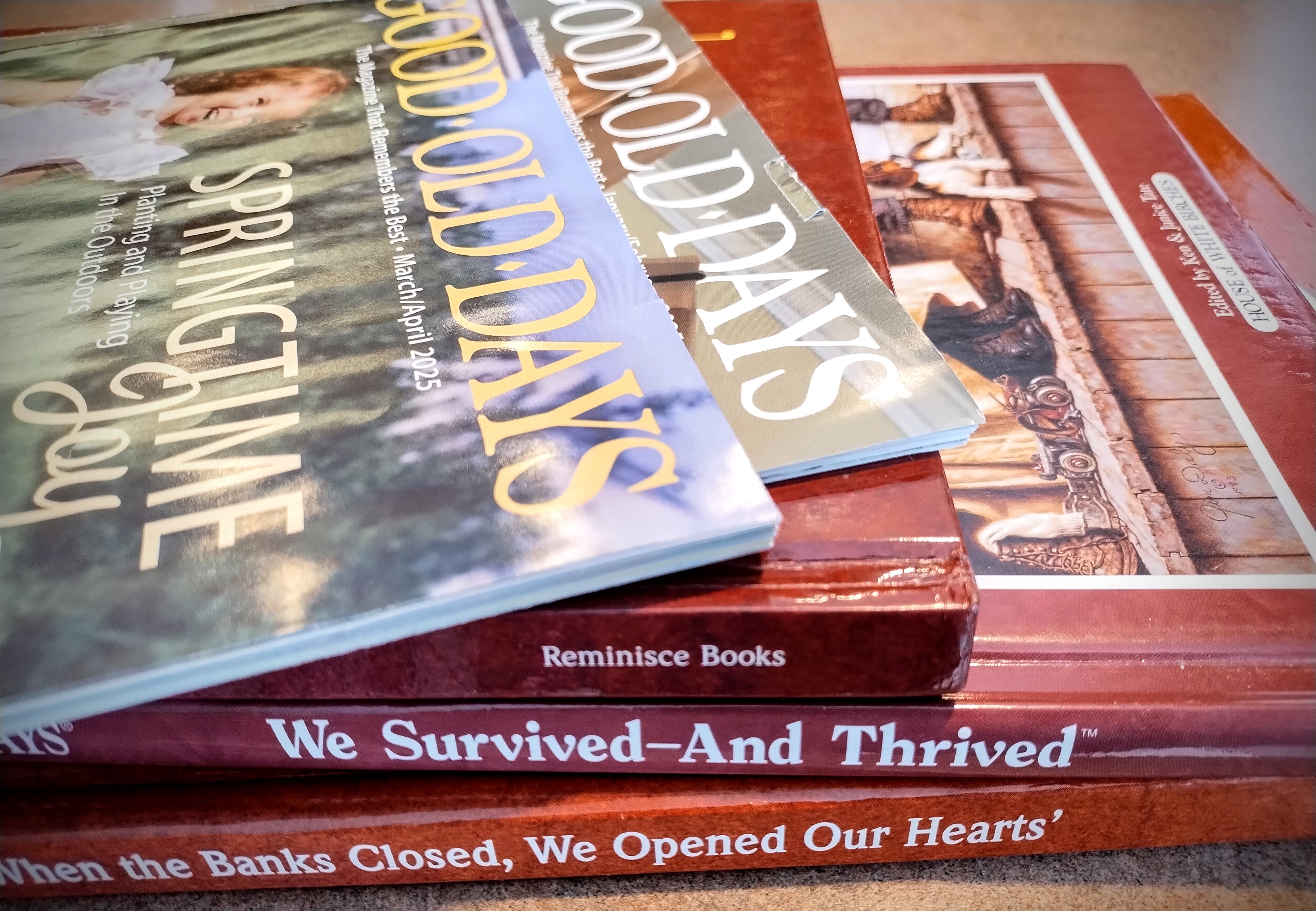
If you’ve never subscribed to a magazine, then you don’t know the eager anticipation of each issue when you check your mailbox. Like expecting the Amazon van, only you didn’t have to select your item, you get to be surprised with interesting articles, beautiful images, and pertinent information about your favorite subject, etc. It’s great!

However, I issue a caveat. I’m not an indiscriminate magazine lover. I only like certain types of magazines. Historical subject matter predominates, followed by beautiful imagery, and then practical information. Victoria and Teatime are favorites, Backwoods Home and Self-Reliance are sometimes subscriptions, but Good Old Days magazine is a perennial, as was Reminisce (sadly, no longer in print).

Is nostalgia really history?

I’ve heard a few opinions through the years that nostalgia is just living in the past. And that such reminiscences aren’t really history because they look back at the past through an idealized lens. But isn’t that exactly what we should do with the past? Look back and preserve the good memories and positive lessons in order to carry them forward, all the while understanding the bad in order not to repeat it?

Nostalgia is an important part of civilization for the very fact that it idealizes certain virtues. There is a reason we have a phrase to describe an optimal version of the past called a “golden age.” There are things in those ages we want to preserve because it wrought great good. Great documents that enshrine freedoms, cultures of debate and consensus that prevent tyranny, religious revelation, acts of great self-sacrifice, and so on.

But nostalgic history serves a less lofty purpose as well. The good memories families pass on that ultimately become happy traditions; those are often rooted in nostalgia. And just as often, practical bits and pieces of wisdom are passed along through nostalgic telling of family tales. Remember the time uncle Alfred did such-and-such…he learned that you can’t paint a house and ride a goat at the same time, and so on. You know the type of story that keeps everyone in stitches but also preserves a valuable lesson.

Reminisce and Good Old Days books: early and mid-20th century “oral” histories

Back to two of my favorite nostalgia publications. Reminisce magazine was conceived and launched by Roy Reiman in 1993, one of several photo-rich publications that was produced by his company, Reiman Publications, which was later sold to the publishers of Reader’s Digest. After a couple more corporate shuffles, it has, sadly, ceased publication. But during its nearly 30 years of being in print it established a standard for quality publication based on reader contributions.

I loved it! Cue the glossy pages and beautiful photos, but I also loved the stories about times before my day. History that I was a little too oblivious to glean from my grandparents during their lifetimes. It was like having an extra grandma or grandpa in print who could fill in some gaps. Much of it dealt with the Great Depression and the World War Two eras, events which have colored our world all the way into the present day.
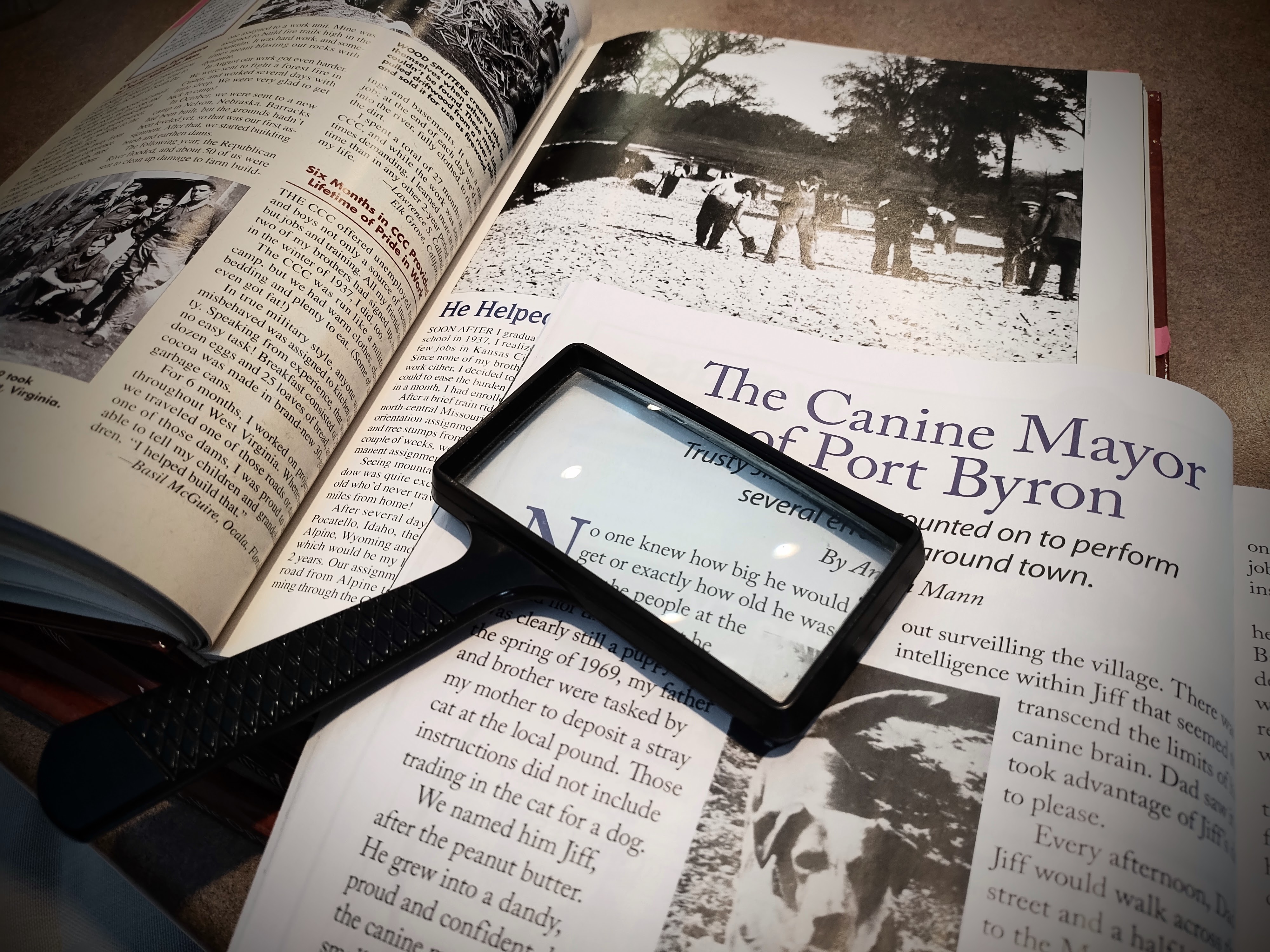
Thankfully, the editors saw fit to compile collections of some of the most pertinent stories and themes. The aforementioned Great Depression and WW2, but also kitchen memories, school days, automobile stories, family time, and women’s contributions in the 20th century, among many others. I highly recommend them as a resource, especially for teaching young ones about daily life in the first half of the 20th century.

Good Old Days magazine is another wonderful resource, happily still in print. It started well before Reminisce, back in 1964, and has continued to provide a space for older folks to process and preserve their memories of the past. That’s a big asset for us. These aren’t celebrity stories or government figures “crafting” their legacy, but rather regular people who learn a lesson here and there that they’d like to pass on to those who come after them.

The publishers of Good Old Days also produced books of submissions compiled into topical themes: cooking, school, farming, thrift, WW2, pets, religious culture, entertainment, small town social life, and so on. I consider these “oral” histories even through they are in print because they are the kid of thing you would hear if you could take the time to sit down and listen to someone over a cup of coffee as they sift through their life experiences. Oftentimes what comes out is profound, touching, sometimes a little raw, but generally a resurfacing of the good times.

Both series are available through Amazon, Ebay, AbeBooks, and the like, usually for around the five-dollar mark.

How to learn from a nostalgic history gateway

I’ve written in the past about history gateways. Avenues that pique our interest and help us to understand and envision the past, thereby learning from it, such as historical fiction, movies, documentaries, museum exhibits, old movies, old time radio, etc.

Compiled histories from nostalgia magazines are another such gateway. They are fun to read just for the sake of hearing someone else’s tales of life and are often amusing, but to really get something out of them, we need to relate it to our lives now. Here are four ways to do that:

  1. Have I ever experienced, in my life now, something like the story I’ve just read? What did I learn from that?
  2. How similar or dissimilar is my life now from the way they lived in the story I just read? For example, did they have running water? If no, how would I have adapted if I’d lived back then?
  3. Did they have other similar or different technologies in the past? If different, how might they be the equivalent of things we have now?
  4. How did the person telling the story learn from whatever it was they experienced. Did it make them stronger, sadder, happier, wiser, or more determined, etc.? How did it help those around them? What would I have learned and how would I have applied it?
  5. What skills did they have then that might be useful for me to learn now?

There are many more possibilities!

Sometimes stories will inspire us to make a living history experiment. Maybe we’ll cook a meal with recipes used during the Great Depression, WW1, or WW2, etc. Or perhaps try one of great grandma’s recipes. Or even build a toy like one described from long ago.

I’m directing a lot of these suggestions at young people and parents with kids (and these history compilations are great resources for home educators), but really, when it comes down to it, we all have a little youthful curiosity within us. Applying it in this way can make the study of history an active and enjoyable intellectual pursuit!

Keep thinking history!

Sources: Good Old Days: We Survived-And Thrived, Editors: Ken and Janice Tate, House of White Birches, 2003.

We Had Everything But Money, Editor: Deb Mulvey, Reminisce Books, 1992.

When the Banks Closed, We Opened Our Hearts, Editor: Mike Beno, Reminisce Books, 1999.

The above are available at Amazon, Ebay, AbeBooks, and other used-book resellers, along with many other titles from both series.

All images are property of Amanda Stiver, unless otherwise noted. Please do not re-use without permission.


Finding A History Treasure: Kitchen-Klatter Magazine

Every once in a while you stumble upon a time capsule. Not the kind buried underground or in the cornerstone of an imposing edifice, but the ephemeral trail to which digital transfer has given us access.

My treasure is a midwestern-American publication from the year 1940 called Kitchen-Klatter Magazine. It was produced and edited by Leanna Field Driftmier, a home economist and radio personality of her day based in western Iowa.

Image: Amanda Stiver

Her sister was a founder of the 4H movement and her brother owned a seed company and dabbled in radio. Additional members of the family provided articles from themes based on their expertise, one daughter, for example was a librarian and offered monthly selections from among recently published books. Other friends supplied additional columns themed according to their professional backgrounds and training.

This was all set into the background of the heyday of the Home Economist movement, which emphasized education for women, particularly in training for developing a healthy, efficient, financially secure home. But it incorporated health sciences, consumer sciences (both of which held the meat, agricultural, and packaged food industries to quality and safety standards), fashion and interior design, sewing, vocational training, cooking and meal preparation, nursing, fitness, etc. The list goes on.

Kitchen-Klatter is fascinating to read. It’s a window into the concerns and insecurities of its time. And what a time it was, in 1940 the world was at war. The U.S. was beginning to ramp up military production, wary, rightly so, that it, too, would become involved in the conflagration that had emerged in Europe and Asia.

In particular, in the latter issues of that year, October and November, Leanna Driftmier’s son, Frederick (Ted), who had been teaching at a mission sponsored school in Assiut, Egypt and regularly sent letters home to his mother, excerpts of which she included each month, began to describe the seriousness of the war situation as it drew closer and closer to Egypt and the Middle East.

Major events, like the Second World War, often become just a dry and dusty marker on the timeline of history. We can find it hard to relate to all the battles and casualties on a human scale, so when I find these very personal accounts of how a young person felt in the midst of unanticipated danger, it helps to draw down history to an relatable level.

Ted Driftmier writes in the October 1940 issue (page 5): “Besides enduring this terrible heat, there is the reality that the war is coming nearer to Egypt daily, and it is quite a nervous strain. Every airplane that flies over makes us jumpy….The Mission does not want to send us all home for probably the school can be opened in the fall and [otherwise] they would have to bring us all back again at a terrific cost. These colleges can’t be left standing [empty]. They must carry on. We will leave only when our lives are endangered but not until then.”

We, too, are facing great uncertainty in our time, with an epidemic, with political instability, so it is, in a strange way, comforting to read and relate to the uncertainty of a previous era. We can face up and move forward, despite constraining unpredictability.

That’s a historical treasure to my way of thinking. Also, there are recipes, and practical housekeeping and gardening tips, and who couldn’t use those?

Take a moment to explore the issues of Kitchen-Klatter from 1940. The magazines are in a publicly accessible digital database at Iowa State University, and available through this LINK.

October and November 1940 are especially poignant.

Keep thinking history!

~ Amanda Stiver

Short on History: Context and the Electoral Process

The recent US election has shown, among many things, that various segments of the population, but particularly younger people are missing a vital facet of education…knowledge of the past and how our written laws and systems of governance emerged from the circumstances of their era and reached up to become supra-generational universalisms (I just made that last one up). For instance, the hotly debated and debased electoral college. Some hate it, but they don’t know why. Some love it, but they don’t know what it is.

This is where context comes in. In the study of history (which we all should be doing, by the way) context is a short mental rehearsal of the key players, national and individual, and the geo-political or cultural spectrum of the day. Religious institutions and mores, popular societal trends, styles of government, etc. We do this when we begin to study a new historical topic. Good historians will write books interwoven with context, unfortunately, so will bad historians who make up non-existent context. One has to do a little individual research.

For instance, one popular slogan goes, “we don’t need that electoral college, we just need a popular vote!” Sounds all neo-socialist, get rid of the elitists, etc, but the reality is that government structures like the electoral college were originally implemented as a check and a balance against any one  side of the US government quadrangle of executive-legislative-judicial-demos (the voters) from misusing its power and presuming to take privileges that don’t belong to it. This was a reaction, in part to the governmental institutions of Enlightenment Era Europe (which only went so far), and the remaining monarchies that ruled nations through both religion and dominion or kingship. The balance of power wasn’t. It was also a reaction to the constitutional monarchy of England and the peculiarly interwoven parliamentary system through which aristocrats and semi-common men could rule. America sought a system with a greater balance of power.

And it is only through a kind of intergovernmental detente that our system works. Thing is, many people would like to up end the balance, from all sides of the political spectrum, in order to funnel power their way. Hence we have checks and balances, however imperfectly they function.

So there you have it, a small sampling of context and how it applies to understanding the past and the world around us now.

Where do you need to apply the tool of context for better understanding?

Keep thinking history!

– Amanda Stiver

Tomorrow’s History: Politics and the Seasons – The Sanity Our Rural Past Brings to Election Nonsense

As I write this a U.S. Presidential election is upon us, tomorrow. I cannot, at this point, following on months of listening to campaigns, lies (let’s be real), and observing endless posturing endure any more analyses of politics, so I shall diverge.

Looking around us now, and by looking around I will be taken to mean, looking around the Internet because that’s where we are these days. We stare at screens, big ones (if we’re well funded), medium ones, and little ones. Ubiquitous rectangles of blue light distorting our ability to sleep and, for that matter, telling us what to think. They’ve only been around on this scale for the last 10 years, a mere blip in the historical timeline, but we seem to be unable to imagine life without them.

And that’s just what I want to do. Imagine life without them. What on earth would we be doing, in say, 1886?

Well, the vast majority of us would be farming.

And no, I don’t mean hobby farming with a flock of rare heritage goats that we pay someone to keep so they can make handmade cheese for us that we can sell with our own cleverly designed label that connotes rural overtones in a setting of glamorous urban prosperity. Sigh.

Image: Amanda Stiver

Image: Amanda Stiver

I mean the real deal, dad, mom and kids working the land, eating what they grow and raise. Planting, tending, harvesting, and preserving. With real dirt and real injuries and real dependency on the land. That’s the kind of rural reality that most Americans faced in 1886.

If you have absolutely no idea what I’m talking about, and cannot even think of a single recent television series you’ve binged on Netflix to draw on for reference (sigh), then tackle a book. One I highly recommend, and have probably done before and will again, is The Seasons of America Past by Eric Sloane. Sloane was one of the foremost meteorological painters of the 20th century and he also put his artistic skills to work preserving images of the rural, agricultural norm that was the American way of life, and of which we are now completely and most tragically bereft.

These sketches, of which the book is full, will put a shape to the past. When we think of tablets, smartphones, and laptops, we can in some, rather inadequate, way attempt to compare to the scythes, plows, apple presses, and wagons of the past. These were the tools of their existence. People were fluent with these items in the same way that we are fluent (or reasonably so) with our technology. They are the implements of our lives.

The other facet of The Seasons of America Past that I relish is the step by step progress through each month of the year that gives us a sample of what agricultural tasks would have been on the schedule for that season.

Let’s take November for instance. Sloane relates that by this time cattle had been or were being driven to market in a parade of moving herds that marked the season for many (or to the railyard and transported by train in 1886). Crop harvests had been taken in and at this time there was abundance and time to preserve and enjoy. Meat was butchered, preserved, and products like the yearly supply of soap made from the rendered fat. Candles were made of the same animal by-products, though some plant sourced fats, such as bayberry, were used for their pleasant aroma. Nuts were harvested from trees, particularly chestnuts, though, tragically, a blight that began from an international exhibition in New York in 1904 destroyed much of the American chestnut tree population.

Daily chores were done, animals were fed, tools were repaired and sharpened, fields dressed for winter. The changing of the seasons was so deep and abiding and intertwined in daily life that people didn’t have to wait for the trees to turn colors and drop their leaves to know what was coming. They saw it coming from August on in every small detail that connotes a slight shift in the seasons from summer to fall. The seasons came to you, you didn’t have to go out in search of them. They still can.

It is a remarkable heritage that we possess, this rural connection. Don’t lose it, even if you don’t live in it, and I confess, I do not, though I should like to. My grandparents did and probably so did yours. Take the time to reflect on the genuine triviality that all politics descends into. For no matter how vaunted a potential leader, he or she cannot make the weather. He or she cannot bring in the harvest and put food on tables. He or she cannot change the seasons. They are inexorable, and remain as their Maker dictates.

Keep thinking history!

– Amanda Stiver

A Look at D-Day through the Eyes of A Village: Aunay sur Odon

Many lives were lost during the Normandy invasion. Among the Allies and the Axis troops, but also the collateral damage that occurred in the small villages and towns over and upon which was the battlefield for Europe at that time.

Sometimes historic events and genealogy merge and you find yourself at a crossroads. In this case my own family history with the village of Aunay-sur-Odon, in the French department of Calvados near the Normandy coast. Many centuries ago my mother’s ancestors followed William the Conqueror across the channel to England and later to Ireland, and possibly back to Wales. At some point they made a greater leap and came to America, maybe in the seventeenth or eighteenth centuries. (Regardless, we got here somehow.)

The village of Aunay-sur-Odon as the bombs fell. Source: By Conseil Régional de Basse-Normandie / National Archives USA, Attribution, https://commons.wikimedia.org/w/index.php?curid=16076017

The village of Aunay as the bombs were dropping. Source:By Conseil Régional de Basse-Normandie / National Archives USA, Attribution, https://commons.wikimedia.org/w/index.php?curid=16076017

But the real story took place back in the village of Aunay after the June 6, 1944 events of D-Day, as the Allies progressed further into the countryside of Normandy and eventually across France. On June 12th, in the British sector, a decision was made to bombard a strategic crossroads between the towns of Caen and Vire, and Bayeux and Falaise. That crossroad village was Aunay-sur-Odon. The initial bombs were dropped and the village centre was obliterated along with the lives of 100 people.

Aunay after the bombardment. Source: By Reeves (Fg Off): - http://media.iwm.org.uk/iwm/mediaLib//9/media-9416/large.jpgThis is photograph HU 92982 from the collections of the Imperial War Museums., Public Domain, https://commons.wikimedia.org/w/index.php?curid=30877964

Aunay after the bombardment. Source: By Reeves (Fg Off): – http://media.iwm.org.uk/iwm/mediaLib//9/media-9416/large.jpgThis is photograph HU 92982 from the collections of the Imperial War Museums., Public Domain, https://commons.wikimedia.org/w/index.php?curid=30877964

Then, a few days later, another decision was handed down that called for the bombardment of the entire surrounding town. On June 14 and through the night into the 15th, the entire town area was barraged. 25 percent of the population was killed.

Undoubtedly, in the crush of events that pushed the invading armies across France to free the enslaved peoples of Europe, the decisions were made quickly and with the full knowledge that collateral damage would happen. The Germans dug themselves in where they could and wanted to keep the roads open for their own defenses. A strategic crossroads was a viable and necessary target for the Allied forces. This is the nature of war.

So, as we remember the sacrifices of the men who died valiantly for their countries, we also need to be reminded that war takes a very real toll on the civilians who are caught in the crossfire, or, in this case, the crossroads. It is always thus, regardless of the conflagration. There is collateral damage, often innocent people, but always those who simply want to stay out of the way but cannot.

War is not always glorious. Mostly, war is death.

Keep thinking history.

– Amanda Stiver

EXPERIENCE HISTORY:  If you are interested in the the D-Day invasions and want to experience them as the news reports came to America through the radio broadcasts that day, tune into Conyers Old Time Radio and listen as they broadcast the original recordings from Invasion day. Try to imagine yourself, gathered with your family around the radio, waiting to hear exactly what was happening across the Atlantic Ocean. Imagine that your brother, husband, or, possibly, father was overseas and his life was on the line that day. Imagine also the villagers and people of France as they braced themselves for what was to come in the next few days once the invasion had begun.

If you’ve missed the June 6 broadcast, you can listen to some of the recordings here at Complete Broadcast Day D-Day from Archive.org.

Tomorrow’s History: Weekly Roundup (Radio Drama – Faith and Health – History Gateways)

Theater of the Mind: Adventures in Classic Radio

Can you see it? The detective walks cautiously through the streets of 1950’s Cairo. An American he, owner of the Cafe Tambourine and subject to all manner of trouble, from old friends, shady ladies, and local desperates. Luckily, he is aided in his sometimes inadvertent quest for justice by the stalwart Lt. Sam Sabaya of the Cairo Police.

Sound intriguing? Imagine the possible sets, camera angles, visual effects and action sequences! So when is this series going to premiere? Which channel? Or is it on one of the digital media powerhouses, Netflix or Amazon Video?

Would you believe……radio? No visual effects, no screens, no adventure sequences filmed with the help of talented stunt teams, just……voices, music, sound effects, and some incredibly talented writers. The show?

The Adventures of Rocky Jordan, starring Jack Moyles and Jay Novello. It was on air from 1948 to 1951 and was one of many in the genre of post-World War Two radio detective-adventurers. But the era called “the golden age of radio” wasn’t just about detectives, it included all manner of entertainment, humor, music, drama, news, matching and often surpassing the content of today’s video media.

The common element was that it was all audio and though it allowed for amazingly low budgets it did require three vital elements. First, actors with tremendous voicing skills, a finely tuned ability to express all emotions, states of mind, and motivations with voice alone. Next, writers of unsurpassed ability who could develop a script that accounted for descriptions that would normally be explained by visuals, as a result many shows were narrated by the main character to allow for this device. Finally, a sound engineer with imagination, timing, and endless energy to produce all the sound effects that filled in the final details of the audio action.

If you want to learn more…start with a simple online search for “old time radio shows”. Since the copyright on this type of entertainment has mostly run out, there are many shows in the public domain and posted by various organizations and individuals. If you use internet radio look for WMKV – wmkv.org (FM 89.3, Reading, Ohio), Conyers Old Time Radio – conyersradio.net (FM 89.9, Conyers, Georgia) and others, or search for an “old time radio” app on your smart phone. Finally, to hear a sample of Rocky Jordan use this link to the comprehensive Archive.org (a site with many episodes of many series available): https://archive.org/details/RockyJordan

Have a listen! It’s one of the places where history and entertainment meet!

Faith and Health: What’s the Connection?

According to the findings from the Nurses Health Study, which tracked 75,000 female nurses from 1992 to 2012, the women who attended church most often (Protestant and Catholic were the most common denominations among the nurses studied) had a lower risk of dying. Those who attended church (or church activities) twice a week had the lowest risk of dying, while those who attended once a week or slightly less also had a significant, though slightly less-lower risk of dying. Churchgoers were also found to be more optimistic.

Experts have endeavored to determine why this is. Some have posited that it is the social support that improves longevity. Others believe it is the framework of a belief system that provides improved life stability (Corina Storrs, “Going to Church Could Help You Live Longer, Study Says,” CBS Philly at Philadelphia.CBSlocal.com, May 16, 2016).

An interesting statistic. Many will find a way to discount it, but it gives food for thought. How does what we believe actually affect us? Do we stand for something? Or not? To go beyond and connect to the study of history: does the historical tradition and impact of ancient documents, such as the Bible, bear more respect as sources of verified history with the ability to create positive change in the life of adherents?

Finding Your Gateway into History

Many times I’ve heard people say that studying history in school was their most dreaded class. And almost instantly, and somewhat sheepishly, comes the follow up that they actually liked some of the stories and they find it fascinating now, but history class was so hard to get interested in then.

There are many explanations, often it has to do with the teacher. Some history teachers are jewels, and imparting the fabric of the past is their highest goal. However, others taught history because it allowed them to do other things, like coach, or sometimes they had to double up and teach history and literature and they simply didn’t have time to dedicate to creating that gateway between the student and the continuum of history.

The gateway is the thing. Think of it as a doorway or passage of curiosity that allows you to enter into the study of history. Not necessarily academic study, but a gradual building of knowledge on a particular part of history or on many parts of history that helps you understand the meaning of it all.

There are many gateways. Sometimes a good film about a historical topic makes us want to know more. At other times a biography makes us curious to know more about the people surrounding the main subject. A living history museum might be it, or a piece of art work that begs the question, what was going on then that made the painter create this image, this way? Even religious belief can be a gateway to history, for instance wanting to know more about the lands in which the biblical record took place.

Whatever the gateway you find, take it! The value of historical knowledge in the quest for truth cannot be overrated.

Keep thinking history!

– Amanda Stiver

Tomorrow’s History: Weekly Roundup (Mt. St. Helens – “Tough Times, Strong Women” – Price of “Choice”)

Mt. St. Helens Recharging – Ring of Fire Active

In the news lately has been a flurry of news items relating to the increased earthquake activity around the Ring of Fire, the Pacific rim volcano and earthquake zones. Among these, Mt. St. Helens has begun to quake again, and scientists believe that the magma cavity is refilling. Incidentally, this is not news…it has been filling for some time. The latest swarm of tremors, however, make good news, and no doubt, are indicative of the overall activity in the Ring of Fire.

Some important things to remember when considering reports of “predicted” earthquake activity. Earthquakes are not predictable, per se. For instance, recent news items have indicated that an earthquake along the San Andreas fault line is imminent, as are earthquakes on the New Madrid fault line in the center of the U.S. Earthquakes are always imminent along fault lines because that’s where earthquakes take place. Even the Yellowstone basin is reported to be seismically active…it is always seismically active and volcanologically active, since it is a giant volcanic hotspot!

The take away from all this is that yes, indeed, the Ring of Fire is more than usually active, there are many fault lines and many possible locations for earthquakes. Most earthquake preparation is done ahead of time, building codes, tsunami warning programs, etc. Be aware of the risks in your area, know what to do, and pray. Same goes for volcanoes, although they have a better rate of prediction. Above all, don’t panic without good reason!

Tough Times, Strong Women – Worth a Read

I just finished a unique history book a few days ago. Titled “Tough Times, Strong Women” and published by nostalgia publication “Reminisce” magazine, this compilation of first hand, personal stories and memories of women in the 20th century, particularly during the Great Depression and World War II, is rare among history works.

Most history books are theoretical, sometimes annotated with quotes from primary sources, but by and large are an abstract overview. This book is different. It’s like listening to your elderly aunts talk all about the “old days”. All the wisdom and appreciation that the generation who lived through the Great Depression learned. Most of these accounts are short, just a memory or a summation of a life, but they are very powerful because of the world that they record.

Right now we live in a vapid age, full of short attention spans and technological and moral quandaries. Those who came before us were not perplexed by such things, they knew if they were men or women, that marriage was designed to produce children, that food grew out of the ground, often from their own garden, and that drug (recreational or pharmacological) and alcohol abuse destroyed lives. Most had a firm belief in God, and a sense of moral rectitude, knowing what was right and wrong.

We no longer have a society with moral rectitude. The painful reality is, however, that “freedom” from essential truths that have been understood for centuries is not necessarily going to bring happiness. Belief in a Divine Creator, whose design for the natural world and the moral world was created to help humans flourish, begs that we put aside our secular constructions and consider the fact that the Divine design is better than the designs and experiments of the created.

A good book can spur many contemplations!

The Cost of Abortion as a Societal Norm

The decision to legalize abortion in 1973 was, and still is, seen as a triumph of women’s rights. In order to accomplish this feat of mental gymnastics, one must accept the fact that the rights of the born outweigh the rights of the unborn, that life does not start at conception (which has recently been refuted by a stunning discovery and recording of the flash that occurs at the moment of conception), that we are better off with fewer people on the earth (a form of population control, which is a foundational principle of abortion theory), and, ultimately, that human life is not sacred, that future generations are not a blessing, and that women are capable of giving birth at any age thanks to advances in science (by no means universally true).

After that exhausting series of leaps and bounds, ignoring the emotional, physical, and mental cost of terminating a pregnancy, some still insist that there is no price to be paid for accepting abortion. Even the 58 million lives lost since 1973 (far more than the Nazis managed to kill during WW2) aren’t enough to move the minds and hearts of many.

However, simple economics may make that irrelevant. 58 million fewer Americans means increased taxes for the surviving younger generations, since somebody has to pay. Fewer people in the workforce. Fewer productive individuals to support industry, agriculture, and business. It means America (to say nothing of Europe) does not have enough births to replace those who die each year, and this nation will gradually, or catastrophically (if we have too few people to defend our borders), disappear in the course of time. Quite a cost (Michael Swartz, “The Long-Term Effects of ‘Choice’ Come Home to Roost,” The Patriot Post at PatriotPost.us, May 13, 2016).

The lesson: Every choice in history has a cost and, ultimately, that price will be paid. No man or woman is an island, one choice becomes many and affects everyone.

Getting the Story…the Whole Story

get-the-story-the-whole-story

Source: morguefile.com/eskodesign

HISTORY.   Or just, the news. When does the one become the other?

A hundred years ago the news was on the page of a newspaper, heard through the local telegrapher’s office, or announced at public meetings or church assemblies…or through gossip. Radio hadn’t quite arrived in 1916, and TV was a long way off, to say nothing of the Internet. So the news usually came at you…relatively slowly.

Is it slow anymore?   Hardly.

What do we owe our intelligence as consumers of this deluge of digital, video, audio or printed matter? We owe ourselves and we owe others the truth.

How do you get the truth from three minute video news stories. Twitter and Facebook posts of a handful of words? Instagram images that tell but one single thread of what ought to be a fully woven story?

TAKE YOUR TIME, QUERY YOUR SOURCES

FIND your way, slow the news down. Digest the story. Then consume another. Look at a story or news item as if with facets. Each side should be explored and there are usually even more than two posited sides of the story. Find those facets and analyze them by a standard of truth.

Find out the bias of the report you’ve just read or watched. Learn about the writer, the  news agency, what is their political interest, what is their national interest? Analyze the thread of logic. Seek wisdom, and if there is none, find out why.

Go to news sources outside your country, not because they are always right, but because as was wisely written…

“…in the multitude of counselors there is safety.” (Proverbs 11:14).

TRUTH

THERE is truth. You have to assume that somewhere, buried beneath the landslide of blather it exists. But to find it, you often have to put your own self interest aside. The greater good…what is it? The rule of law…what supports it? What precedents lead to good government? Good leadership?

And remember…after you find the truth, don’t let go of it.

History is made in the stacking up of events. News stories are made, in many cases, in the moment and for a moment’s notice.

Seek the long term. Find the history.

– Amanda Stiver

What Other Flags Fly in Support of Slavery?

IT’S A WEEK for heavy subjects, so let’s look at the recent flag removals from Southern state capitals…

Though the removal of the flag of the Confederate States of America (a long-dead representative republic based, economically and culturally, on the repugnant sin of human slavery) ought to have come many years ago, not just in reaction to a tragic massacre, but as a matter of course of the acknowledgement of the Union of the United States after the American Civil War; one cannot help but notice a certain hypocrisy among American politicians.

Readily and eagerly they hop on the bandwagon of publicity by taking down flags of a defunct republic (a noble thought, but not one that faces significant opposition), while at this very time, a mere 12 hour flight away, another self-proclaimed nation/terror state – the Islamic State, which is a theocracy, and does violence and murder to any under the rule of its flag, is also presently, culturally based on the human slave trade.

Why are these same voices in America so utterly silent? Why, if they truly wish to abolish the sin of human slavery, do they not declaim those who continue to indulge in its depravity around the world, in the Middle East, in Asia, and other places?

Keep thinking history.

– Amanda Stiver

Tragedy in Charleston…Division is Destructive

YOU KNOW, what strikes me with this latest tragic shooting in Charleston, is that while the US media has been preoccupied with the high profile psychological problems of two individuals (Bruce Jenner and Rachel Dolezal), we have been neglecting the core principles of what makes America great. It is our heritage of honor, dignity, respect, morality (hard fought for during a bloody Civil War), and, most importantly, fear of God and His Law, regardless of ethnicity, that has made and can make America great. Bluntly, our professional media is divisive and destructive. Respectful coverage of the lives of the individuals lost in this recent shooting will be neglected for political aims (as we lead up to a campaign year), and skewed for various agendas. Tragedy of loss of life, compounded by the tragedy of division.

As a student of history it is not impossible to understand that what happens when a society is riveted by its rifts and hatreds, its criminals, and its moral inadequacies. We can look to the debauchery of Rome as it slid into oblivion to see a case study for lost focus. America is great because it is full of regular folks, being regularly law abiding, and caring about their neighbors, regardless of ethnicity. Millions of immigrants from various backgrounds have come here to become “Americans.” Some came by force, some came by choice, but without that coalescing of identity into “American” – we will become stressed and fractured by division, hatred and violence. America is framed by a set of laws, a Constitution. Back in the day, a constitution was what we called our human frame, our bodies. If you don’t have a body of laws that frame our society, that protect the individual and define respect for same, we have nothing, we simply have to wait for the “strong men” who want a piece of the action to hack away through violence and intimidation so we can pay for the pleasure of not being killed. Am I being extreme? I think not…please refer to recent coverage of the Middle East and the rise of ISIS.

ABRAHAM Lincoln once quoted this simple statement, “And if a house be divided against itself, that house cannot stand.” If you want to quote Lincoln’s source, see the book of Mark, chapter 3, verse 25.

If we continue to feed on divisions, to disdain the beauty and mechanics of law abiding, and to neglect the value of life, our house, our nation will fail. If by chance, we can summon the courage, by the grace of God, to reject division and those that feed on it, to treasure the Divine intelligence of Law, and to respect life…we might, might have a chance. The choice is ours.

Value, and keep thinking history! For we are living tomorrow’s history today.

– Amanda Stiver