
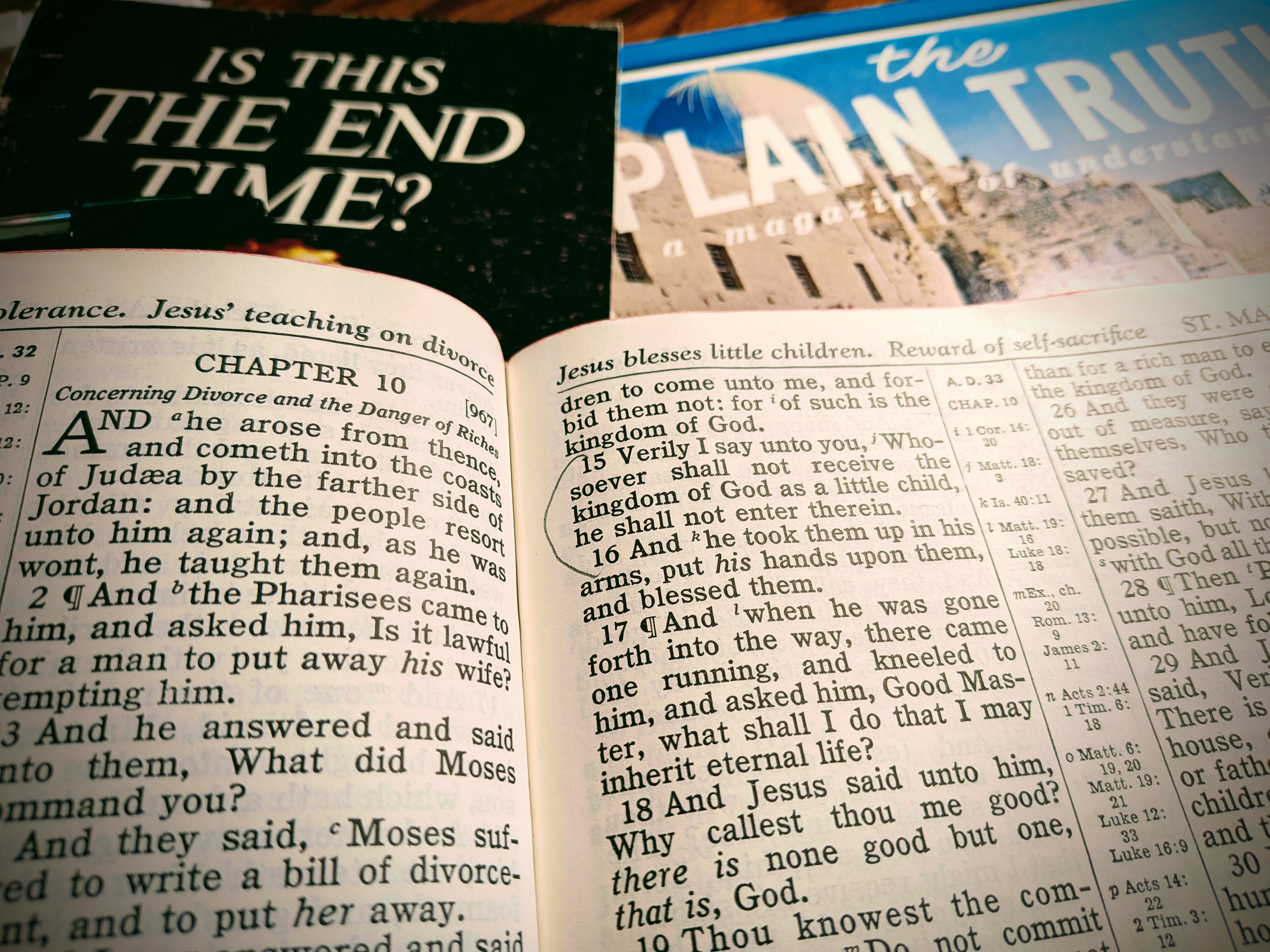
Through his years of service as a minister of Jesus Christ, my dad, Randy Stiver, often examined certain themes, and prominent among them was the “year of last things.” It started as a lesson learned during his years at Ambassador College in Bricket Wood, England, when he was asked by a faculty member if he was truly appreciating his “year of last things” as a senior. Last dance, last Bible study, last Sabbath, all the many “lasts” of his college experience.
But as he meditated on it, and we discussed it as a family, it grew into a concept that was much bigger than youthful experiences. It developed a more somber tone, are we truly appreciating all of God’s blessings in our lives because we don’t know the day or hour of our death. We could all be facing our “year of last things” in life. 2026 was certainly my dad’s year of last things, according to God’s will.
More importantly, since we know that according to God’s plan, we who are called now have this one lifetime to act on our calling, there is an exponentially more serious tone to our own “year of last things”. We have a choice in this life, we can choose God’s way on His terms or we can reject it. Closely examined, there really isn’t an “in between” choice where we can sort of follow God’s way, but by our own standards. No soap, as the old saying goes.
When “year of last things” becomes our personal end-time
I remember that, in the course of one sermon on the year of last things, dad followed the thought through to its logical end. If our life-span is the test of our true commitment to God, then by extension, the end of our life is our, personal, end-time.
Most of us think of the “end times” as a narrow period of time that precedes the last days, a period of world conflagration and tribulation, the Divine justice of the Day of the Lord, and, ultimately, the Return of Jesus Christ. Those events will come to pass, and will be the defining moment of the generations that are alive when they transpire (perhaps even our own), but if we convince ourselves that we can live an endless summer existence of “good times,” being fairweather friends with God’s Law and way of life, and then “if things get really serious, prophetically” we shape up in the hopes (possibly vain) that God will protect us, we are deluding ourselves. We miss the reality that we are living in our own “end time.”
Our convictions should have deeper roots than that. This is a “live or die” calling. We aren’t here for the good times only, or the social outlet, or the fun Feast travel, or the doctrinal dabbling, or the [insert your distraction of choice here]. We are here for the whole life-long fight, as Paul put it: “For I delight in the law of God after the inward man: But I see another law in my members, warring against the law of my mind, and bringing me into captivity to the law of sin which is in my members” (Romans 7:22-23, NKJV).
We’re here for the overcoming because there is only one goal of any value and that is our calling to be born into the Family of God at the Return of Jesus Christ. It should shape us every step of every day.
This was what motivated my dad through the years to keep on with the extremely exhausting job of pastoring, especially when not everyone was receptive to God’s way, even in the Church of God. (Imagine that.) Nonetheless, he wanted to see that internal combustion engine of conviction and true faith chugging away in all the people of God he worked with through the years. He poured his energy into his preaching to try to stir up God’s Spirit in others. Sometimes it was effective, sometimes it felt like an endless uphill climb.
Berean brethren I have known
But there is a small subset of brethren that he, and my mom and I, found endlessly encouraging through the years. Even inspiring to our own faith. My own great-grandmothers and grandparents were among them.
They were people from, primarily, another generation. They lived life before the digital revolution, a few even before the electrical revolution. I remember some of them from my very early youth, I wasn’t yet 10 years old, and they would have been in their late 70’s and 80’s, close to the century mark in the late 1980’s. The world of their youth was less distracting, and they had a unique ability to focus on what mattered. Many of them came from an agrarian background, so being attuned to the patient perseverance necessary to grow crops and work with livestock was built into their perspective.
When they came to the knowledge of the truth of God, at that time through the work of Herbert W. Armstrong and the Radio Church of God, later Worldwide Church of God, and having proved it true from their Bibles they had a “pearl of great price” attitude. That was it, they had found the truth and a lot of the other distractions in life that people aspire to didn’t really interest them.
They loved to talk about the truth, especially as it was outlined in the literature of the church at that time. They loved to talk about what they read in their Bibles. Not to dispute or to dabble with various interpretations or misinterpretations, as is often the case, but to be profoundly amazed and appreciative that God had revealed the fullness of His plan of Salvation for all mankind to them, in their lifetime. To know that, if they remained committed to the end, they, too, would be a part of the very Family of God. Living out the most purposeful existence of which our minds can scarcely conceive.
They knew the cost and the price of being prepared for their personal, end time. One such man had been a minister in a mainstream Christian church his entire career and only came to a true understanding of Scripture late in life. Yet he embraced it with absolute enthusiasm. He knew the cost and value of God’s truth.
Their memory still inspires me, just as my dad’s unwavering commmitment to teach God’s way of life even as he declined in the hospital, inspires me. The same way that the record of the faithful in the Bible inspires me, and the commitment and struggle and suffering that the apostles lived inspires me. The way the suffering and commitment of Jesus Christ should inspire us all.
Live like this is your year of last things, as if your personal end time is upon you. Eyes forward. Onward and upward as my dad used to say. You will not regret it. We will not regret it.
*If you wish to reprint this commentary or learn more about how to do so, please contact me in the comments below. I reserve my rights to this content, it is not in the public domain for use or reprint without my permission. **All images are property of Amanda Stiver, unless otherwise noted. Please do not re-use without permission.