Collecting History: Old Sayings

Some people collect antiques. Some collect old cars. Many collect old books. There are innumerable items to collect and most often we associate certain things with history, like antiquities.

As exciting as ancient pieces of statuary may be, they are expensive, often hard to move, and quite frequently illegal to gather. I have a solution. It requires no storage, no expense and is, as yet, quite legal. I urge you then to collect old sayings!

These are the short pieces of advice that have been around for centuries. Some are extremely useful and some are not.

Here are a few examples (taken from Wise Words and Country Ways: Traditional Advice and Whether It Works Today by Ruth Binney and Little Heathens: Hard Times and High Spirits on an Iowa Farm During the Great Depression by Mildred Armstrong Kalish):

Weather –

“Ring round the moon, snow soon.”

“When swallows fly low, rain is on the way.”

“Rain before seven, fine by eleven.”

Health –

“Sit up straight.”

“Eat your crusts – they’ll make your hair curl.”

“Chew each mouthful twenty times.”

“Put vinegar on a wasp sting.”

“Eat a peck of dirt before you die.”

Education, gab and whatnot –

“Improve your mind each day.”

“What’s on her mind is on her tongue.”

“She’s got a tongue that’s loose at both ends and has a swivel in the middle.”

“I’ll be with you in two shakes of a lamb’s tail.”

Kitchen –

“After melon, wine is a felon.”

“Don’t open an oven door while a cake is cooking.”

“Stew boiled is a stew spoiled.”

There you are. I’ve started you off with your own small collection. Add to it as you come by a funny old saying, factual or not. Listen for these from older family members and friends. If you don’t have access to these resources whose sayings will vary by region and nation, then look to books.

These sound bites are a direct link to history. They tell us how people thought in the past, what they believed, and how they acted. To keep the thread of history alive, start collecting today!

– Amanda Stiver

Putting Up with Food: Canning

I remember jars of preserves on my grandma’s shelves. When I was little and my family would go on our annual cross-country visit to my grandparent’s home in Oregon, I always looked forward to a yummy dish of canned cherries or plums.

Not the kind from the grocery store that swims in high fructose corn syrup. Nope, the good old-fashioned home-canned variety in its own juices, some additional water and a bit of sugar. Best of all in a glass jar instead of a metal can sprayed with plastic.

In a dark, back corner of the house was the pantry in which the jars were stored. By the time I was a youngster grandma was putting up less home canned goods because the stores were filled with affordable options. However, in past years she and many like her put in a great deal of work each year to grow and put up produce.

Great pride was taken in one’s beans, tomatoes, peaches, berries, pickles, and mincemeat, etc. One scene in the movie State Fair typifies this domestic skill and pride. The main character and her mother, Mrs. Frake, are watching a contest at the state fair in which mother’s pickles and mincemeat are up for prizes. As the contestants anxiously wait, more than a few smug looks are shared by the previous year’s winner, until she finds out she lost to Mrs. Frake.

Producing the most delicious home canned goods from one’s own garden was a big deal. Much more of America farmed and lived off the land at that time. People were tied into the earth and very proud of what they could produce. Proud they were of the self-sufficiency of which they were capable.

The next time you reach for a can of peas think about the task of putting food up. Think about what kind of work went into growing, harvesting, cooking and canning those peas so you could buy them at the store. Now, imagine doing all that work yourself! That’s history!

– Amanda Stiver

The Clive Cussler Effect: More Gateways to History

A while back I wrote a post about gateways to history. These are sneaky ways to get interested in history if you weren’t blessed with splendid history teachers.

It’s time to revisit. Specifically, fiction books.

How can fiction and history be mentioned in the same breath? Isn’t fiction more or less a mess of lies, accounts of things that never happened? And isn’t history, ideally, an account of things that did happen?

Yes, and yes, but fiction we are supposed to know is not true, and history, we are supposed to assume has been researched for veracity. So, how can the one be useful for exploring the other?

Fiction is fun and, for some, history is boring. Sad, but true, but if you use the fiction as a jumping off point, you get the benefit of the fun which will hopefully be carried along into the study of the history, thereby making it fun too!

The briny deep

Now for the Clive Cussler part. I just started reading Medusa, a mystery by Cussler and co-author Paul Kemprecos. The book is one of several in a series that feature the protagonist Kurt Austin, a tough, marine researcher and systems specialist.

As is often the case with Cussler books, the story begins with a flashback in history. In this case the whaling industry of the mid-19th century. Then in the present-day setting of the bulk of the book, reference is made to William Beebe and the bathysphere (submersible sphere) in which he launched himself in the 1930’s.

These are prime examples of history nuggets. They are the bits of accurate history that give a realistic touch to works of fiction. They are also history gateways.

I like to take these gateways when I’m working through a book like Medusa, do a little bit of my own research to further my store of historical knowledge. Sometimes I also want to make sure the author I’m reading is accurate, not all are as conscientious as Cussler and company.

So, the next time you pick up a piece of fiction, a favorite mystery or adventure, look for the history nuggets. If they strike your fancy, dig a little deeper, and as you travel to a different time and place in the past carry the fun with you and you’ll discover that history can be a blast!

– Amanda Stiver

July the 4th: Illuminating Independence

The flag of the United States adorns a small flower arrangement in my dining room and bits of red, white, and blue are to be seen inside and outside my house. I may even have an illumination or two. But these things are only the outward symbol of 200+ years of American history and the quest for freedom that began when the Second Continental Congress adopted the Declaration of Independence on July 2, 1776.

We celebrate the 4th day of July and not the 2nd, but as you’ll read in the following quote* written by John Adams (yes, him again) to his wife Abigail the vision for an expansive future was there from the earliest days of the Republic:

“But the Day is past. The Second Day of July 1776, will be the most memorable Epocha, in the History of America. — I am apt to believe that it will be celebrated, by succeeding Generations, as the great anniversary Festival. It ought to be commemorated, as the Day of Deliverance by solemn Acts of Devotion to God Almighty. It ought to be solemnized with Pomp and Parade, with Shews, Games, Sports, Guns, Bells, Bonfires and Illuminations from one End of this Continent to the other from this Time forward forever more.

You will think me transported with Enthusiasm but I am not. — I am well aware of the Toil and Blood and Treasure, that it will cost Us to maintain this Declaration, and support and defend these States. — Yet through all the Gloom I can see the Rays of ravishing Light and Glory. I can see that the End is more than worth all the Means. And that Posterity will tryumph in the Days Transaction, even altho We should rue it, which I trust in God We shall not.”

The line, “It ought to be commemorated, as the Day of Deliverance by solemn Acts of Devotion to God Almighty,” always stands out in my mind. How often do we hear the words “solemnity” and “God Almighty” attached to 4th of July celebrations? Fireworks, yes, solemnity, not so much.

But think about the cost of human lives it has taken to maintain this country and its freedoms from the first days of the Revolution to the lives lost in Iraq and Afghanistan just recently. Not to mention the support crews on the home soil that built the boats, planes, jeeps, tanks, weapons, and other ordnance that saw us through WWII as well as every other major war? Their memory deserves more than a few moments of solemnity in the presence of God Almighty.

“Rays of Ravishing Light and Glory,” – I love these words because not only to they refer to the illuminations that we are so used to seeing on Independence Day, but they also describe the hope of opportunity, freedom of religion, and peaceful existence that America has promised to generations of immigrants from the earliest English, Scots, Welsh, Irish, German, Dutch, Spanish, and French settlers to those who still, with patience, go through all the red tape and hassle it takes to become a legally invested American citizen.

Happy 4th of July! May you see the Rays of Ravishing Light and Glory and may your 4th be solemnized by acts of Devotion to God Almighty!

– Amanda Stiver

*All quotes from Our Sacred Honor: Words of Advice from the Founders in Stories, Letters, Poems, and Speeches edited by William J. Bennett

Ignorance Is Disaster: Why It Pays To Know History

“Those ignorant of history are doomed to repeat it.” – variation of a quote by George Santayana

Those ignorant of this quote are doomed to hear it repeated also. I’ve heard history professionals praise and condemn this concept. Those who praise it (I am one) revel in its quality of just comeuppance. They like to think that their superior knowledge will avail them in the future when others are forced to replay some rather nasty bits of history. This is the ego in human nature, but that doesn’t make the quote untrue.

Those that condemn this idea of ignorance breeding repetition are either fans of experiential history where each generation must make its way on its own instincts, or they simply don’t want to face the fact that this particular quote is true, painfully true. Ignorance is only bliss for a while.

The truth is that the ones who are ignorant of history usually trump the ones that have studied it in that so many people are ignorant of history in general – the odds are in their favor. Bad ideas have a greater chance of being replayed because of this. Each succeeding generation, ignorant of the pain and suffering an idea or course of action caused those who came before, get a flash of brilliance and think, hey, this might work after all – let’s try it again.

Socialist hiccups

Communism is like this. Even among historically educated people, often in academic circles, is a day-dream like coma to the realities of applied Communism in history, past and present. Life in the Soviet union was terrible, especially if you got on the wrong side of the firing squad. Life in communist Cambodia was horrible, especially if you lived long enough. Castro’s Communist Cuba is not a land of a thousand delights. Communism and it’s relatives, Socialism, dictatorship, and Fascism have led to the most wholesale genocide in virtually the entirety of history. It is insanity to think it will work again (and yet, people want to try)!

A connoisseur of irony, my favorite response from academic types trying to make excuses for violent Communist excess was, “Well, it wasn’t Communism that was the problem, it was the Russians/Slavs/Cambodians/Cubans/Vietnamese/Koreans/Chinese, etc… that messed it up. Now, if we would try it, it would be different!” If you keep trying the same thing and expect a different result each time, is that not the definition of insanity?

My plea to you – pick up a book and learn about history – the true kind. Don’t be one of the many who are fooled into thinking that a bad idea (any bad idea not just Communism) the first time, might become a good idea if we simply try it again!

– Amanda Stiver

And I quote… Paine, A. Adams, and Longfellow

A web-log on history has many avenues available to the author and as I explore them I find that sometimes the thoughtful exploration of a quote* from an historical document can give enlightenment to history as a whole. A few lines of prose or poetry, short and succinct, allows time for analysis when hundreds of pages of reading is too demanding.

Ideas are carried in words and none more so than those of Revolutionary era America. I find myself, during times of upheaval, turning to the words of the men and women who influenced the founding of the  United States or later recorded their stories. Ironically, those individuals saw the dangers that faced the generations to come after them. Over two hundred years later, we are witnesses to the dangers they foresaw.

`-`-`-`-`-`-`-`-`-`

Freedom

“These are the times that try men’s souls. The summer soldier and the sunshine patriot will, in this crisis, shrink from the service of his country; but he that stands it NOW, deserves the love and thanks of man and woman. Tyranny, like hell, is not easily conquered; yet we have this consolation with us, that the harder the conflict, the more glorious the triumph. What we obtain too cheap, we esteem too lightly; ’tis dearness only that gives every thing its value. Heaven knows how to put a proper price upon its goods; and it would be strange indeed, if so celestial an article as FREEDOM should not be highly rated.”

– Thomas Paine, The American Crisis, 1776

Sacrifice

“I will take praise to myself. I feel that it is my due, for having sacrificed so large a portion of my peace and happiness to promote the welfare of my country which I hope for many years to come will reap the benifit, tho it is more than probable unmindfull of the hand that blessed them.”

– Abigail Adams to John Adams, June 17, 1782

Watchfulness and Courage

“So through the night rode Paul Revere;
And so through the night went his cry of alarm
To every Middlesex village and farm –
A cry of defiance and not of fear,
A voice in the darkness, a knock at the door,
And a word that shall echo forevermore.
For, borne on the night-wind of the Past,
Through all our history, to the last,
In the hour of darkness and peril and need,
The people will waken and listen to hear
The hurrying hoof-beats of that steed,
And the midnight message of Paul Revere.
”

– Henry Wadsworth Longfellow, “Paul Revere’s Ride,” last stanza

* All quotes from Our Sacred Honor: Words of Advice from the Founders in Stories, Letters, Poems, and Speeches edited by William J. Bennett

The Paul Bunyans and Me

Sometimes you get the chance to draw near to your family history and often in the most unexpected ways. Yesterday I watched a tree trimming crew dispatch some overgrown pine trees from a neighbor’s yard.

A piece of large-scale logging equipment on display near Snowshoe, WV.

As the cutter scaled the approximately 40-foot tree and removed limbs as he went, I was reminded that my grandfather and uncles did this very type of work during their years as men of the forest. By trade they were loggers, harvesters of tree growth, but to say they were just lumberjacks who chopped down trees doesn’t even begin to do them justice.

The tree trimmer reached the top of the tree, supporting himself with a band around the trunk and sharp spiked boots, and secured with rope the very top of the tree, branches still intact. Still perched precariously he zipped through the trunk above him and his ground crew kept well back as the top fell to the earth with a crash. He descended and finally the bare trunk was ready to come down.

Making the connection…

I was never able to watch my grandfather or uncles at work, so my image of a logger’s work came in books, movies, family stories, and the occasional tree removal in the yard. Seeing this type of scaling firsthand helped to flesh out the stories of danger and hazard that they dealt with every day.

It also brought to mind their other accomplishments. Knowing forests are full of very tall plants and, considering that we farm by planting plants and harvesting them, you can begin to understand that logging is another form of farming. My grandfather knew more about forest life and tree ecology than I will ever hope to know. You can’t work in that environment for such a length of time without developing a clear understanding of your surroundings. Your life depends on it!

The harvesting of trees is only half of a lumberjack’s job. To harvest again in the future you have to replant and I believe the ratio is 7 trees planted for every 1 tree cut. To know how to fall a tree you must have knowledge of branch growth which can interfere with the fall and cause undue damage to you or other trees. Even then the forest is full of surprises and the best of men have lost their lives in this line of work.

Clear cutting an area is only one of many methods of harvesting; however, it is the most drastic with the most visual impact. That’s why it made the news so much in the late 1990’s when the politically correct trend was to be a tree worshipping environmentalist. Selective cutting is what you do if you want to continue to make an income from your stand of trees. A few trees, cut specifically, improve the health of the remaining trees.

By the way, woodland animals live in meadows and at the edge of the forest, not in deep, dark, densely packed old-growth stands. They need vitamin-D, too – just to knock another myth in the head while I’m on the subject.

Hat’s off…

History is like that. Sometimes you unexpectedly come across a connection to the past. You begin to better understand what happened during an important historical event or your own family history.

I’m glad I got the chance to see the kind of work my grandfather did. Thanks grandpa (and to all the other Paul Bunyans out there) for surviving all the injuries and near-death crisis inherent in your work. I wish I could have said it while you were still present to hear it.

– Amanda Stiver

Back to John Adams – Marriage

A few posts back I reviewed a biography of John Adams and so to return to that illustrious personage here is a piece of correspondence from John to his wife Abigail. I think it exemplifies the loving relationship they maintained despite the long years of separation in service to the new nation.

Oh my dear Girl, I thank Heaven that another Fortnight will restore you to me – after so long a separation. My soul and Body have both been thrown into Disorder, by your Absence, and a Month or two more would make me the most insufferable Cynick, in the World. I see nothing but Faults, Follies, Frailties and Defects in any Body, lately. People have lost all their good Properties or I my Justice, or Discernment.

But you who have always softened and warmed my Heart, shall restore my Benevolence as well as my Health and Tranquility of mind. You shall polish and refine my sentiments of Life and Manners, banish all the unsocial and ill natured Particles of my Composition, and form me to that happy Temper, that can reconcile a quick discernment with a perfect Candour.

Believe me, now & ever yr. faithful

Lysander [a pseudonym used by Adams when writing to his wife]

– Taken from Our Sacred Honor: Words of Advice from the Founders in Stories, Letters, Poems, and Speeches edited by William J. Bennett.

Mummies, Pyramids, and Science!

– Egypt and Radiocarbon Dating –

I love it when a story like this comes up in the news, “BGU Scientist Sheds Light On Ancient Egypt,” (Judy Siegel-Itzkovich, The Jerusalem Post, Jun. 21, 2010).

Using all available resources to answer archeological questions is fascinating, even if we still don’t end up with a solid conclusion. Putting science to use within the confines of its capabilities is positive, rather than toying with genetic material we don’t completely understand, we can try to better understand the history we already know.

Ever since The Mummy (the 1999 Brendan Fraser version), I’ve had a soft spot for Egyptian history. Actually it dates back further than that. Long ago, my parents went to a display of King Tutankhamen’s funerary objects and bought a souvenir booklet. I remember pouring over the images as a child, alongside, oddly enough, a coffee table book on African animals and another with images of Great Britain.

“Wonderful things”

I once discussed this fascination with a friend who was likewise enamored with ancient Egypt. We came to the conclusion that along with an interest in Biblical events of the Exodus, we thought Egypt had some of the prettiest ruins of all the ancient civilizations. The latter was not a serious, academic conclusion, but people have gone on to study a subject for worse reasons than that.

Egyptian paintings, carvings, and buildings are very beautiful. They have a stylistic element; static, yet fluid and graceful that stands apart from the realism of later Greece and Rome and the frightening, super-detailed elements of Assyrian creations. I think Egypt strikes us as at once other worldly (and the ancient Egyptians certainly thought they were, hence mummies) and cosmopolitan.

“If you build it, they will come”

And yes, those Pyramids – that’s the real cause of much interest. Who would go to all that trouble? What cultural influence and ideologies pushed a man (albeit a Pharaoh who thought he was a god) to spend all that wealth, manpower, and time constructing such a memorial when he would have been off conquering half the known world as did the Assyrians, Persians, Greeks, and Romans at later dates?

I guess we’ll have to wait a while for an answer to that. In the meantime, keep your historical curiosity alive and maybe someday you’ll be the one to tell us why!

– Amanda Stiver

Making Your Own Keeps You in Stitches

– Sewing as an Historical Exercise –

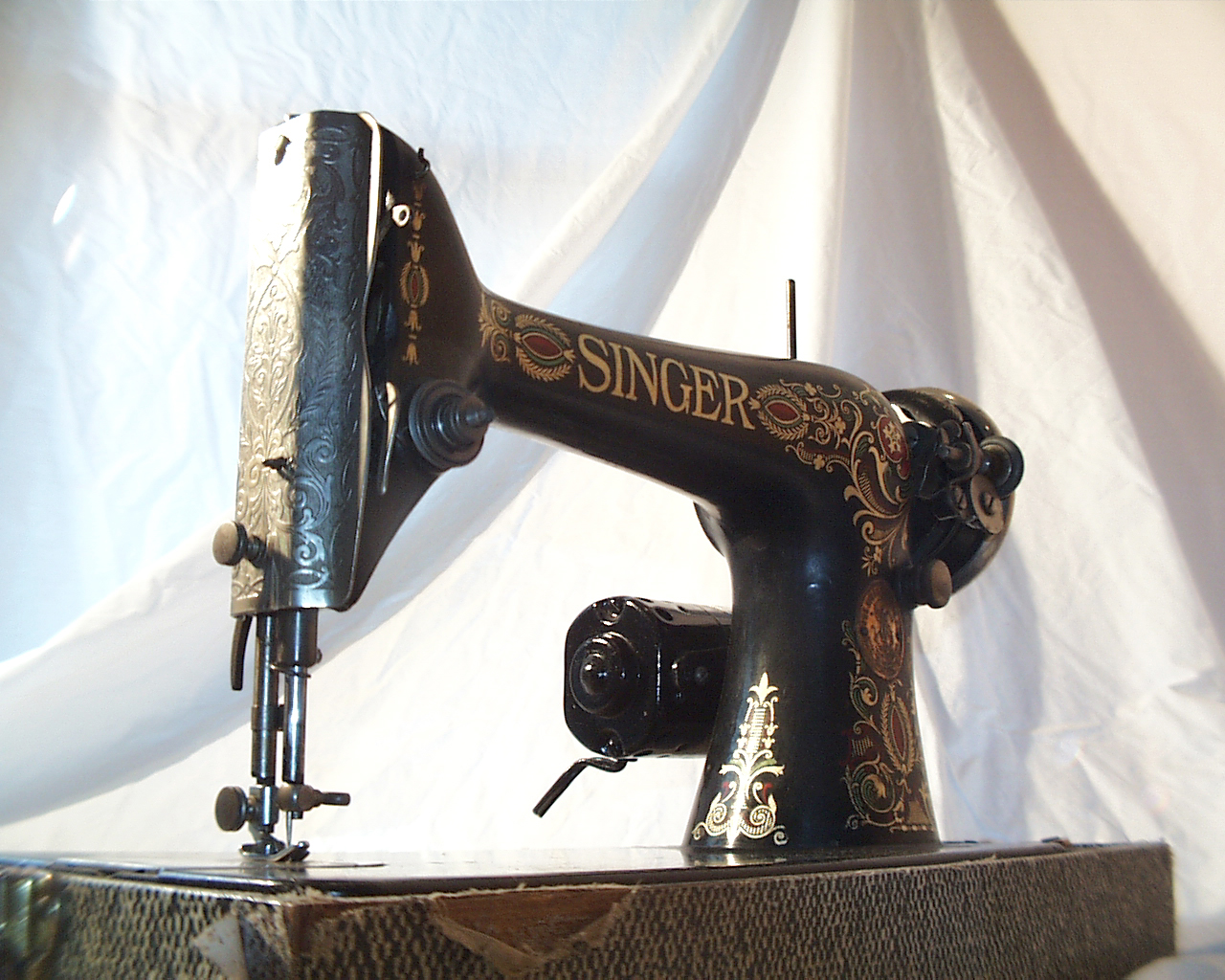
When you think of a sewing machine do you imagine the hum of an electrical unit or the rhythmic thum-thum-thum of a treadle machine that is powered by foot and coordination? No, I don’t suppose most people often think of sewing machines.

I do, occasionally, mostly when I recall visits to my grandmother, who used the antique treadle version. She was a talented seamstress and would make little outfits for me when I would visit from half a continent away each summer. Full skirts that would spin when I twirled were generally the demands of a six-year-old girl.

Likewise would my aunt, also skilled with a needle and thread, make me lovely dresses. I recollect these memories here because I want to talk about the continuum of history.

What goes around, stays around

The history continuum sounds like something out of Star Trek, but as I see it, it is simply the importance of recognizing that there are some methods of daily living that have been around for thousands of years and ought to be preserved and rehearsed so as not to be lost. Actively live in the past to preserve skills that might otherwise be forgotten because of dis-use.

Skills are like tools: you don’t need them all the time, but you’re sorry when you don’t have the right one when you need it!

Sewing fits this continuum. It was a skill used frequently in the past but has fallen into dis-use among the general public because of the large-scale factory production of clothing and textiles. It is, in theory, more affordable to buy ready-made clothes at the store than to go to the trouble of making them yourself.

I agree, and I buy most of my clothes at the store, but sewing has a place. If you can sew on a button, stitch up a seam, or repair a rip, you are ahead of most people and you won’t have to toss out as many clothes that are only slightly maimed.

Stitch, not pitch

I recall family stories in which most items of clothes were made at home and, if they fell into disrepair, then they were simply “re-purposed.” Or, as it was back then, you “made-do” with what you had.

I’m sure this came of the Great Depression, but it reaches much further back. The Industrial Revolution of the 18th and 19th centuries caused a spike in manufacturing. Thus, everyday items produced in vast numbers fairly cheaply would cost much less than before.

People could afford lots of “stuff,” however, not nearly as much as we have now. Therefore, they still didn’t waste what they weren’t sure they could replace. Overabundance didn’t really hit until the last third of the 20th century.

On a visit to Old World Wisconsin, a living history museum in that state, I remember observing a linen-making display (I highly recommend visiting the museum, by the way, great exhibits). The flax was harvested, soaked to soften, fibers separated from the stem, combed, and then spun into thread. Finally it was ready to be woven into fabric from which a seamstress or tailor would cut and sew a final garment. Imagine if you had to do all that just to have a new shirt – you wouldn’t throw it out in a hurry – that’s for sure.

The moral of my post – if you get the chance, learn your way around a needle and thread and a sewing machine. Not only will you save some money, but you will be participating in a thread of experience woven through the tapestry of human history!

– Amanda Stiver