Making Your Own Keeps You in Stitches

– Sewing as an Historical Exercise –

When you think of a sewing machine do you imagine the hum of an electrical unit or the rhythmic thum-thum-thum of a treadle machine that is powered by foot and coordination? No, I don’t suppose most people often think of sewing machines.
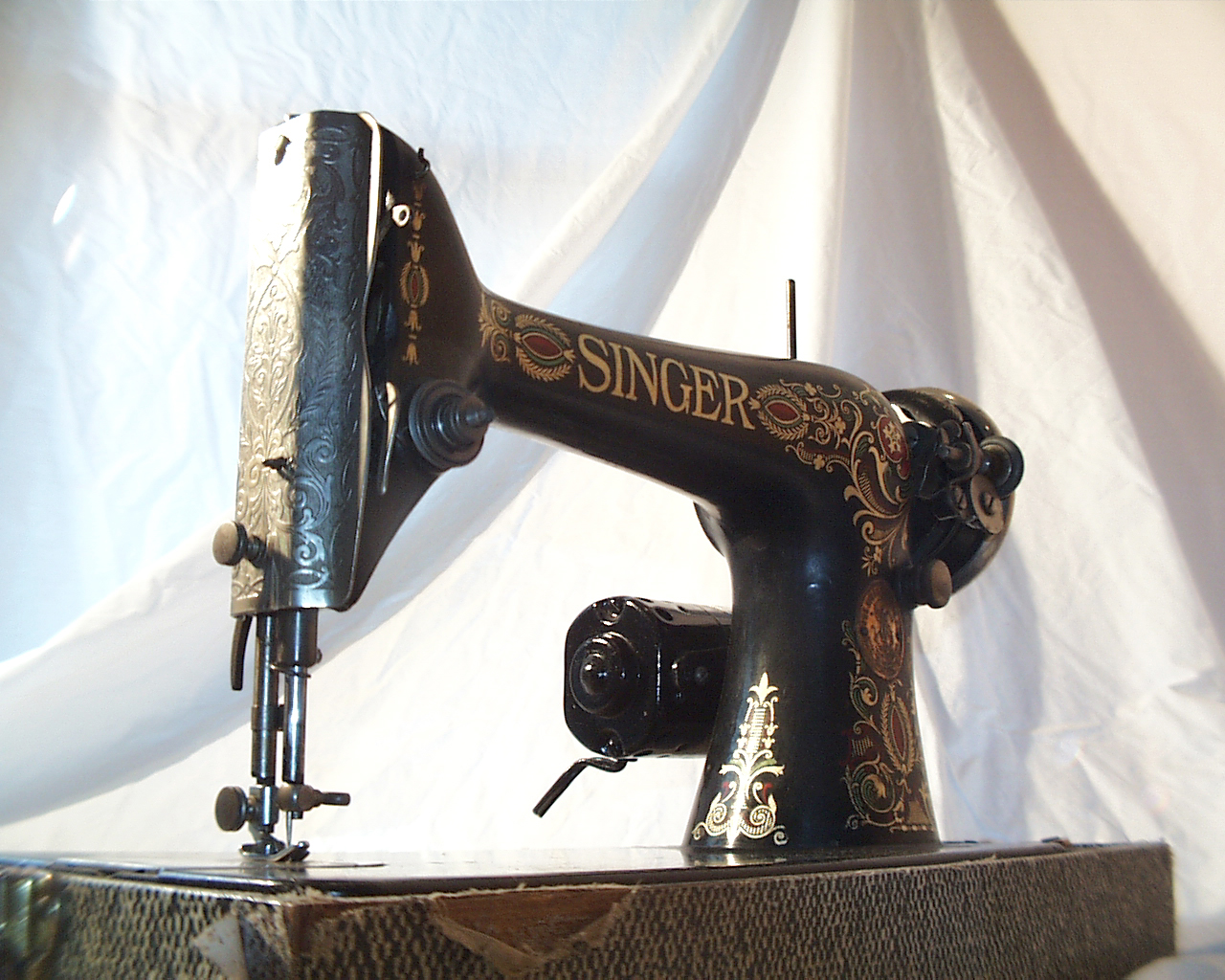
I do, occasionally, mostly when I recall visits to my grandmother, who used the antique treadle version. She was a talented seamstress and would make little outfits for me when I would visit from half a continent away each summer. Full skirts that would spin when I twirled were generally the demands of a six-year-old girl.

Likewise would my aunt, also skilled with a needle and thread, make me lovely dresses. I recollect these memories here because I want to talk about the continuum of history.

What goes around, stays around

The history continuum sounds like something out of Star Trek, but as I see it, it is simply the importance of recognizing that there are some methods of daily living that have been around for thousands of years and ought to be preserved and rehearsed so as not to be lost. Actively live in the past to preserve skills that might otherwise be forgotten because of dis-use.

Skills are like tools: you don’t need them all the time, but you’re sorry when you don’t have the right one when you need it!

Sewing fits this continuum. It was a skill used frequently in the past but has fallen into dis-use among the general public because of the large-scale factory production of clothing and textiles. It is, in theory, more affordable to buy ready-made clothes at the store than to go to the trouble of making them yourself.

I agree, and I buy most of my clothes at the store, but sewing has a place. If you can sew on a button, stitch up a seam, or repair a rip, you are ahead of most people and you won’t have to toss out as many clothes that are only slightly maimed.

Stitch, not pitch

I recall family stories in which most items of clothes were made at home and, if they fell into disrepair, then they were simply “re-purposed.” Or, as it was back then, you “made-do” with what you had.

I’m sure this came of the Great Depression, but it reaches much further back. The Industrial Revolution of the 18th and 19th centuries caused a spike in manufacturing. Thus, everyday items produced in vast numbers fairly cheaply would cost much less than before.

People could afford lots of “stuff,” however, not nearly as much as we have now. Therefore, they still didn’t waste what they weren’t sure they could replace. Overabundance didn’t really hit until the last third of the 20th century.

On a visit to Old World Wisconsin, a living history museum in that state, I remember observing a linen-making display (I highly recommend visiting the museum, by the way, great exhibits). The flax was harvested, soaked to soften, fibers separated from the stem, combed, and then spun into thread. Finally it was ready to be woven into fabric from which a seamstress or tailor would cut and sew a final garment. Imagine if you had to do all that just to have a new shirt – you wouldn’t throw it out in a hurry – that’s for sure.

The moral of my post – if you get the chance, learn your way around a needle and thread and a sewing machine. Not only will you save some money, but you will be participating in a thread of experience woven through the tapestry of human history!

– Amanda Stiver
Old Things

There are two kinds of people in this world – pack rats and scrupulous cleaners. I am related to both. Honestly though, I have been known to show pack rat tendencies. I like to think that I am fulfilling an archeologist’s dream when sometime in the future he stumbles upon my “cache.” Therefore I like old things, known more eloquently as “antiques.”

Some people collect old things like furniture, carpentry tools (had an orthodontist who did that – impressive collection and he even used them!), cars and appliances. I find those interesting and probably if I had a place or a budget for them, I, too, would acquire.

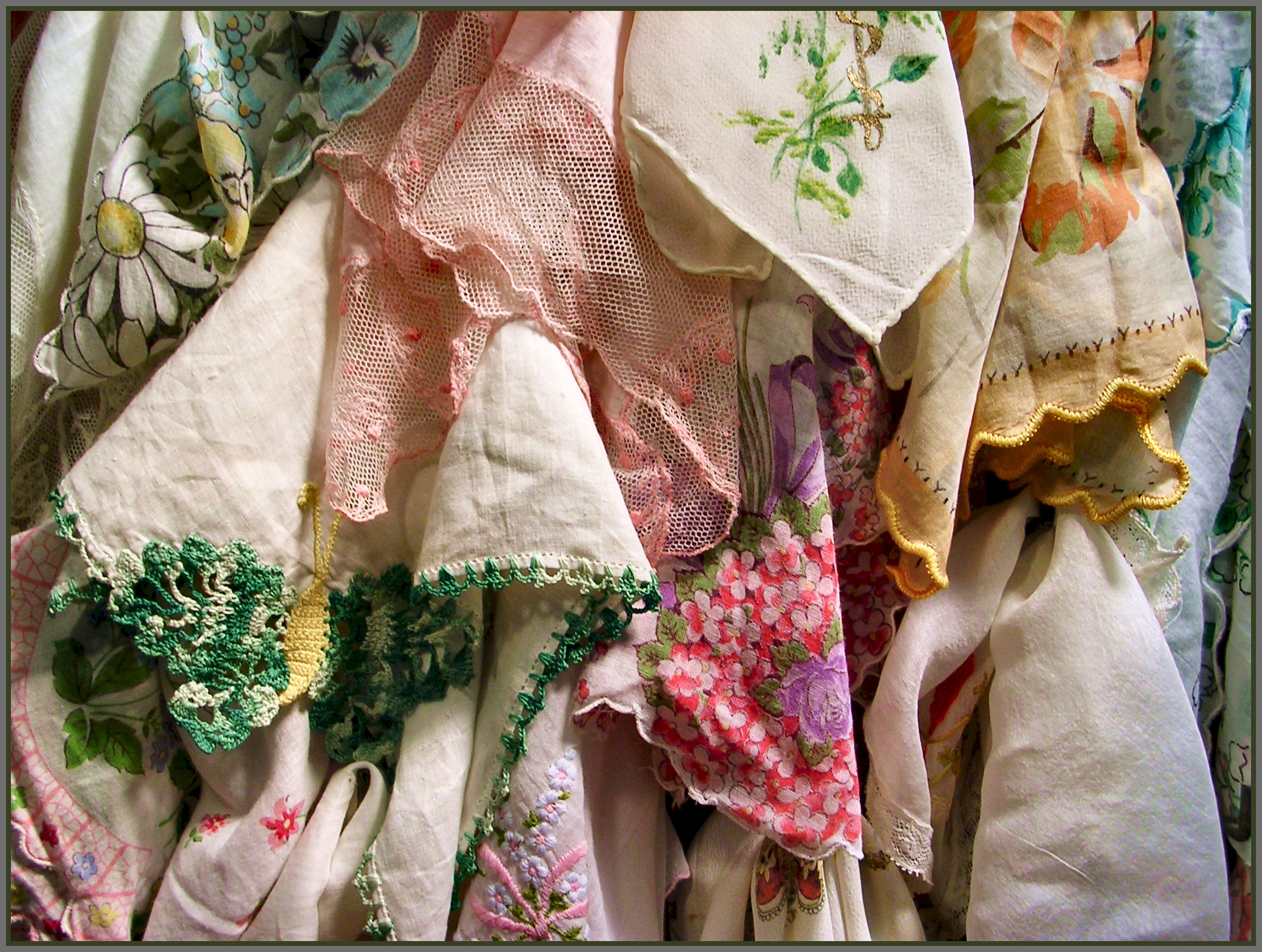
However, my interest in old things tends toward books, lots and lots of books, and sometimes china and textiles. Old handkerchiefs and tablecloths are fun to collect and cheap, too.

Objects to me are a solid way to connect to the past. Using the dishes that Great-grandmother Ethel set each Thanksgiving keeps the flow of history going. Sopping up your brow with a dainty hanky embroidered by Aunt Gertrude fifty years ago keeps the continuum of history on its course. Some things change, but the basics stay the same.

Waste not, want not

Things were better made in the past. The last fifteen years have seen shoddiness in foreign manufactured goods seep onto the market. Items that are purposely made to last about two weeks with no use and then fall apart right at the crucial moment. It’s a sad testament to consumer expectations and manufacturing standards; sad also that in an uncertain economy we can’t even afford to bypass the trash and buy quality.

Rummage through a garage sale sometime and you begin to see the things that have stood the test of time. They may be dirty, but after some cleaning they are still serviceable.

My Depression era grandparents would have shuddered at the wastefulness of the present day. “Making do” was the catchphrase well into World War II. If something broke, you could fix it. Admittedly this is more difficult with the digital technology around us. One must have a degree or a lot of time on one’s hands to try to fix a broken iPod.

Old things remind us of where we’ve been. They also show us that our standards are slipping and that we need to tighten up. Learn what a well-made product is and when you can afford it, buy quality. Buy just what you need.

As one of my favorite movies quotes goes, “More isn’t always better Linus. Sometimes it’s just more.” (Sabrina)

– Amanda Stiver

Tocqueville’s America

As the theory goes, travel is an education, which can help the individual better understand the wider world. This idea has merit, but I’d like to put a twist on it – the written journey of a past traveler can help the nation better understand itself now.

In 1831 a young Frenchman embarked on a journey to the young American republic and he documented his observations in a book called Democracy in America. Alexis de Tocqueville was the son of aristocrats who had managed (just) to keep their heads during the Terror of the French Revolution. He toured the United States and interviewed all those he could.

What he observed:

On American sovereignty,

“The nation participates in the making of its laws by the choice of its legislators, and in the execution of them by the choice by the agents of the executive government; it may almost be said to govern itself, so feeble and so restricted is the share left to the administration, so little do the authorities forget their popular origin and the power from which they emanate.”

On patriotism,

“For in the United States it is believed, and with truth, that patriotism is a kind of devotion which is strengthened by ritual observance. In this manner the activity of the township is continually perceptible; it is daily manifested in the fulfillment of a duty or the exercise of a right, and a constant though gentle motion is thus kept up in society which animates without disturbing it.”

On the land,

“Everything is extraordinary in America, the social condition of the inhabitants, as well as the laws; but the soil upon which these institutions are founded is more extraordinary than all the rest… That continent still presents, as it did in the primeval time, rivers which rise from never-failing sources, green and moist solitudes, and fields which the ploughshare of the husbandman had never turned.”

On the elusiveness of freedom,

“When the bulk of the community is engrossed by private concerns, the smallest parties need not despair of getting the upper hand in public affairs. At such times it is not rare to see upon the great stage of the world, as we see at our theaters, a multitude represented by a few players, who alone speak in the name of an absent or inattentive crowd; they alone are in action whilst all are stationary; they regulate everything by their own caprice; they change the laws, and tyrannize at will over the manners of the country; and then men wonder to see into how small a number of weak and worthless hands a great people may fall.”

When the people are content with building their own fortunes and uninterested in the affairs of state – a group of elites may step in to wrest their liberties from them.

How much we’ve changed? How much we’ve stayed the same?

– Amanda Stiver

Ice Cream, We Scream!

Ice cream is an American pastime ubiquitous to a hot, humid summer. And I do mean pastime – in the Midwest, in particular, ice cream stands and brands abound and elicit very strong opinions.

Whether you are a frozen custard or an ice cream purist will determine the store you patronize. National chains compete for attention with the homegrown article – and often lose! On this note, if you are ever in Ohio, visit Granville and try Whit’s – it’s excellent!

Then there are the mad scientists who like to concoct their own homemade varities. Even among this crowd is division. Are you an old-fashioned ice cream maker? Do you only use the rock salt and ice, hand cranked models? Or are you technologically advanced and prefer the self-freezing chamber versions that are electrified?

Frozen, in time

As with all my history quests, I want to know whether, and how, people made things in the past. So, what about ice cream – was it available in the days before electric refrigeration?

Well, if you’ve ever watched Meet Me in St. Louis you will discover that yes, it was, at least according to MGM’s version of the early 20th century. Ice cream was a special treat to be had in the summer, after all, who wants a freezing bowlful of cream in the dead of winter?

Likewise, ice cream and frozen custards were a specialty of the colonial era. George Washington and Thomas Jefferson were both aficionados of the tasty treat introduced to them by the French. Recipes from this era abound and their decadent sweetness was made possible by the construction of icehouses to store blocks of frozen ice through the summer (Alice Ross, “Ice Cream, a Colonial Delicacy,” Early American Life, June 2010).

Brrrrrr

Hauling ice to be stored was a going business until the dawn of electrical refrigeration. Each winter big blocks of ice had to be cut from frozen lakes, hauled to privately-owned icehouses or stored in a big, partially-subterranean barn. Packed in sawdust or straw, the ice would keep far into the summer.

Ice chips and rock salt were used to drop the temperature of the chamber in which cream, sugar, and fruit or an egg-based custard mixture would freeze. Hearty volunteers turned the handle keeping the ice cream moving in order to freeze evenly.

Finally, after all that work, was the finished product – smooth, homemade ice cream!

This is by far one of most rewarding historical re-enactments that you can pursue today – find a hand-cranked ice cream maker at a garage sale, marshal your ingredients, crank away, and slip into the past via a bowl of ice cream! Chipping the block of ice from a frozen lake and storing it all summer is up to you!

– Amanda Stiver

Praising John Adams

The U.S. had its fair share of kingmakers and quasi-aristocrats in its early years, but the venerable John Adams seems not to have been among them. That didn’t stop his opponents from labeling the force behind the Declaration of Independence a royalist!

From a farm in Braintree, Massachusetts and working as a lawyer in Boston and environs, Adams stood up for what was right and faced down those with whom he disagreed, most vociferously at times and sometimes to the annoyance of others – many others.

However, an aristocrat he was not and seemed not to have been riddled by the double standards that plagued Jefferson and others. He is fast becoming one of my favorite patriots of the revolutionary period.

I draw these conclusions from the masterful biography, John Adams, written by David McCullough. I know that it doesn’t do to rely only on one book to try to understand an historical figure, but I was struck by the fairness of McCullough’s approach to Adams, his friends, and his enemies.

The author treats his subjects as men with all their flaws, but doesn’t deny that they were extraordinary men in extraordinary times. Especially touching is the skillful way he weaves in the relationship between John and Abigail Adams and that of their extended family. Their vast letter writing capacity despite years and years of separation proves that a happy marriage isn’t based solely on the physical, but requires a strong intellectual attraction as well.

I strongly recommend this book as a basic primer on Adams. McCullough’s very approachable style of writing turns a somewhat lengthy book into a compelling page-turner. If you are trying to sink your teeth into history, this is a good place to start. I will admit that it slows as the narrative follows Adams life to its close, but perhaps that is because the 1770’s in America were so packed with action that the 1820’s seem placid in comparison.

For the interested historian John Adams is a fabulous resource of excerpts from letters and written works by Adams and others. A good author knows how and when to use a source directly rather than a paraphrase and this book is proof of that. Hearing the subject in his own words helps us draw a better picture of the man, more so because Adams was a straightforward individual (agree with him or not) and free of rank political duplicity.

Great book, great man, great marriage – great history.

– Amanda Stiver

America: A Vision for the Present

Lately I’ve been reading David McCullough’s John Adams, upon which the recent HBO series was based. Although I won’t write a review yet (I haven’t quite finished it), some interesting observations can be drawn from this era of history.

As I read the comments in letters and writings of individuals like John Adams, Abigail Adams, George Washington, Thomas Jefferson, John Quincy Adams, Benjamin Rush and others, I found myself reading sentiments of modern proportions.

Devaluation of money, excessive national debt, wartime alliances, and visions of America for centuries to come and not just as a mere 13 British colonies. After the conclusion of the Revolutionary War, men and women worried about America’s acceptance with the British, if we were to be continually their enemy or treat for total peace and recognition. Whether America would be a collection of very loosely confederated, nearly autonomous states, a pure, overwhelming national state with a central government, or united in balance under state and federal establishments.

Policies and Politics

Mud was slung between politicians and between factions. Republicans (at that early stage) stood for continuous revolutions and applauded the bloody, messy French Revolution, while Federalists looked to a strongly central government.

These positions would switch back and forth between liberal and conservative parties through the centuries. Today a less empowered federal government is the aim of conservatives while liberals yearn for a highly centralized, intensively regulated state.

Adams worried about America’s future with dire forebodings about the continual practice of slavery. Constant was his worry about how the new nation would be received in Europe and if it would or should get involved in the wars of that continent.

Past and Present

This is how history affects us. The same worries tie us to an era whose daily life is so very different from our own. The industrial revolution had not yet begun in earnest and everyday life was much as it had been for thousands of years.

You traveled by horse, your house was unplumbed, electricity was a gleam in Benjamin Franklin’s eye, and cooking was done over an open wood fire!

And yet, the human yearning for liberty is not sequestered by physical environment. Despite the differences of our dress, manner, speech, and abode, we all still cling to the hope of freedom – to live a free and virtuous life full of opportunity.

For more on this, please read The Declaration of Independence.

– Amanda Stiver

Natural History, Naturally

History covers all sorts of topics and usually we assume “history” means social history – the study of groups of people, the way they live, their actions, and specifically their interactions, peaceful or violent. But let’s not forget natural history.

Natural history is the study of plants and animals, the natural world. Nowadays we have more specific scientific names for all the various sub-categories. Natural history museums are in every major city and usually at every university. There you will learn about the indigenous peoples of the area (why they are tagged with plants and animals and not with human history I have no idea), geological formations and distinguishing characteristics, local animal and plant species, etc.

Pliny of this and Pliny of that

Way back when, Pliny the Elder published his Naturalis Historiae in 77-79 AD. It covers a multitude of subjects and is, according to our friends at Wikipedia, a compendium of ancient knowledge from sources and experts extant at that time relating to and drawing on the natural world. His work served as the model for the study of natural history through the centuries.

Natural history, quite naturally, relates to social history because people did and still do make their living from the natural world. Despite those nice glossy “modern” dwellings and all our digitized efforts, we still have to root around in the dirt to get our veggies and I guarantee without agriculture our societies will collapse in famine and pestilence.

Know the natural world

What I mean to impart is that it is as important to understand how the natural world really works (be careful, there are experts who purport to know and whose theories of climate, health, and ecology drawn on more supposition than fact) as it is to have a good grip on social history.

It also serves to remember that we haven’t been industrialized all that long, so knowing how the ancients and the denizens of the “olden days” lived helps us to gauge if society is moving in a positive technological direction or toward disaster.

The Teatime Experience

Branching out from my usual trend toward military or related history, I’ve been thinking about tea lately. I am off caffeine and therefore can’t have the lovely dark liquid for a while, so naturally I should choose to write about it.

Much is said about tea these days regarding its health qualities. And for the past few years the idea of an extravagant and elegant afternoon tea has enjoyed a revival of popularity in the U.S. Cute little tea houses have popped up in various places, often only to fold a few months later. It takes marketing genius or a known clientele to get Americans to shake their coffee loving habits.

Although colonial America owes many of its identifying traditions to British norms of the eighteenth century, we did shake loose a few things during the revolution. Tea was one. The Boston Tea Party incident sparked by increased taxes on this most essential of British liquids made a seminal statement. So much so that when you step into a diner the waitress will hand out menus and ask if you want a cup of coffee – you have to ask for tea!

Tea, once upon a time

Don’t get me wrong; I have nothing bad to say about traditional British teatime. It’s lovely and when I visited England I was determined to experience this glorious repast.

In the city of York there is a lovely place called Betty’s Café Tea Rooms. Here you will find the kind of tea service, sandwiches, sweet things, and goodies dreamed about by little girls in frilly dresses. They also serve a pretty swell coronation chicken if you hanker for something more substantial.

For the real deal, tea is prepared with loose leaves in a teapot and strained into your cup. Then a tower of delights arrives at the table. Three layers: warm scones and clotted cream (something I dream of, but rarely can afford stateside), then small open-faced sandwiches conspicuous by the absence of crust and the delicacy of cut, and, finally, a platter of small tarts, lemon curd and raspberry, and other little cakes.

Why is this historic?

Well, at one time people frequently indulged in this colossal teatime repast, but they don’t so much anymore, so participating in such a meal is akin to attending one of those medieval banquet performances, with jousting, and a goofy looking minstrel wandering around playing on a lute. You wouldn’t dine that way every night, but once in a while it gives you first hand experience of a different era of history. Living history.

So have a cup of tea, a scone, and some cake. Live a little… history.

Living like it’s 1873

Not long ago I finished A Lady’s Life in the Rocky Mountains by Isabella Bird. The book covers her remarkable travels as an Englishwoman in the nineteenth century American West.

Bird was subject to ill health and traveled, as many did at that time, to different climates to restore her strength. Among other places she also visited Hawaii as well as Canada, Japan and China. In this case Bird was on a trip to reach Estes Park, Colorado.

Her journey begins at Lake Tahoe and she travels east from there into Colorado. Given the strictures of the time she was unusual as an independent woman who traveled alone and un-chaperoned through vast prairies and mountainous regions. With the exception of a few close calls she remained quite safe. After her return she compiled letters written to family into a journal of her travels and published it for sale.

The narrative is full of action and moves quickly, so it is a worthy read if you are interested in doing a little time travel and getting some firsthand experience in the “old west.”

Word pictures

Two things stand out from the book. First, is Bird’s ability to use language to describe her surroundings. The book is un-illustrated, but I was surprised at how little I missed photographs or maps. Her descriptions are precise and show a facility of language usage that is completely lacking these days.

Here are a few samples:

“The stars were intensely bright, and a well-defined auroral arch, throwing off fantastic coruscations, lighted the whole northern sky. Yet I was only in the Foot Hills, and Long’s glorious Peak was not to be seen (p. 229, Comstock Editions, INC., 1987).”

Who uses the word “coruscations” these days? (It means “sparklings and glitterings,” by the way.)

“Long’s Peak, 14,700 feet high, blocks up one end of Estes Park, and dwarfs all the surrounding mountains. … By sunlight or moonlight its splintered grey crest is the one object which, in spite of wapiti and bighorn, skunk and grizzly, unfailingly arrests the eyes. From it come all storms of snow and wind, and the forked lightnings play round its head like a glory. It is one of the noblest of mountains, but in one’s imagination it grows to be much more than a mountain. It becomes invested with a personality (pp.78-79).”

I know that a picture can speak a thousand words, but words like these can speak a thousand pictures!

At your leisure…

Secondly, the descriptions of life at this time in American (and British) history fill a need-to-know of mine. When I sit down in the evening to watch a television show or movie I sometimes ponder at the passivity of my modern habits. It doesn’t take much intellectual stimulation to watch a video (which is sometimes the point after a busy day), but on the other hand, how much of the human brain do we leave inactive for the sake of “entertainment.”

The following quote from the book gives a hint at the kind of end-of-day events common in the early 1870’s:

“After that we all sit in the living room, and I settle down to write to you, or mend my clothes, which are dropping to pieces. Some sit round the table playing at eucre, the strange hunters and prospectors lie on the floor smoking, and rifles are cleaned, bullets cast, fishing flies made, fishing tackle repaired, boots are waterproofed, part-songs are sung, and about half-past eight I cross the crisp grass to my cabin, always expecting to find something in it [based on a previous encounter with a skunk] (pp. 108-109).”

Life was not a piece of cake and leisure time was at a minimum. If you wanted to hear music, you sang it. If you wanted amusement, you played cards. Otherwise you were busy repairing your equipment.

Travel by book – I highly recommend this volume as your personal tour guide into the past!

The Great Depression and “Stuff”

A few months back I was blessed to be able to compile an article about survivors of the Great Depression. The article was an assignment for Vertical Thought magazine, which reaches out to a young adult and teen audience. My goal was to connect young people to the now elderly folks who lived through the Great Depression.

What was great about doing the article was that the subject fascinated me. Likewise, my interview material was everywhere! My relatives, older folks from the church congregation I attend, and from the community.

I think what has always amazed me about that era was that although so many people were barely scraping along; you will often hear them say that they didn’t know they were poor.

There was still an unspoken rule that if you had food to eat, a roof over your head, and a family with love – you were all right. Notice I didn’t say indoor plumbing, electricity, air conditioning, a new car, digital communication devices, digital music devices, etc. There are some basic things that all humans truly need. Then there are “necessities” that we are conditioned to “need.”

Binary Burden

To be fair, I, like the next person, use my fair share of these devices and benefit as a result, but I also find myself over-processed from them. In the same way that junk food is over-processed to the point that it doesn’t resemble its original components; I think over-digitalization is similar.

We lose ourselves in the crush of information, our ability to concentrate is tampered with, and we begin to feel like we can’t live without all the social networking, constant texting, and electronic gadgets. We’re addicted to a pile of things or worse, to the miles of information encoded in the vapor that is the web!

Tough as it is to imagine, we could all probably get along without the proliferation of leisure and time saving devices that drive store and Internet sales these days.

Maybe I’m a young curmudgeon in the making, but there is something to be said for daily physical activity that leaves you fatigued, but invigorated by the activity and accomplishment.

Walk the talk

My challenge to you – go find one of these elders and ask them about (if possible) their life before electricity. Ask them to tell you what it was like when each new device came into popular use. Ask them how they got along without all those things.

You will be intrigued by the answers, and more than that, you will have made a connection to their past, which is now part of yours. You will be an historian!