Nostalgia Publications: History Goldmine

I’m a magazine junkie. I admit it. I don’t know what it is about those glossy pages or attractive photographs that pull me in, but I’ve loved a beautifully crafted monthly publication since I was a kid. Alas, I was born too late, and the digital age has attempted to dislodge this most tactile of printed material.
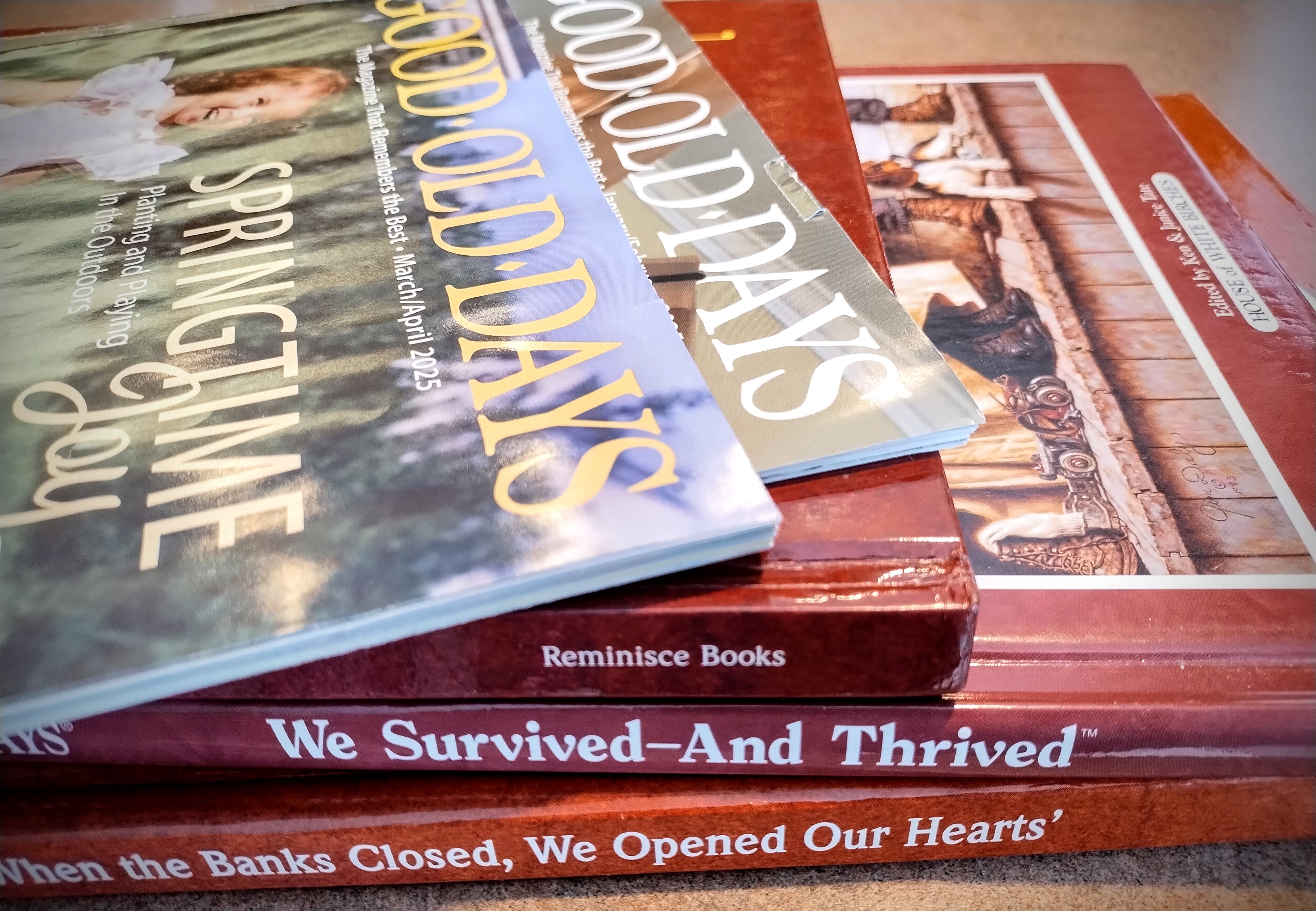
If you’ve never subscribed to a magazine, then you don’t know the eager anticipation of each issue when you check your mailbox. Like expecting the Amazon van, only you didn’t have to select your item, you get to be surprised with interesting articles, beautiful images, and pertinent information about your favorite subject, etc. It’s great!

However, I issue a caveat. I’m not an indiscriminate magazine lover. I only like certain types of magazines. Historical subject matter predominates, followed by beautiful imagery, and then practical information. Victoria and Teatime are favorites, Backwoods Home and Self-Reliance are sometimes subscriptions, but Good Old Days magazine is a perennial, as was Reminisce (sadly, no longer in print).

Is nostalgia really history?

I’ve heard a few opinions through the years that nostalgia is just living in the past. And that such reminiscences aren’t really history because they look back at the past through an idealized lens. But isn’t that exactly what we should do with the past? Look back and preserve the good memories and positive lessons in order to carry them forward, all the while understanding the bad in order not to repeat it?

Nostalgia is an important part of civilization for the very fact that it idealizes certain virtues. There is a reason we have a phrase to describe an optimal version of the past called a “golden age.” There are things in those ages we want to preserve because it wrought great good. Great documents that enshrine freedoms, cultures of debate and consensus that prevent tyranny, religious revelation, acts of great self-sacrifice, and so on.

But nostalgic history serves a less lofty purpose as well. The good memories families pass on that ultimately become happy traditions; those are often rooted in nostalgia. And just as often, practical bits and pieces of wisdom are passed along through nostalgic telling of family tales. Remember the time uncle Alfred did such-and-such…he learned that you can’t paint a house and ride a goat at the same time, and so on. You know the type of story that keeps everyone in stitches but also preserves a valuable lesson.

Reminisce and Good Old Days books: early and mid-20th century “oral” histories

Back to two of my favorite nostalgia publications. Reminisce magazine was conceived and launched by Roy Reiman in 1993, one of several photo-rich publications that was produced by his company, Reiman Publications, which was later sold to the publishers of Reader’s Digest. After a couple more corporate shuffles, it has, sadly, ceased publication. But during its nearly 30 years of being in print it established a standard for quality publication based on reader contributions.

I loved it! Cue the glossy pages and beautiful photos, but I also loved the stories about times before my day. History that I was a little too oblivious to glean from my grandparents during their lifetimes. It was like having an extra grandma or grandpa in print who could fill in some gaps. Much of it dealt with the Great Depression and the World War Two eras, events which have colored our world all the way into the present day.
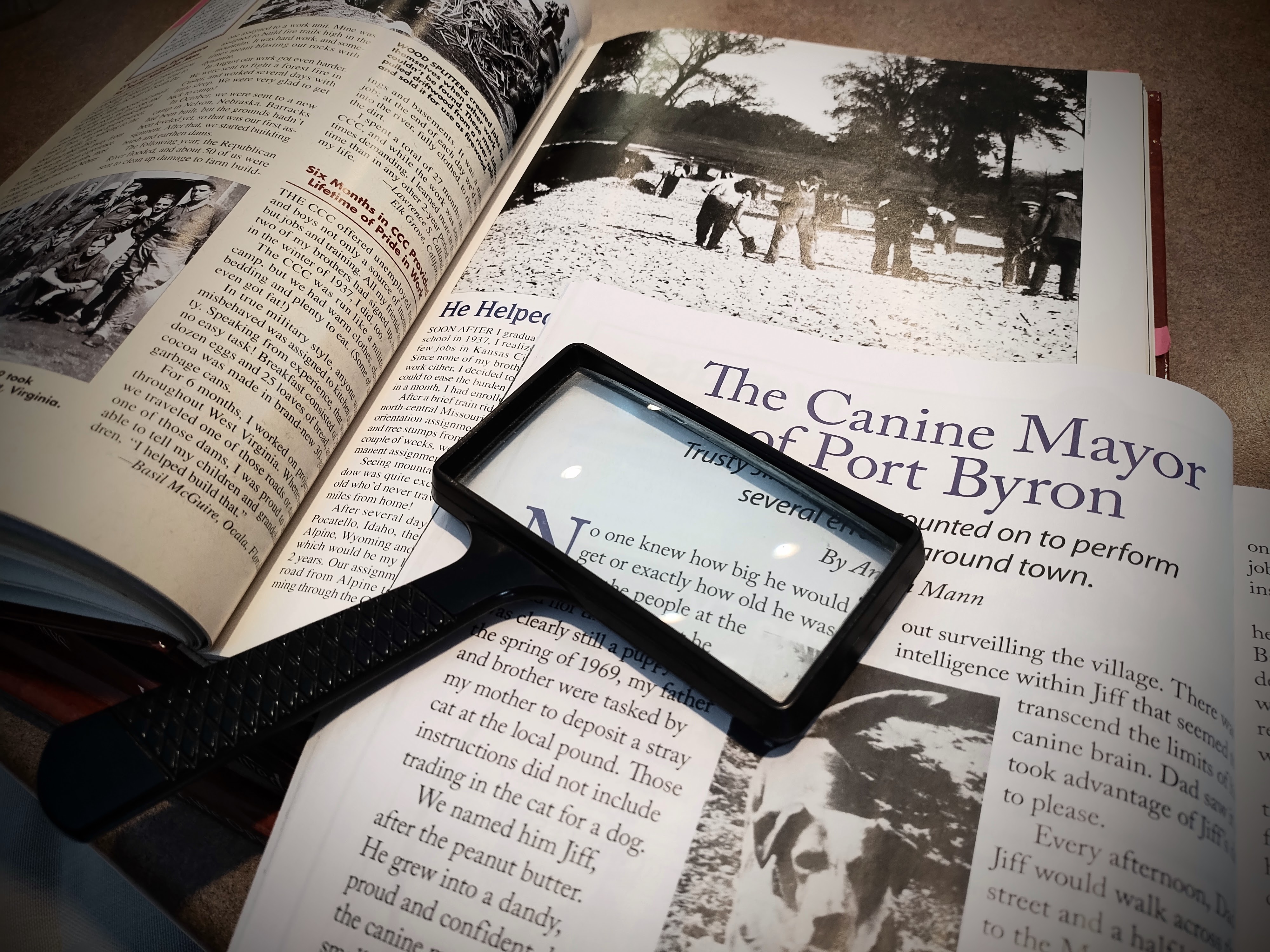
Thankfully, the editors saw fit to compile collections of some of the most pertinent stories and themes. The aforementioned Great Depression and WW2, but also kitchen memories, school days, automobile stories, family time, and women’s contributions in the 20th century, among many others. I highly recommend them as a resource, especially for teaching young ones about daily life in the first half of the 20th century.

Good Old Days magazine is another wonderful resource, happily still in print. It started well before Reminisce, back in 1964, and has continued to provide a space for older folks to process and preserve their memories of the past. That’s a big asset for us. These aren’t celebrity stories or government figures “crafting” their legacy, but rather regular people who learn a lesson here and there that they’d like to pass on to those who come after them.

The publishers of Good Old Days also produced books of submissions compiled into topical themes: cooking, school, farming, thrift, WW2, pets, religious culture, entertainment, small town social life, and so on. I consider these “oral” histories even through they are in print because they are the kid of thing you would hear if you could take the time to sit down and listen to someone over a cup of coffee as they sift through their life experiences. Oftentimes what comes out is profound, touching, sometimes a little raw, but generally a resurfacing of the good times.

Both series are available through Amazon, Ebay, AbeBooks, and the like, usually for around the five-dollar mark.

How to learn from a nostalgic history gateway

I’ve written in the past about history gateways. Avenues that pique our interest and help us to understand and envision the past, thereby learning from it, such as historical fiction, movies, documentaries, museum exhibits, old movies, old time radio, etc.

Compiled histories from nostalgia magazines are another such gateway. They are fun to read just for the sake of hearing someone else’s tales of life and are often amusing, but to really get something out of them, we need to relate it to our lives now. Here are four ways to do that:

  1. Have I ever experienced, in my life now, something like the story I’ve just read? What did I learn from that?
  2. How similar or dissimilar is my life now from the way they lived in the story I just read? For example, did they have running water? If no, how would I have adapted if I’d lived back then?
  3. Did they have other similar or different technologies in the past? If different, how might they be the equivalent of things we have now?
  4. How did the person telling the story learn from whatever it was they experienced. Did it make them stronger, sadder, happier, wiser, or more determined, etc.? How did it help those around them? What would I have learned and how would I have applied it?
  5. What skills did they have then that might be useful for me to learn now?

There are many more possibilities!

Sometimes stories will inspire us to make a living history experiment. Maybe we’ll cook a meal with recipes used during the Great Depression, WW1, or WW2, etc. Or perhaps try one of great grandma’s recipes. Or even build a toy like one described from long ago.

I’m directing a lot of these suggestions at young people and parents with kids (and these history compilations are great resources for home educators), but really, when it comes down to it, we all have a little youthful curiosity within us. Applying it in this way can make the study of history an active and enjoyable intellectual pursuit!

Keep thinking history!

Sources: Good Old Days: We Survived-And Thrived, Editors: Ken and Janice Tate, House of White Birches, 2003.

We Had Everything But Money, Editor: Deb Mulvey, Reminisce Books, 1992.

When the Banks Closed, We Opened Our Hearts, Editor: Mike Beno, Reminisce Books, 1999.

The above are available at Amazon, Ebay, AbeBooks, and other used-book resellers, along with many other titles from both series.

All images are property of Amanda Stiver, unless otherwise noted. Please do not re-use without permission.

Gold Rush Stagecoach: Black Hills Transportation Time Capsule

In a small, local used bookstore, I came across an old paperback book with this peppy title: The Cheyenne and Black Hills Stage and Express Routes. Written by Agnes Wright Spring, a renowned historian and journalist from Wyoming and Colorado, who wrote prodigiously on topics of U.S. Western history. She was a trail blazer and the first woman to graduate with a civil engineering degree from the University of Wyoming, among many other accomplishments.

The small but lengthy volume, published in 1948 with all the attitudes and perspectives of that time, gives an impressively complete history of the establishment of the Black Hills Stage Company (1876 to 1887), and a history of the Cheyenne-Deadwood Trail. Spring drew on the accounts and diaries of those who were eyewitnesses to the events of that time.

Road agents and Shotgun Messengers

In particular, the chapters on the robbers, horse thieves, and highwaymen who plagued the stagecoach line with holdups for several years, is just as exciting as the “B” westerns of yesteryear. They really did stop the coaches, rob the passengers, and make off with treasure chests or the mail. Even more impressive were the band of “shotgun messengers” who were employed to stop them, and sometimes, to follow their trail, recover the loot, and bring them to justice.

One of the original Deadwood stagecoaches used in the Buffalo Bill Cody Wild West Shows. Pictured here at the Buffalo Bill Cody Center of the West in Cody, Wyoming, June 2019.

No wonder there were so many westerns made in the first half of the 20th century. These kinds of events were well in living memory for many people, and to see them portrayed on the big screen was less about fantasizing a different era, and more about reliving a very familiar past.

Likewise, strong men of sterling character, another feature of early 20th century western movies, was an ideal also based in example. There are many names, but one whose reputation features throughout the first seven years of the eleven-year history of the Cheyenne and Black Hills Stage Line is Luke Voorhees. He was superintendent out of Cheyenne for the entire line up to the Black Hills. He traveled thousands of miles checking on stage stops, trouble shooting, and at times helping to track down miscreants.

He’s quoted as saying, “A man likes to be a creator of circumstances, not altogether a creature of circumstances.” A glance at his picture in the appendix of the book gives the impression of a piercing gaze and the strong features of a man who stuck to his principles. And that was essentially his reputation.

Reputation was a valuable commodity in that age and was defined by your honesty, moral integrity, and faithfulness in carrying out a mission with which you had been entrusted, even to the point of your own hurt. Not a bad ideal.

Stocking the trail

Another notable focus of Spring’s tale of the stagecoach business is the supply side. We probably do the same thing now, we fuel-up our vehicles and take off for our journey without really paying attention to the supply chain that brings the fuel to us, whether gas or electric current.

View of the Buffalo Gap into the Black Hills. Looking north from Oral, SD, 2020.

We notice when prices go up, or when policies dictate switching from one kind of fuel to another, gas vs. electric, etc. But usually, we get into our wheels and set forth, not dwelling on the truck that brings the fuel to the station, the men who drive them, the tankers that supply them, the refineries that make corn into ethanol or crude oil into gasoline, and so on.

The same was probably true of those traversing the stage lines in the 1870’s, too. Little did they dwell on the exacting specifications necessary for production of the Concord coaches back in New England, whose familiar rolling, swaying gait swept across prairie and mountain valley. Or the many thousands of head of horses necessary to have two or three teams of six horses ready at any given stage stop to replace the weary equines that had brought the coach in. Nor did they dwell on the many endless details of supplies needed to keep the stage stops open and welcoming to feed and house passengers. But they did notice if they had a good meal and night’s rest, and felt safe on the road.

Even the details of the treasure coaches, while probably more fascinating to the public via the lurid tales of coach robberies and outlaws that circulated in pulp magazines in the American east, and certainly interesting to the thieves themselves, were lost on the citizenry whose daily and weekly mail was anticipated and whose banknotes and gold were shipped hither and yon via the coaches. They expected the mail to get through somehow, but they probably didn’t know what the exact specifications were for the “salamander”, a portable, green iron safe, or “the Monitor”, a steel reinforced stagecoach.

For a map of the trail, this article from Ridermagazine.com gives a good approximation based on modern roads: https://ridermagazine.com/2019/12/20/stage-route-to-deadwood-tracing-a-historic-route-to-the-black-hills/

Tools of the road

Another essential aspect of the stage business were the drivers’ tools. The proper whip, used mostly for the loudness of its crack rather than contact with horse hides, was a prized possession of each driver. His cold weather gear was essential for survival, such as buffalo skin coats, and other furs to ward off the sometimes below zero winters of eastern Wyoming and western South Dakota as the driver sat on top of the coach, exposed to the elements. A fine, warm pair of gauntleted driving gloves kept his hands from freezing.

Each detail and piece of equipment and its cost was important to the men who managed the stage line. A federal mail contract, unfulfilled, could result in serious loss of commerce, or worse, government fines. Scheduled travel has long been a story of closely guarded trails, careful meting out of supplies, and pinching of pennies where possible.

Freedom of movement

Transportation, and its other important off-shoot, freedom of movement has become an inherent right to humanity in the last hundred years, due mostly to the proliferation of the automobile. But our ability to move freely from point “A” to point “B” is a matter of complicated, interconnected planning and expense.

Taking a trip back in time can help us to better understand and place greater value on the blessings and opportunities we enjoy in the present. A virtual ride on an historical stagecoach line that flourished during the rapid and impactful gold rush days of the 1870’s and 80’s is one such trip, all due to the careful historical work of a dedicated journalist, writer and state historian.

Keep thinking history!

Sources: Agnes Wright Spring, The Cheyenne and Black Hills Stage and Express Routes, A Bison Book, University of Nebraska Press, 1948, second printing 1967. Available at Abebooks.com: https://tinyurl.com/2ckjvuz6

* All images are property of Amanda Stiver, unless otherwise noted. Please do not re-use without permission.

Facebook Blackout: When Social Media Fails Us!

Tuesday, March 5th the U.S. and other parts of the world survived a, roughly, ninety-minute Facebook blackout. One possible explanation I came across was a failure with the authentication mechanism that prevented users from logging in. But due to the outages among other social media outlets and government websites in the ensuing days, the ongoing wars around the globe, and the election year in the U.S., cyberwarfare or disruption seems a reasonable possibility.

Whatever the case, what struck me most when I couldn’t log in and kept getting an “invalid password” error, was, what do I do without Facebook and Messenger? Both of which were affected along with Instagram and other Meta products.

I realized my dependency and began the process that we all do in perceived emergencies, assess what other means of communications we have available. I had text, email, phone service, so it wasn’t a real “panic,” but, then again, I don’t have an online business that primarily uses Facebook as a contact page. I imagine those folks were in more of a pickle than personal users of social media.

I suspect, in the near future, we will be dealing with more and more of these disruptions, and probably, at some point, an all-out failure. So, what do we think about this? What practical lesson, and what historical lesson is hidden in this recent, seemingly minor, disruption?

Practically speaking, I was reminded that I need to get out more!

I’ve moved a lot, so I communicate most frequently with my circle of friends via social media because we live thousands of miles apart. Connecting with neighbors can be a daunting task for one who was born in the middle between Gen-X and Gen-Y. We seem to have a lot of conditioned introvertism and a lack of small talk skills. Nonetheless, in a time of trouble, it’s nice to know someone nearby you can call on for help.

Moving away from social media to a “real-time” existence is probably something beneficial to cultivate. Since its introduction some 15 years ago, social media has rapidly become a crutch and a source of virtual reality. But virtual reality and actual reality share one special trait, they are both capable of producing tremendous stress in our lives. It’s hard to ignore actual reality, but you can suddenly and significantly reduce virtual reality stress by simply cutting off social media. We have control over that stress.

Historically, a communications blackout sent my thoughts back to the days of WW2, when there were actual blackouts at various times in the U.S. You couldn’t use lights at home, and public streetlights were doused as well. It was limiting, but if you read the accounts of children in that era, they learned to enjoy those moments and find ways to stay entertained.

They also had only landline phones and during simulated emergency drills, which were often conducted in communities to test the skills of Air Raid personnel, First Aid and other emergency services, and volunteers in the event of a real attack, those lines were taken over by Air Raid Wardens and other official personnel. Private calls were delayed or ignored at the switch boards. People had to do what they always did, take a message, on foot, from house to house. They adapted to their circumstances and found a way to make the best of unusual times.

There’s a lesson for us. Getting off social media and cutting off virtual stress can be a very valuable tool. If we do so periodically, of our own will, then in the event of a social media failure we will have the emotional skills in place to prevent personal panic. It will take creativity, forcing us to develop workarounds, but that’s good. We need to reinstate those flexibility skills that alleviate stress.

Always find the silver lining. No social media? No problem! Spend time meditating on worthy thoughts, enjoy the silence, look outside, see what the real world is up to, pray, check in with others in real-time, read a book, sing….and, as always…

Keep thinking history!

Walking Hadrian’s Wall at Home – Why?

As the winter months in South Dakota drew near (and they are long), I realized that I needed an exercise plan. I’m an historian by education and inclination, so what better way to keep up with a fitness routine than by setting a suitable historic goal? A vicarious hike along Hadrian’s Wall in northern England perfectly fitted the bill.

Starting with a few YouTube videos produced by those who have actually walked the wall in real life, I acquired a pedometer and set a goal to cover the same mile length as the Wall, but on my treadmill over the course of the winter months. (As an update, I’m about halfway through.)

I quickly realized that to really get a kick out of the project, I would need a basic knowledge of Hadrian’s Wall and its role in Roman Britain. And for that I needed a look into Rome’s role in Britain, and, finally, a better understanding of the Roman Empire, its history and its overwhelming impact on our world, even after the fall of Rome, and through the Byzantine Empire, the Middle Ages, the Holy Roman Empire, the Early Modern era, the Enlightenment, and all the way up into our modern world, which is to say, all the way from approximately 500 BC to the present day. Our world is tremendously impacted by the Roman Republic, as well as the Roman Empire. We simply cannot avoid it, more on that in a later post.

My first book of “research” material was the Rosemary Sutcliff Eagle of the Ninth trilogy. The three volumes, The Eagle of the Ninth, The Silver Branch, and The Lantern Bearers, take the reader from the first century of Roman occupation in Britain all the way to the last days of Roman rule, and beyond. While these stories have their historical flaws, since archeological discoveries of the late 20th century corrected some of the conclusions the author makes, they are still a very imaginative and descriptive introduction to the world of Roman Britain, and they are great stories!

After reading those three books, I moved on to a solid history of Roman Britain. Roman Britain: A New History 55 BC-AD 450 by Patricia Southern came to me via Amazon as an ex-library book from Wales, I thought this was a very nice bit of historic connectivity. I will warn you, if you want to retrace my steps historically, histories written by British authors are very meaty with detail, but if you aren’t used to that depth and methodical chronological progression you might find them a bit, well…heavy going. I don’t, but I’m a full-blown history nerd.

And now I’ve moved on to a survey of Roman history extracted from “The Great Courses” History of the Ancient World: A Global Perspective taught by Professor Gregory S. Aldrete. Supplemented by the Hillsdale College free online course The Rise and Fall of the Roman Republic.

Though my college history and art history degrees took me to many fascinating places (China, Scythia, Latin America, et al), historically, I didn’t spend much time in ancient Rome or Classical history in general, so what started as a fun fitness project to keep me focused has turned into a degree adjunct.

I’ve posted a lot in the past, during the early years of my blog, about gateways to history. There are many small discoveries or curiosities that pique our interest and gradually pull us into more detailed research of any given historical event, personage, or era. Sometimes it’s an epic movie, other times a documentary, sometimes a map, travel, or even an object. So, I’ll add to that list a vicarious fitness project, which swathed in a history topic, can pull you toward a better understanding of past events and people.

Keep thinking history!

AI Rebuttal: The Gift of a Unique Mind

*Warning, dripping sarcasm ahead*

There is no other mind like your mind. Did you know that? Perhaps you’ve never thought of it in those terms, but it’s true.

Whatever your frame of belief, you were given a unique origin point in this life. Born as all humans are and from that starting point, you developed a unique individuality. There is no one else with a mind like yours. That is one of the blessings of being human, we are born with a mind to cultivate, protect and through which to be productive.

This is why I object to Artificial Intelligence applications outside of calculations (and even there, I’m not in unalloyed favor). Specifically, I object to written applications that mimic the compositions that should be the work of a unique human mind after proper education and digestion of information. Human reason.

Job displacement aside, which, historically speaking, has come with every “innovation” in technology through the millennia, to surrender your unique human mind to a fancy algorithm that extracts, swirls, and regurgitates all the thematic written material on a given topic is to diminish and demean that unique gift. (College students and professional plagiarists, I’m looking at you here.)

Could it be useful in collating information? Yes, probably, but so is a keenly cultivated human mind. Ask the librarians of old who could direct you to shelf, book, and page on a given topic. By the way, we don’t even begin to push to the limits of what our intellect and memory can do. One of the side-effects of the advance of digital technology is to deactivate human mental capacity.

Some have argued that AI and robotics are the future. A few starry-eyed digital darlings have nodded their heads in sycophantic admiration, but let’s examine the tenuous undergirdings of that robotic AI monolith. Garbage in, garbage out. A system that was predominantly developed by individuals of questionable virtue for purposes of war, and into which is fed the outpourings of humanity, written, audio, video, and mathematical, a humanity that I might mention has brought us the current climate of conflict, war, menace, greed, and would-be totalitarianism in which we now live, is going to produce an idealistic, utopian existence for humanity into the future?

Surely, you jest?

To my readers who are fans of the digital delights, I suspect I have annoyed you. Good, that shows that you are using your unique mind enough to disagree with me. Please continue to use your mind, don’t absolutely defer to technology.

To my readers who agree with me, thanks guys, but don’t take it for granted.

Often noted, in my reading on AI, is that while it is “almost perfect” enough to displace all and sundry human data center employees, content and copy writers, etc., it still requires “significant human oversight because AI generated content often contains errors”. Ya think?

Question: what is required of humans in order to detect the frequent errors in AI generated content?

Um, a unique and highly cultivated human mind that is familiar with a wide range of topics. So, in order to avoid becoming a human lemming led over the cliff by the AI pied piper (see, if you don’t recognize that I cited there, you need to look up “medieval fables and moralistic stories”), you still have to go to school, read things written by historical humanity (in order to detect the AI errors). You just can’t get off the hook and curl up in your human sized doggy bed waiting for the coming digital Utopia. Bummer, I know. (Pardon, while I wipe the sarcasm from off my screen.)

AI tends to compound human error. How do I know this? Because when enough people misspell something on Microsoft Word, it becomes an accepted common spelling of a given word and the program stops flagging it. This is a very rudimentary flaw, but you can imagine that it can be compounded as AI ventures into more complex concepts.

Are there arguments in favor of AI?

Yes, but that’s not the bone I’m chewing on today. I want you to walk into the future with shields up and sensors on “detect” (see, I can do tech-y Trekkie, too) for what is going to become an increasingly complex, and murky world full of falsehoods and fakes. Keep your unique mind activated, develop your critiquing skills and always ask the questions: Am I reading what a human individual has thought through and produced, or mere digital regurgitation? And then, is this really true?

*Note, the above was decidedly not written by or in any way AI generated.

Keep thinking history.

Photo Story: A Cup of History

Objects carry a lot of history. Each time I walk into an antiques store I can imagine that there are hundreds or thousands of people whose histories are attached to those objects. Imagine if each story was printed up and when you bought your antique, you could take home that little record of history.

The little blue cup and saucer above belonged to my great-grandmother. I never met her, but I like to imagine what kind of person she would have been and how she might have enjoyed this little demi-tasse.

What objects do you have that spur a personal history or family history? Have you written it down?

Finding A History Treasure: Kitchen-Klatter Magazine

Every once in a while you stumble upon a time capsule. Not the kind buried underground or in the cornerstone of an imposing edifice, but the ephemeral trail to which digital transfer has given us access.

My treasure is a midwestern-American publication from the year 1940 called Kitchen-Klatter Magazine. It was produced and edited by Leanna Field Driftmier, a home economist and radio personality of her day based in western Iowa.

Image: Amanda Stiver

Her sister was a founder of the 4H movement and her brother owned a seed company and dabbled in radio. Additional members of the family provided articles from themes based on their expertise, one daughter, for example was a librarian and offered monthly selections from among recently published books. Other friends supplied additional columns themed according to their professional backgrounds and training.

This was all set into the background of the heyday of the Home Economist movement, which emphasized education for women, particularly in training for developing a healthy, efficient, financially secure home. But it incorporated health sciences, consumer sciences (both of which held the meat, agricultural, and packaged food industries to quality and safety standards), fashion and interior design, sewing, vocational training, cooking and meal preparation, nursing, fitness, etc. The list goes on.

Kitchen-Klatter is fascinating to read. It’s a window into the concerns and insecurities of its time. And what a time it was, in 1940 the world was at war. The U.S. was beginning to ramp up military production, wary, rightly so, that it, too, would become involved in the conflagration that had emerged in Europe and Asia.

In particular, in the latter issues of that year, October and November, Leanna Driftmier’s son, Frederick (Ted), who had been teaching at a mission sponsored school in Assiut, Egypt and regularly sent letters home to his mother, excerpts of which she included each month, began to describe the seriousness of the war situation as it drew closer and closer to Egypt and the Middle East.

Major events, like the Second World War, often become just a dry and dusty marker on the timeline of history. We can find it hard to relate to all the battles and casualties on a human scale, so when I find these very personal accounts of how a young person felt in the midst of unanticipated danger, it helps to draw down history to an relatable level.

Ted Driftmier writes in the October 1940 issue (page 5): “Besides enduring this terrible heat, there is the reality that the war is coming nearer to Egypt daily, and it is quite a nervous strain. Every airplane that flies over makes us jumpy….The Mission does not want to send us all home for probably the school can be opened in the fall and [otherwise] they would have to bring us all back again at a terrific cost. These colleges can’t be left standing [empty]. They must carry on. We will leave only when our lives are endangered but not until then.”

We, too, are facing great uncertainty in our time, with an epidemic, with political instability, so it is, in a strange way, comforting to read and relate to the uncertainty of a previous era. We can face up and move forward, despite constraining unpredictability.

That’s a historical treasure to my way of thinking. Also, there are recipes, and practical housekeeping and gardening tips, and who couldn’t use those?

Take a moment to explore the issues of Kitchen-Klatter from 1940. The magazines are in a publicly accessible digital database at Iowa State University, and available through this LINK.

October and November 1940 are especially poignant.

Keep thinking history!

~ Amanda Stiver

When In Crisis – Head Back to the Homefront and We’ll Meet Again!

I find it notable that in times of national crisis on an international scale our (writing from the U.S. here) collective reaction is to draw on the resolve and the homefront spirit of World War Two.

Image credit: Amanda Stiver

What has sold out in stores, aside from toilet paper and vitamins? Yeast, meat and potatoes, and other staples. In a strange way, we’re self-rationing. Just as our grand and great-grandparents did during that all-consuming war in the 1940’s. People are scrounging online to learn how to make their own bread, or at least have the means to do so, and looking for other simple comfort meals much like those that people relied on to stretch their rations.

This sense of, “If I’m stuck at home, I might as well go on with life and get back to the basics” is striking.

Families are exercising together, at least in our neighborhood. And neighbors are trying to keep a healthy distance, not unlike the way neighborhoods used to make sure that everyone had their windows blacked-out as an air-raid precaution. If we’re all in this together we have to take a care for those around us.

What else has sold out? Vegetable seeds! Can you believe it?! It’s like there is an instinctive need to plant a Victory Garden deep down inside us, despite being several generations away from WW2. Those who survived the war are in their 80’s and 90’s, yet this collective sense of history has reached all the way through the years of trends and revisions to visit their children, grandchildren and great-grandchildren.

On the dark side, we also have hoarders and black market-style price gougers (individual and corporate, and mostly online). The good and bad of the WW2 has a tendency to repeat itself.

The global and national nature of the Coronavirus epidemic and the fact that it, like war, is no respecter of persons, wealth, or nation, has forged a similar atmosphere as the Second World War. Totality and finality forces you to face reality.

I had the privilege of studying civil defense documents from WW2 as my undergraduate thesis, and the same kind of local pull-together was recorded for me in those memos, memorabilia, and notations. First-Aid training was a community wide-effort. Plane spotters (which my own grandparents did while living in the Cascade Mountains of Oregon) and Air-Raid wardens were a vital part of daily life.

Experts were sent out from Washington D.C. to train local communities and encourage clothing and other drives for necessities for soldiers and civilians. Avid knitters and seamstresses accomplished great things to send items to those in need over-seas, just as readily as many now are making masks to protect loved-ones, neighbors, and perfect strangers.

In the same way, industry was refitted to produce vital supplies and the phrase “make-do and mend,” which was already a part of daily life from the Great Depression, extended into the war years as production of non-essential items was stopped. And here we are with our light and some heavy manufacturing rapidly refitting to produce medical supplies and field hospitals (also a feature of WW2 and WW1).

It’s no wonder that after Queen Elizabeth II’s televised speech last night in which she quoted the lines from a Vera Lynn song “We’ll Meet Again” (made famous during the Second World War) that it, as so many things related to that historic time, has surfaced again. It’s now number 22 on the iTunes chart.

There truly is nothing new under the sun. What we experience now has been lived before, yet how we react to it will be the measure of our generation.

Keep your chin up and keep thinking history!

Amanda Stiver

More Dollars and Sense Savvy: Meal Planning from Limited Resources and One Cut of Meat

How do you take a single package or cut of meat and make it last for a whole week of meals? How many of us even think about these things anymore?

Photo credit: Amanda Stiver

The coronavirus crisis has made it cross minds again, and the best place to look is back to the 1930’s when salaries were low, if they existed at all, and homemakers (or women who worked from home before it was cool in this moment of history) used strategic planning to eke out the last bit of everything.

One account goes as follows:

“My husband graduated in the late 1930’s…He was finally able to land one [a job] and after we figured out our weekly budget, there wasn’t much left over for food shopping…To get the most for our money, I shopped at the two markets in our neighborhood to get the best price on staples, vegetables and meat. To stretch the meat…I came up with a strict schedule. I’d buy a round-bone pot roast and cut out the largest portion for our Saturday night dinner… I’d serve more of the same on Sunday. Monday’s supper would be hot beef sandwiches and gravy…”

On Tuesdays the author, Lucella Bowman, would make stew from a small portion of the original roast. Then Wednesday was meat pie made from leftover roast and stew with a biscuit crust. Friday was soup from the round bone she’s cut out earlier and leftover vegetables.

This short memory was from page 157 of a recipe book called, Dining During the Depression: The simple-yet-satisfying foods that saw families through those tough years. Edited by Karen Thibodeau, it was published in 1996 by Reminisce Books.

Just as in the above, one of the best places to search for old time common sense and home economics wisdom are in nostalgia magazines. Titles such as Reminisce and Good Old Days both also publish topical books on everything from the Great Depression and the Second World War, to kitchen traditions and entertainment.

If you come across one of these, nab it. They are oral histories in writing, full of practical lessons drawn from personal, historical experience.

Lucella’s account is a prime place to mine some practical tips:

1. Keep a weekly/monthly budget, and budget for food.

2. Shop around for the best deals, and use your consumer skills to make a limited budget last.

3. Buy mostly staples, milk, eggs, cheese, butter, flour, sugar, spices and seasonings, vegetables (fresh, canned and frozen), and meat. You can make an amazing number of variations with the basics. There is a learning curve, but it will be a savings and a newly acquired skill set.

Notice: I didn’t include fruit, which is now much more of a staple than it was then due to out- of-season availability and shipping. During WW2 in England, fruit was often rationed to go first to children and invalids who needed the readily available Vitamin-C the most. The rest of the population was admonished to get their vitamins and minerals from vegetables instead, and there were a surprising array of “substitutes” for fruit such as carrots for oranges, and so on.

4. Stretch your meat by planning a week’s worth of meals off of one large roast. The author does a great job of outlining how this is possible. Use up leftovers, don’t throw them out. Extend them into a new dish with added vegetables and crusts. Don’t throw bones away…the current fad of bone broth should teach us this. Cook them into a stock and make soup! You get not only protein, but collagen.

5. This is an unspoken lesson, but have a set of simple go-to recipes that allow you to make these variations in a flash. Save the more gourmet or finicky recipes for when there is more availability, or in our case, mobility and variety! Challenge yourself to make things last!

So there we go, one small oral history provides all of these useful lessons. You can do this from a variety of historical accounts and on various topics. Find the lessons and carry them with you into your daily life!

Keep thinking history!

– Amanda Stiver

Dollars and Sense Savvy: Cut Up Your Own Meat

We live in an unprecedented time, a pandemic from a novel coronavirus and resulting disease, COVID-19, has nations advising their citizens to work from and stay at home until further notice. This is history in the making, and not far removed, just over a century from the last world-impacting pandemic, the Influenza epidemic of 1918 that followed close on the heels of WW1.

The author, apron on, read to get down to practicalities!

But I don’t really want to focus strictly on big history for the moment, but rather domestic history and frankly, the practical lessons thereof. What do you do when store shelves are running out from the depredations of panic shoppers, and you can’t get the pre-packaged foods you’re used to?

Home economics/Depression-era savvy to the rescue! The home economics movement taught, mostly women, how to take advantage of common sense when shopping to be a good consumer, and get the best deals and therefore most mileage from your income.

Likewise, the Great Depression taught people that wastefulness was a dirty word. When you can’t easily go out and buy a replacement the next day, you make do with what you have. In the same vein, wasted food thrown out is wasted money thrown away.

After visiting the local warehouse club store today for provisions, my mom noticed that though most of the frozen meat was sold-out (the Sunday rush, we presumed) there were plenty of larger-size packages of fresh beef and chicken, still there, looking for a hungry home.

As we reviewed the collective wisdom of both my grandmothers, we realized that the only thing standing between a fresh package of meat and a deep-freezer was a sharp knife, a little slicing know-how, and a freezer bag or two.

From one big package of beef round roast we got two good-sized steaks, one medium roast, and a package of stew meat. Then we sharpened the knife because there is nothing more creepy-crawly than trying to cut up fresh meat with a dull edged blade.

From a package of giant chicken breasts (4 to a pack) we got a gallon bag of chicken cutlets. Again, with the sharp knife.

Divvied up into freezer bags and marked with the date and store we originally bought them at, into the freezer they went. And the cost was substantially lower then buying the pre-frozen variety.

My grandparents and many of their generation who dealt with a pandemic (1918-1921), a massive economic depression (1929-1940), and a second World War (1941-1945) had a “can-do” outlook, rather than a “do-for-me” attitude. We’ve been used to a culture of “do-for-me”, but it’s actually extremely empowering to take back some of that being done-for and turn it into, “I can do this!”

Even something as simple as cutting up some of your own meat or getting back into the swing of pantry cooking. These are little steps, training wheel into a different mentality, but they can make a dollars and cents difference!

[If you care to comment: What kind of dollars and sense savvy and practical considerations have you drawn on to make the best of difficult circumstances?]

Even during this crisis the past is full of practical lessons that can teach us how to react to emergencies in the present.

Keep thinking history!

-Amanda Stiver