Gold Rush Stagecoach: Black Hills Transportation Time Capsule

In a small, local used bookstore, I came across an old paperback book with this peppy title: The Cheyenne and Black Hills Stage and Express Routes. Written by Agnes Wright Spring, a renowned historian and journalist from Wyoming and Colorado, who wrote prodigiously on topics of U.S. Western history. She was a trail blazer and the first woman to graduate with a civil engineering degree from the University of Wyoming, among many other accomplishments.

The small but lengthy volume, published in 1948 with all the attitudes and perspectives of that time, gives an impressively complete history of the establishment of the Black Hills Stage Company (1876 to 1887), and a history of the Cheyenne-Deadwood Trail. Spring drew on the accounts and diaries of those who were eyewitnesses to the events of that time.

Road agents and Shotgun Messengers

In particular, the chapters on the robbers, horse thieves, and highwaymen who plagued the stagecoach line with holdups for several years, is just as exciting as the “B” westerns of yesteryear. They really did stop the coaches, rob the passengers, and make off with treasure chests or the mail. Even more impressive were the band of “shotgun messengers” who were employed to stop them, and sometimes, to follow their trail, recover the loot, and bring them to justice.

One of the original Deadwood stagecoaches used in the Buffalo Bill Cody Wild West Shows. Pictured here at the Buffalo Bill Cody Center of the West in Cody, Wyoming, June 2019.

No wonder there were so many westerns made in the first half of the 20th century. These kinds of events were well in living memory for many people, and to see them portrayed on the big screen was less about fantasizing a different era, and more about reliving a very familiar past.

Likewise, strong men of sterling character, another feature of early 20th century western movies, was an ideal also based in example. There are many names, but one whose reputation features throughout the first seven years of the eleven-year history of the Cheyenne and Black Hills Stage Line is Luke Voorhees. He was superintendent out of Cheyenne for the entire line up to the Black Hills. He traveled thousands of miles checking on stage stops, trouble shooting, and at times helping to track down miscreants.

He’s quoted as saying, “A man likes to be a creator of circumstances, not altogether a creature of circumstances.” A glance at his picture in the appendix of the book gives the impression of a piercing gaze and the strong features of a man who stuck to his principles. And that was essentially his reputation.

Reputation was a valuable commodity in that age and was defined by your honesty, moral integrity, and faithfulness in carrying out a mission with which you had been entrusted, even to the point of your own hurt. Not a bad ideal.

Stocking the trail

Another notable focus of Spring’s tale of the stagecoach business is the supply side. We probably do the same thing now, we fuel-up our vehicles and take off for our journey without really paying attention to the supply chain that brings the fuel to us, whether gas or electric current.

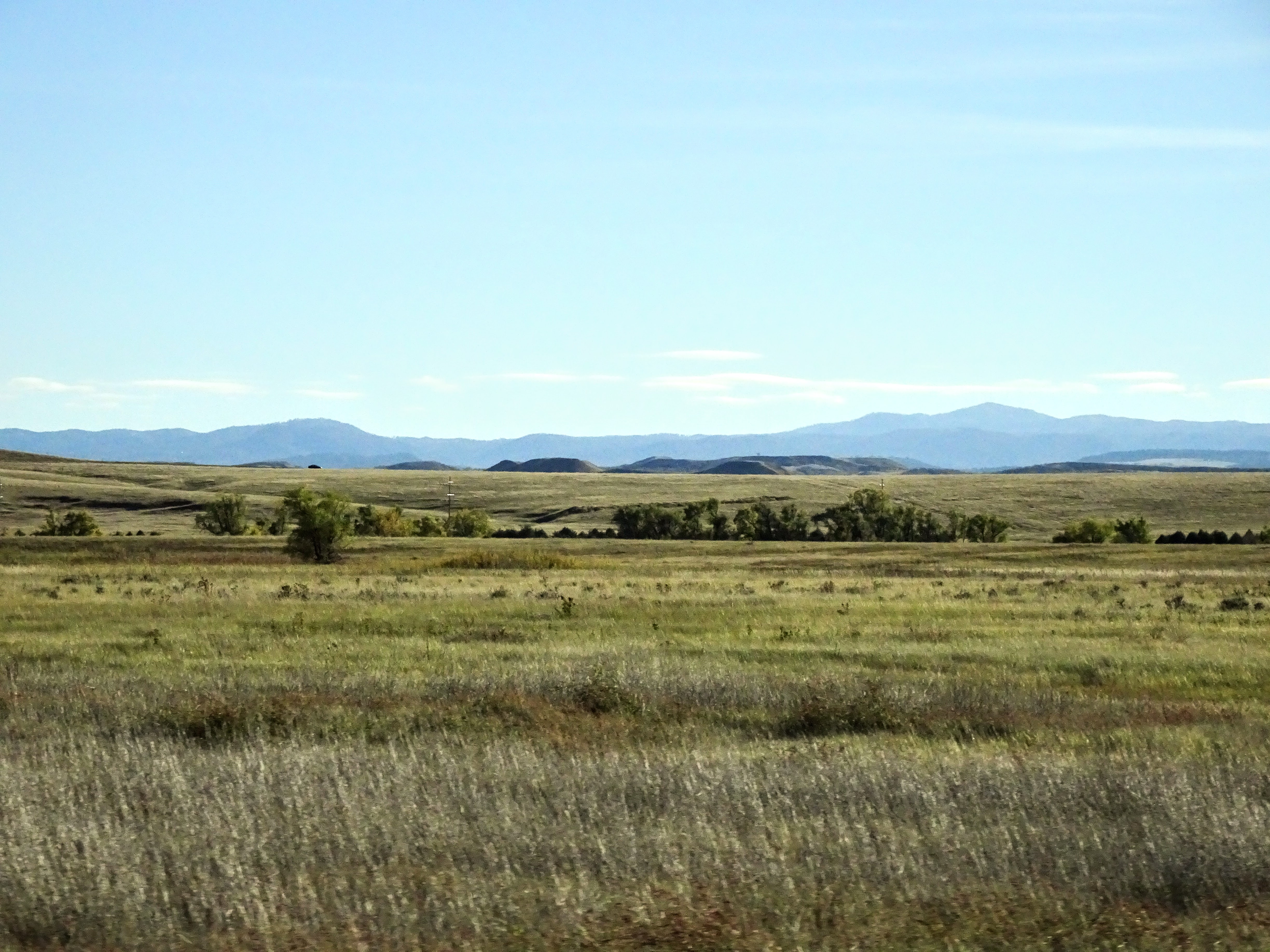
View of the Buffalo Gap into the Black Hills. Looking north from Oral, SD, 2020.

We notice when prices go up, or when policies dictate switching from one kind of fuel to another, gas vs. electric, etc. But usually, we get into our wheels and set forth, not dwelling on the truck that brings the fuel to the station, the men who drive them, the tankers that supply them, the refineries that make corn into ethanol or crude oil into gasoline, and so on.

The same was probably true of those traversing the stage lines in the 1870’s, too. Little did they dwell on the exacting specifications necessary for production of the Concord coaches back in New England, whose familiar rolling, swaying gait swept across prairie and mountain valley. Or the many thousands of head of horses necessary to have two or three teams of six horses ready at any given stage stop to replace the weary equines that had brought the coach in. Nor did they dwell on the many endless details of supplies needed to keep the stage stops open and welcoming to feed and house passengers. But they did notice if they had a good meal and night’s rest, and felt safe on the road.

Even the details of the treasure coaches, while probably more fascinating to the public via the lurid tales of coach robberies and outlaws that circulated in pulp magazines in the American east, and certainly interesting to the thieves themselves, were lost on the citizenry whose daily and weekly mail was anticipated and whose banknotes and gold were shipped hither and yon via the coaches. They expected the mail to get through somehow, but they probably didn’t know what the exact specifications were for the “salamander”, a portable, green iron safe, or “the Monitor”, a steel reinforced stagecoach.

For a map of the trail, this article from Ridermagazine.com gives a good approximation based on modern roads: https://ridermagazine.com/2019/12/20/stage-route-to-deadwood-tracing-a-historic-route-to-the-black-hills/

Tools of the road

Another essential aspect of the stage business were the drivers’ tools. The proper whip, used mostly for the loudness of its crack rather than contact with horse hides, was a prized possession of each driver. His cold weather gear was essential for survival, such as buffalo skin coats, and other furs to ward off the sometimes below zero winters of eastern Wyoming and western South Dakota as the driver sat on top of the coach, exposed to the elements. A fine, warm pair of gauntleted driving gloves kept his hands from freezing.

Each detail and piece of equipment and its cost was important to the men who managed the stage line. A federal mail contract, unfulfilled, could result in serious loss of commerce, or worse, government fines. Scheduled travel has long been a story of closely guarded trails, careful meting out of supplies, and pinching of pennies where possible.

Freedom of movement

Transportation, and its other important off-shoot, freedom of movement has become an inherent right to humanity in the last hundred years, due mostly to the proliferation of the automobile. But our ability to move freely from point “A” to point “B” is a matter of complicated, interconnected planning and expense.

Taking a trip back in time can help us to better understand and place greater value on the blessings and opportunities we enjoy in the present. A virtual ride on an historical stagecoach line that flourished during the rapid and impactful gold rush days of the 1870’s and 80’s is one such trip, all due to the careful historical work of a dedicated journalist, writer and state historian.

Keep thinking history!

Sources: Agnes Wright Spring, The Cheyenne and Black Hills Stage and Express Routes, A Bison Book, University of Nebraska Press, 1948, second printing 1967. Available at Abebooks.com: https://tinyurl.com/2ckjvuz6

* All images are property of Amanda Stiver, unless otherwise noted. Please do not re-use without permission.

Exploring Gateways to History: The Used Bookshop

Stepping into a previously unexplored used bookstore for the first time is akin to stumbling on that long lost tomb of King Whoever with the certain knowledge that inside are more artifacts of priceless historical value than you can shake a stick at. It is a place ripe with undiscovered adventures, knowledge, and surprises. It’s also addictive, so explore at your own risk, you may never find your way out!

Maybe the Indiana Jones-esque archeological connection is a bit much, but not far off. As a gateway into history (which you can read about in a previous post) used bookstores are an unmined field waiting to be excavated. Any bookstore can do the job, but used bookstores offer the advantage of old books, books out of print, and rare volumes along with the mundane. All of these are really, the fodder of history as they shed light upon a viewpoint that encapsulates the outlook and perspective of its time.

Old books are a slice of history, just as archeologists sometimes create a shaft in order to see what pieces of history are beneath their feet at a dig site, so too, is the experience of flipping through a book from fifty, sixty, or a hundred years ago. We see what people fed on, their thoughts, their concerns, their solutions for their time. These all inform the present, by the way, since those problems and solutions have become our own.

A gateway to history is something that intrigues us into wanting to know more about the past, to take a little time to study and appreciate all that came before us and to seek to learn from those successes and mistakes, problems, and stories. For some a gateway is a good biography or autobiography of an historical personage (a favorite approach of mine) since you get a compelling human story along with all kinds of fascinating historical tidbits about their time and place. Others enjoy a good historical film, with the caveat that you know the history in the film will most often be “adapted”, which means, changed, to make a spiffy or more exciting film. Sometimes a fun documentary will draw you in and make you want to know more. Maps of different eras bring up questions that need answers. Photographs of famous events or people strike up a curiosity for some.

There are many gateways into history, and as I crept carefully down the dimly lit, rather tight quarters of the little local bookshop the other day, I was struck again at the excitement and breathless sense of exploration that can emerge when you find a gateway and get set to explore. I found books that I was looking for, some that I already had, many that I had never heard of, and a few that I will have to go back again and read. I may not be able to buy them all, but knowing that little place is there to explore will rescue many a rainy day in the future!

Keep thinking history! Keep exploring!

– Amanda Stiver

EXPERIENCE HISTORY: If you are in the Massillon, Ohio area be sure to stop by the local used bookstore…

The Village Bookshelf  — 746 Amherst NE, Massillon, OH 44646

The Window of History

window

Image: morguefile.com/hamper

Sitting in my office I have a great view of the woods. I can see birds, cats, deer, my neighbors, lush deciduous trees, the change of seasons and the occasional fox or raccoon. My view out the window is never the same twice. It can be similar, but never an exact copy. A leaf moves, the clouds are different, the dappling of sunshine through leaves changes, and different creatures troll the yard.

I never get tired of peering out that window to see what’s below. Such variety is refreshing and I often turn to look out when I get filled to saturation with staring at the computer.

Window of history

In the same way I never get tired of peering through the window of history. Okay, sometimes I do get tired of the same historical subject. So I solve the problem, I rotate subjects. On the whole, though, I don’t get tired of history. I find that a trip back in time via a well written history book helps me to see the present more clearly.

According to the StrengthsFinder program this is a particular trait called “Context.” StrengthsFinder is a workplace personality testing program that helps users find out how to use their strengths in connection with others.

Context is the use of a knowledge of history to see how that past shapes people and events. The ultimate goal being to anticipate what may happen in the future. According to StrengthsFinder it is also a way of relating to other people by empathizing with how they came to be the way they are.

Thus history becomes a window into not only the past, but also the future.

Back to the future!

I have been on a recent stroll through the boulevard of history, peering into various centuries and cultures as I go. It’s really a form of historical tourism, only you learn stuff and don’t pay as much as you would for a third-rate hotel room assigned to you because of over-booking.

Since the beginning of the year I’ve been to ancient Greece, the American Civil War era, the Revolutionary War era, and I’m just beginning a look into the history of the City of Jerusalem. Each book is a window, allowing me to see into the past with an eye open to the potential of what may come in the future.

What have I learned?

People haven’t really changed much despite centuries and millennia of existence. The window dressing may be different, but human motivation, greed, lust, anger, jealousy… are still the same and they still are at the crux of what turns the tide of world events.

So what window of history will you peer through today? What will you see and how will it affect your understanding of the present and the future?

Keep thinking history!

– Amanda Stiver

The Boundaries of History: Mountains

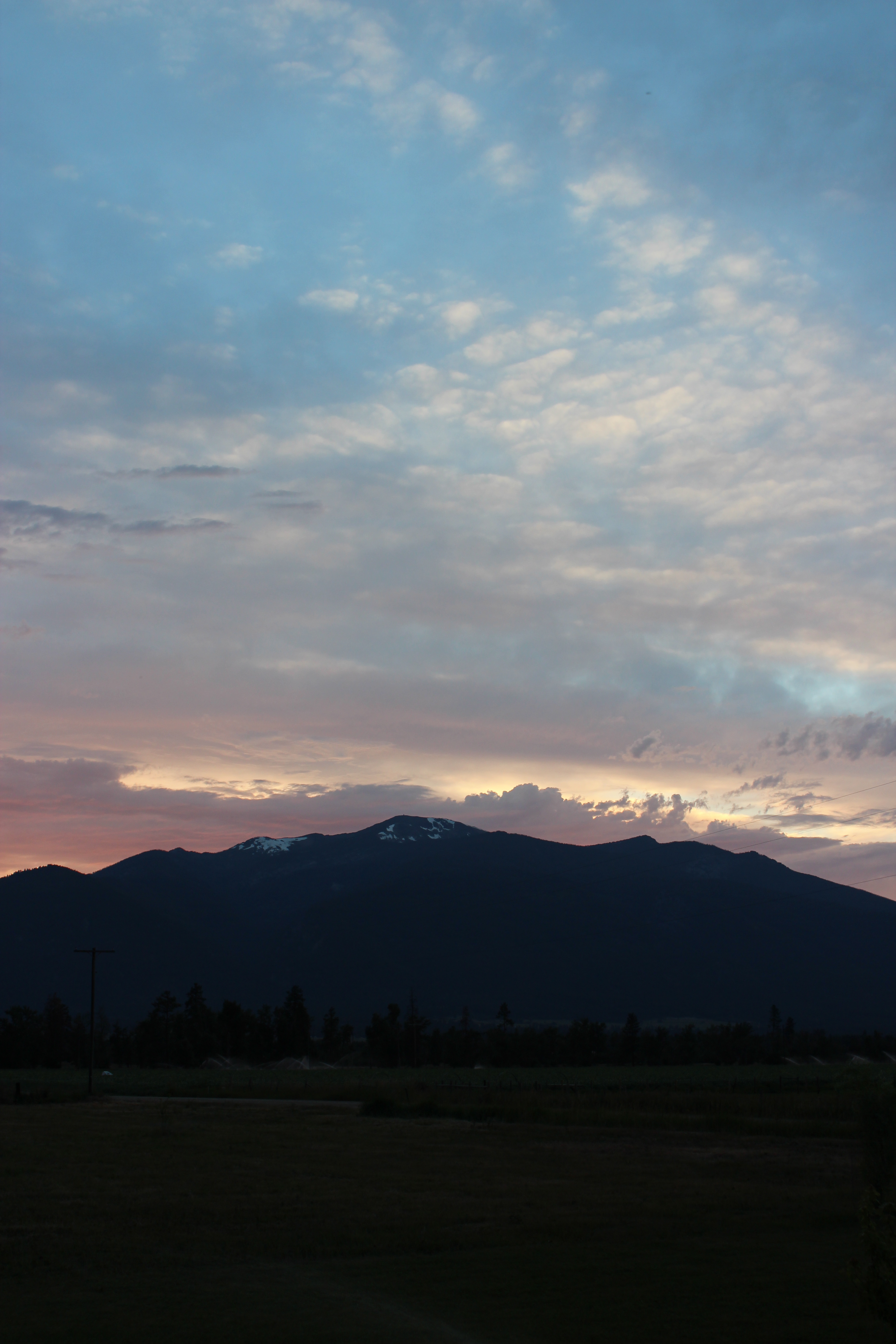
(Image: Amanda Stiver)

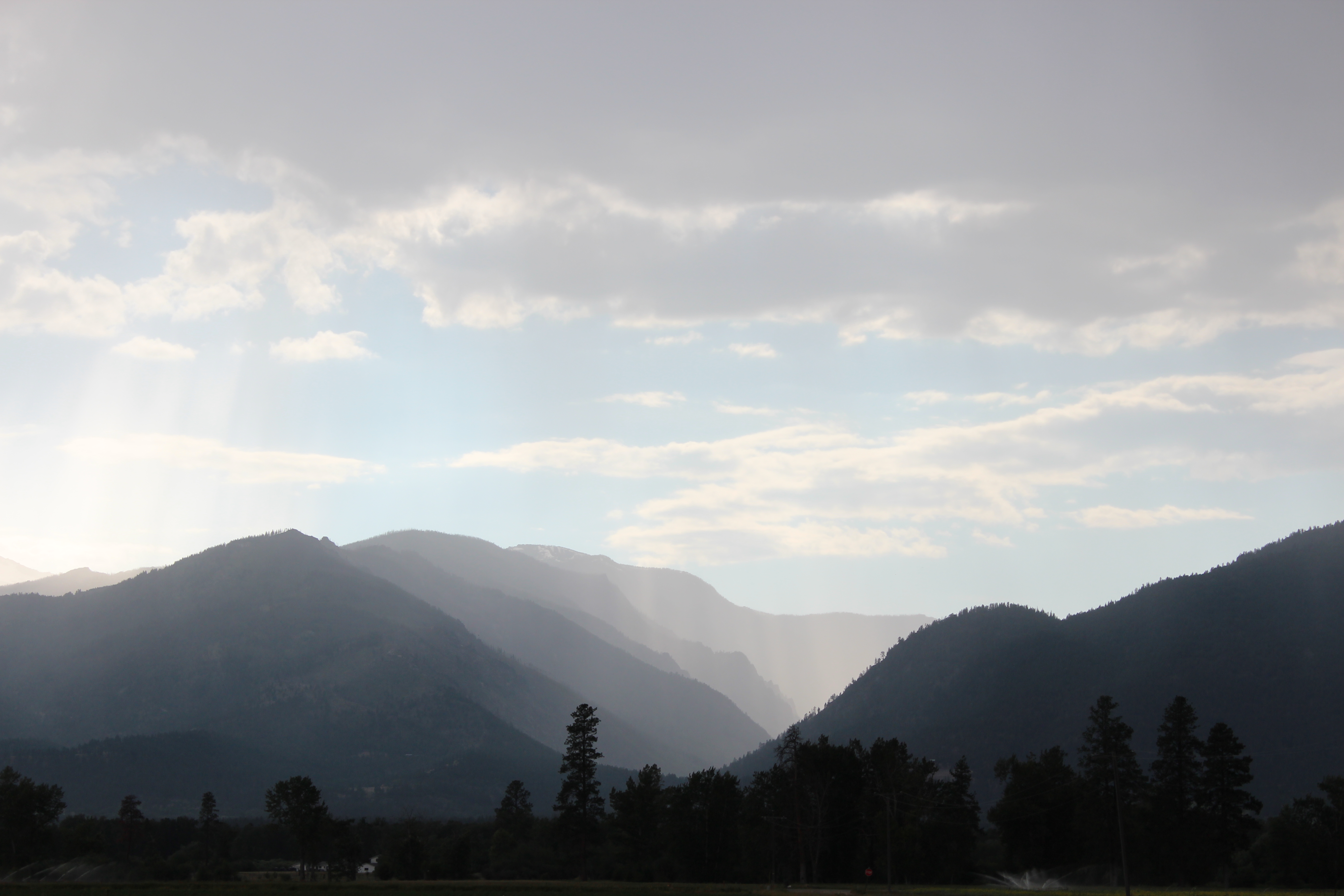
I’m watching a storm break over the Bitterroot Mountains. It’s a spectacular show of grays, blues, greens, and a touch of white off and on. Almost as spectacular as the sunset I watched over the same mountains a few days later. I live in the Midwest in a house among grove of trees and I rarely get to see a solid sunset, just a tint now and then, so watching the mountain version on my visit to Montana was worth the wait.

Mountains. What can I say about them? They are solid, craggy, and looming. They get in the way, they make people go around them and occasionally, they spew lava and pyroclastic muck.

They also make history. For without mountains, the conflicts, borders, traditions, and cultures of our human history would be something completely different. If it were plains all the way around, history would probably look like a glorified game on a chessboard.

(Image: Amanda Stiver)

Kings and their armies would charge across and gain a few miles, and then the opponent would charge over and take them back. Like an endless replay of the trenches of World War One. It takes a lot of manpower and materiel to gain and hold an indefensible flat space. It’s harder to take a mountain fortress, but easier to hold it.

Mountains have shaped us. Mountains and rivers and plains and valleys and oceans. They still shape us.

“And He has made from one blood every nation of men to dwell on all the face of the earth, and has determined their preappointed times and the boundaries of their dwellings,…”

Food for thought.

Keep thinking history.

– Amanda Stiver

Wall Drug: An American Experience

I’m back in one of those tourist haunts that helps define the geography of my life. That sounds a lot more romantic than it is. I’m in Wall, South Dakota, at Wall Drug, a strip of western themed tourist trap that is a true tribute to the effectiveness of billboard advertising.

(Image: Amanda Stiver)

When Ted Hustead and his wife moved to the town of Wall to operate their drugstore back in the 1930’s, they latched onto the idea of using billboards to advertise their wares to weary and thirsty passing tourists. If you have ever taken Interstate 90 across the state of South Dakota, you know what I’m talking about. You can establish your relative location in the state by the sheer number of “Wall Drug” billboards that stack up in herds along the freeway.

Selling the goods

The funny thing about it is that it actually works. After 1,200 miles of seeing Wall Drug signs, people become, quite naturally, curious. Even people like me who have driven these roads to see family so many times I can watch the scenery (or sometimes lack thereof) pass through my visual memory with my eyes closed. Familiarly provides no immunity to the lure of Wall.

(Image: Amanda Stiver)

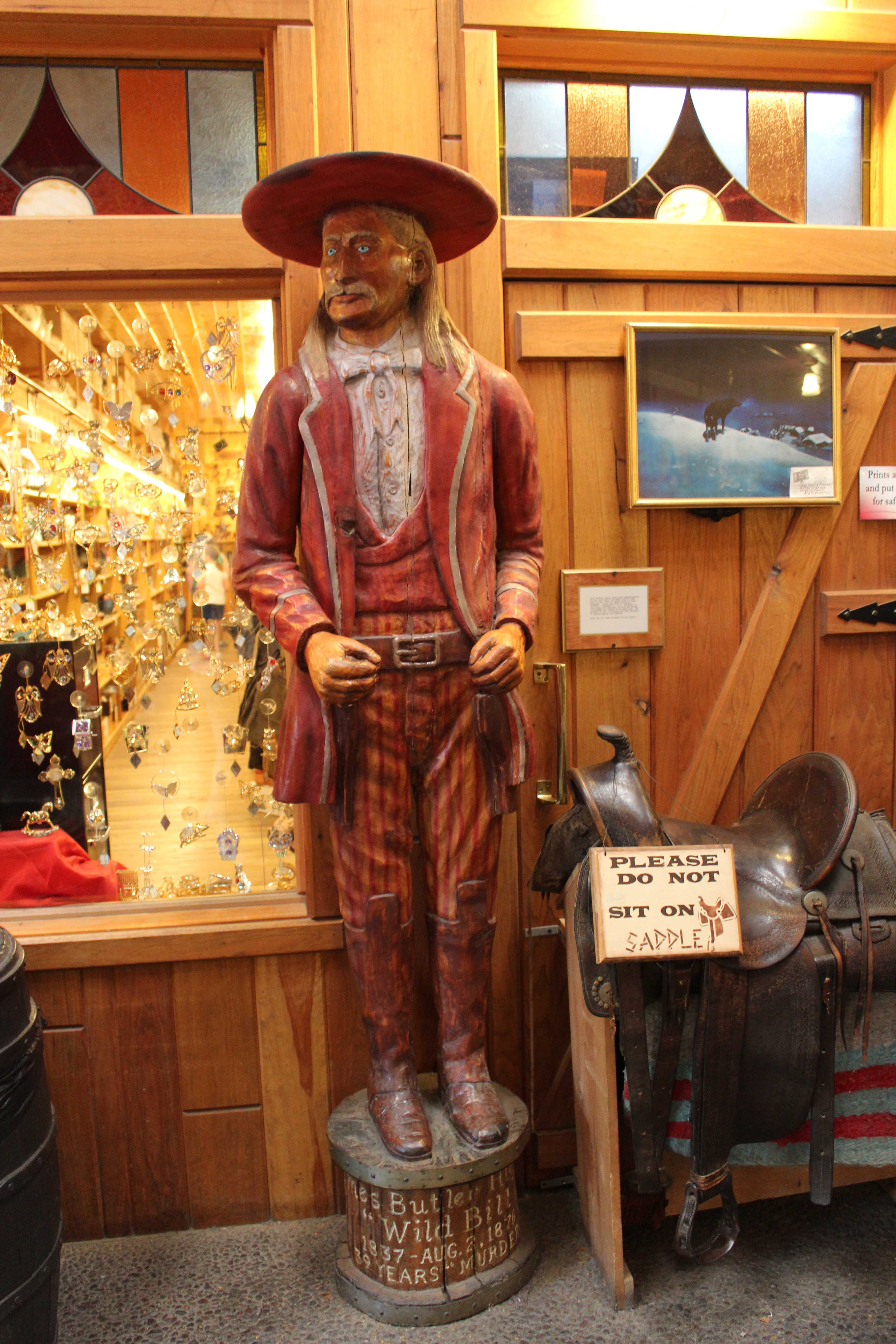
I think this is because Wall Drug, despite all the tourist adverts and schtick, provides things that tourists naturally crave – restrooms and cold liquids and ice cream. That and a nice bookstore and some quality western art. It also provides the myth of the west, with wooden cowboys and gamblers lurking in the halls of the indoor street. The complex has grown over the years, but the core is comfortingly familiar.

My last visit was 15 years ago, and by and large it remains the same. Families roaming the halls, ice cream in one hand, camera in the other. People taking a pit stop before continuing on to Mt. Rushmore or the Badlands. Just as I did on my visit years ago I bought a book, a definite step up from my initial visit when I was small and craved such sundries as cute little dolls dressed as western characters.

Questions raised

There is something plaintive, too, about a place like Wall. It raises questions: How long will tourism last in a tough economy? How long will we even recognize the quaintness of such a place? What does the future hold for a country whose younger generations know only a caricature of the history of the American West?

(Image: Amanda Stiver)

Maybe part of the answer is in that history of the peoples whose collective experiences made the West great. Where ideals of hard work, faith and justice, side by side with hardship and struggle fill in the spaces of the Western Myth of gamblers, claim jumpers, and outlaws.

If you’re in South Dakota and need a cool drink on your parched journey, stop at Wall and contemplate these questions and maybe you’ll be the one to find the answer.

– Amanda Stiver

Book Me: Keeping History Real

This scowl could only be saying, “Interpret history for yourself!” (Image: Morguefile.com)

Some days history comes alive and some days it stays comatose. Why is that? Why does one subject or exhibit or picture, etc, spur a curiosity in the past and another makes voluntary dental work sound like fun?

I had one of these moments at an interpretive center the other day. I can’t call it a museum because museums tend to emphasize collections of things as is, without intensive interpretation.

This location wasn’t bad, but there were a lot of ambient battle noise recordings that could have been a couple of decibels lower. That coupled with an audio playback of each written display in tight quarters resulted in a cacophony that made me want to leave rather than immerse myself in history.

On the other hand, it might have been me because I was tired out from a long couple of days of filming, so I wasn’t in a very receptive mood. However, on the road home as I read the short pamphlet about Fort Necessity in southwestern Pennsylvania I really got into the subject. Who knew that a multi-thousand dollar interpretive center would fail to inspire where a 50 plus cent sheet of folded paper with a few paragraphs would?

This is the dichotomy of history and of the use of interpretive centers, which are more and more replacing old style museums.

Is interpreting history wise? Should not each one of us have a chance to examine the facts unimpeded and come to our own conclusions?

What if the bias of the interpretive center is wrong? Are you really teaching history or are you perpetuating an opinion?

Probably both. We must interpret, and any teacher of history, no matter how much they try to avoid it, is interpreting the subject via their own personal bias to their students. That’s part of being human.

Developing a personal curiosity into history can help each of us interpret the facts on our own. If an exhibit fails to enthrall you then dig into some books on the subject. You might find the angle that eluded you and develop a whole new area of interest.

Keep history real!

Amanda Stiver

Fun at Fort Ancient

In southern Ohio, just north of the city of Cincinnati is a fort that is technically not a fort, but that might have been a fortified settlement, but we don’t know for sure.

The pink shape on the left shows the outline of the Fort Ancient earthworks.

Welcome to the world of mound culture history. There is so much that is unknown about the culture of the builders of these earthen mounds that even authorities on the subject have to qualify almost everything they say. We do know that these mounded earthen structures were carefully constructed by carrying soil in woven buckets to each site. And the sites themselves are scattered from Wisconsin to Louisiana, but particularly in Ohio

The earthen mounds of Fort Ancient, which is located near Oregonia, Ohio, were built between 1 and 200 A.D. according to the handy posters located on the grounds of the state park. They were built and inhabited by the Adena culture until about 500-600 A.D. (if memory serves). At this point their culture seems to have faded away.

More is known about the Native American cultures that also revere the earthworks, but their exact relationship to the original builders is still clouded. A Native American village in the area dates from 1,000-1,200 A.D. and American Indian settlements in the area continued from then on until the well past the arrival of European explorers.

Field trip

Touring the grounds of Fort Ancient was instructive and illustrated to me the immense size of the earthworks complex. The mounded earthen hills themselves range in height from about 6-7 feet tall to 20+ feet or more.

What the area was used for is another one of those unsolved mysteries. Archeological digs are in progress to help understand more about the area and its purpose. It could have been important for a number of reasons. The digs hope to prove that as a spiritual center there is evidence of an astronomical connection to the location. It might have been a setting for social or religious rituals. Perhaps a burial site or even a settlement, or maybe all of these combined.

Other similar earthworks in the region appear to have served a variety of purposes, so it will depend on future research and archeology of the locations to confirm their actual uses. The Adena culture didn’t have a written language, unless evidence of such simply has not yet been found.

If you have a chance and are anywhere near Ohio come check out Fort Ancient. There is a museum on site and other educational activities. The grounds are accessible by automobile and there is also a walking trail, which gives you a closer look at the location.

For more information visit www.fortancient.org

Happy history travels!

– Amanda Stiver

English is Two Languages

You can learn a lot about a person from the way they speak. You can learn a lot about a country by the language they use. In this case, by the language that is shared by two countries.

The English language is named for its country of origin, but it is shared with in use by England’s rebellious former colonies, The United States of America. That said, we really don’t speak the same language. Particularly our idioms and slang. We may spell a word the same, but that doesn’t mean we grant it the same meaning.

Perusing my copy of British English A to Zed by Norman W. Schur and Eugene Ehrlich proves elucidating.

I have heard of kerfuffles before, but didn’t realize it was a British word for a fuss, commotion or dither. Fascinating, although I rarely hear Americans use the words commotion or dither, perhaps fuss.

Girl Scouts are Girl Guides in Britain and oddly enough if you get in a kerfuffle in your troop you might get up someone’s nose! Or in America, get in someone’s hair 0r on their nerves.

A publican sounds vaguely Roman, but it really just means saloon keeper. A puncture isn’t a medical state; it is a flat tire on your car after you’ve been motoring on rough ground.

A spate is a flood of something or other. And a shout isn’t something you do after you’ve had too much alcohol, but is instead the word used for treating others to a round of drinks.

So here’s to speaking a foreign language that you already know!

Cheers!

– Amanda Stiver

Roamin’ with the Romans

I recently acquired a thin volume called The Romans and their Empire, book two of the “Cambridge Introduction to the History of Mankind” edited by Trevor Cairns.

I have lamented my lack of detailed knowledge of the Classical world and I started to remedy that by reading a volume on the Athenian Navy. Rome was also in my sights, not unlike the Visigoths of old, and now, thanks to this little jewel of a book, I’ve begun to put Roman history in its place.

Little book, big info

What I like about this volume is its short length and the breezy way history is presented. I’m guessing the target audience is a 13-15 year old or an adult history novice. It doesn’t mire itself in boring analysis, but it does demand at least a working knowledge of past events. Expectation is a good thing, it makes us strive to achieve more, in this case filling our minds with the outline of human history.

The book is illustrated with photographs of ruins, reconstructed models of Roman life, maps, and some great little cartoonish illustrations of various events in Rome’s history. It goes by quickly, but is a rather nice outline of the Roman past from Republic to Dictators.

Wherever you Rome…

What I’ve learned so far is that Rome was founded back in the 700’s B.C. and developed its form of representative government around 510 B.C. Gradually it conquered and collected the various tribes around the Italian peninsula into a relatively cohesive smallish empire.

Apparently the Romans treated their subjugated peoples better than the Greeks had done. If you lost to Greece they could, on a bad day, kill your entire population, or maybe just the adult males, and on a good day simply sell you into slavery. The Romans were nicer, they didn’t kill you as they knew the value of positive relations and the wealth that functioning subjugated peoples could bring them.

The Romans even tolerated a certain amount of religious freedom, as long as you weren’t a troublesome Christian, Jew or a Celtic Druid. But alas, their republic couldn’t last forever, as it seems, can any modern republic of which we see evidence each day in the United States. As the empire expanded the power of the people shrank.

Et tu Rome?

In 46 B.C. Julius Caesar became Emperor of Rome, principal citizen, and dictator. The republic survived in form if not in deed. The senate could not thwart the will of the Emperor (more pity that) and for a while the arrangement worked as long as there was a series of good Emperors, but then they wound up with a whole slew of rotters and things got bad.

That’s the jist of the story. Good book, good resource, unfortunately out of print, but Amazon.com, BarnesandNoble.com or other booksellers probably have a used copy or two. If you want to develop a working outline of ancient Roman history without bogging down in excess information, this is your gateway. You can add the details later!

– Amanda Stiver

The Clive Cussler Effect: More Gateways to History

A while back I wrote a post about gateways to history. These are sneaky ways to get interested in history if you weren’t blessed with splendid history teachers.

It’s time to revisit. Specifically, fiction books.

How can fiction and history be mentioned in the same breath? Isn’t fiction more or less a mess of lies, accounts of things that never happened? And isn’t history, ideally, an account of things that did happen?

Yes, and yes, but fiction we are supposed to know is not true, and history, we are supposed to assume has been researched for veracity. So, how can the one be useful for exploring the other?

Fiction is fun and, for some, history is boring. Sad, but true, but if you use the fiction as a jumping off point, you get the benefit of the fun which will hopefully be carried along into the study of the history, thereby making it fun too!

The briny deep

Now for the Clive Cussler part. I just started reading Medusa, a mystery by Cussler and co-author Paul Kemprecos. The book is one of several in a series that feature the protagonist Kurt Austin, a tough, marine researcher and systems specialist.

As is often the case with Cussler books, the story begins with a flashback in history. In this case the whaling industry of the mid-19th century. Then in the present-day setting of the bulk of the book, reference is made to William Beebe and the bathysphere (submersible sphere) in which he launched himself in the 1930’s.

These are prime examples of history nuggets. They are the bits of accurate history that give a realistic touch to works of fiction. They are also history gateways.

I like to take these gateways when I’m working through a book like Medusa, do a little bit of my own research to further my store of historical knowledge. Sometimes I also want to make sure the author I’m reading is accurate, not all are as conscientious as Cussler and company.

So, the next time you pick up a piece of fiction, a favorite mystery or adventure, look for the history nuggets. If they strike your fancy, dig a little deeper, and as you travel to a different time and place in the past carry the fun with you and you’ll discover that history can be a blast!

– Amanda Stiver