The Paul Bunyans and Me

Sometimes you get the chance to draw near to your family history and often in the most unexpected ways. Yesterday I watched a tree trimming crew dispatch some overgrown pine trees from a neighbor’s yard.

A piece of large-scale logging equipment on display near Snowshoe, WV.

As the cutter scaled the approximately 40-foot tree and removed limbs as he went, I was reminded that my grandfather and uncles did this very type of work during their years as men of the forest. By trade they were loggers, harvesters of tree growth, but to say they were just lumberjacks who chopped down trees doesn’t even begin to do them justice.

The tree trimmer reached the top of the tree, supporting himself with a band around the trunk and sharp spiked boots, and secured with rope the very top of the tree, branches still intact. Still perched precariously he zipped through the trunk above him and his ground crew kept well back as the top fell to the earth with a crash. He descended and finally the bare trunk was ready to come down.

Making the connection…

I was never able to watch my grandfather or uncles at work, so my image of a logger’s work came in books, movies, family stories, and the occasional tree removal in the yard. Seeing this type of scaling firsthand helped to flesh out the stories of danger and hazard that they dealt with every day.

It also brought to mind their other accomplishments. Knowing forests are full of very tall plants and, considering that we farm by planting plants and harvesting them, you can begin to understand that logging is another form of farming. My grandfather knew more about forest life and tree ecology than I will ever hope to know. You can’t work in that environment for such a length of time without developing a clear understanding of your surroundings. Your life depends on it!

The harvesting of trees is only half of a lumberjack’s job. To harvest again in the future you have to replant and I believe the ratio is 7 trees planted for every 1 tree cut. To know how to fall a tree you must have knowledge of branch growth which can interfere with the fall and cause undue damage to you or other trees. Even then the forest is full of surprises and the best of men have lost their lives in this line of work.

Clear cutting an area is only one of many methods of harvesting; however, it is the most drastic with the most visual impact. That’s why it made the news so much in the late 1990’s when the politically correct trend was to be a tree worshipping environmentalist. Selective cutting is what you do if you want to continue to make an income from your stand of trees. A few trees, cut specifically, improve the health of the remaining trees.

By the way, woodland animals live in meadows and at the edge of the forest, not in deep, dark, densely packed old-growth stands. They need vitamin-D, too – just to knock another myth in the head while I’m on the subject.

Hat’s off…

History is like that. Sometimes you unexpectedly come across a connection to the past. You begin to better understand what happened during an important historical event or your own family history.

I’m glad I got the chance to see the kind of work my grandfather did. Thanks grandpa (and to all the other Paul Bunyans out there) for surviving all the injuries and near-death crisis inherent in your work. I wish I could have said it while you were still present to hear it.

– Amanda Stiver

Ice Cream, We Scream!

Ice cream is an American pastime ubiquitous to a hot, humid summer. And I do mean pastime – in the Midwest, in particular, ice cream stands and brands abound and elicit very strong opinions.

Whether you are a frozen custard or an ice cream purist will determine the store you patronize. National chains compete for attention with the homegrown article – and often lose! On this note, if you are ever in Ohio, visit Granville and try Whit’s – it’s excellent!

Then there are the mad scientists who like to concoct their own homemade varities. Even among this crowd is division. Are you an old-fashioned ice cream maker? Do you only use the rock salt and ice, hand cranked models? Or are you technologically advanced and prefer the self-freezing chamber versions that are electrified?

Frozen, in time

As with all my history quests, I want to know whether, and how, people made things in the past. So, what about ice cream – was it available in the days before electric refrigeration?

Well, if you’ve ever watched Meet Me in St. Louis you will discover that yes, it was, at least according to MGM’s version of the early 20th century. Ice cream was a special treat to be had in the summer, after all, who wants a freezing bowlful of cream in the dead of winter?

Likewise, ice cream and frozen custards were a specialty of the colonial era. George Washington and Thomas Jefferson were both aficionados of the tasty treat introduced to them by the French. Recipes from this era abound and their decadent sweetness was made possible by the construction of icehouses to store blocks of frozen ice through the summer (Alice Ross, “Ice Cream, a Colonial Delicacy,” Early American Life, June 2010).

Brrrrrr

Hauling ice to be stored was a going business until the dawn of electrical refrigeration. Each winter big blocks of ice had to be cut from frozen lakes, hauled to privately-owned icehouses or stored in a big, partially-subterranean barn. Packed in sawdust or straw, the ice would keep far into the summer.

Ice chips and rock salt were used to drop the temperature of the chamber in which cream, sugar, and fruit or an egg-based custard mixture would freeze. Hearty volunteers turned the handle keeping the ice cream moving in order to freeze evenly.

Finally, after all that work, was the finished product – smooth, homemade ice cream!

This is by far one of most rewarding historical re-enactments that you can pursue today – find a hand-cranked ice cream maker at a garage sale, marshal your ingredients, crank away, and slip into the past via a bowl of ice cream! Chipping the block of ice from a frozen lake and storing it all summer is up to you!

– Amanda Stiver

Natural History, Naturally

History covers all sorts of topics and usually we assume “history” means social history – the study of groups of people, the way they live, their actions, and specifically their interactions, peaceful or violent. But let’s not forget natural history.

Natural history is the study of plants and animals, the natural world. Nowadays we have more specific scientific names for all the various sub-categories. Natural history museums are in every major city and usually at every university. There you will learn about the indigenous peoples of the area (why they are tagged with plants and animals and not with human history I have no idea), geological formations and distinguishing characteristics, local animal and plant species, etc.

Pliny of this and Pliny of that

Way back when, Pliny the Elder published his Naturalis Historiae in 77-79 AD. It covers a multitude of subjects and is, according to our friends at Wikipedia, a compendium of ancient knowledge from sources and experts extant at that time relating to and drawing on the natural world. His work served as the model for the study of natural history through the centuries.

Natural history, quite naturally, relates to social history because people did and still do make their living from the natural world. Despite those nice glossy “modern” dwellings and all our digitized efforts, we still have to root around in the dirt to get our veggies and I guarantee without agriculture our societies will collapse in famine and pestilence.

Know the natural world

What I mean to impart is that it is as important to understand how the natural world really works (be careful, there are experts who purport to know and whose theories of climate, health, and ecology drawn on more supposition than fact) as it is to have a good grip on social history.

It also serves to remember that we haven’t been industrialized all that long, so knowing how the ancients and the denizens of the “olden days” lived helps us to gauge if society is moving in a positive technological direction or toward disaster.

Gateways to History: Getting Started

What makes a person like history?

Is it just a quirk of personality that leads them to be insatiably curious about the past?

Is it a family member who shared his or her own love of history?

Is it just a coincidence of factors: good books, great teachers, a need to know?

All of these things can contribute to the creation of an avid historian, but what if you didn’t have the benefit of such circumstances – are you doomed to dislike history?

Not at all! There are other gateways to history and finding yours is the challenge!

Image: Amanda Stiver

Image: Amanda Stiver

More than one way to… study history

History is stereotypically fed to students via the textbook and a class lecture. A good textbook can spur an interest in students, but more importantly a good teacher can spur a lifelong love of the subject.

I had two particularly memorable high school history teachers. They each had a different approach to teaching, but were equally successful.

One teacher taught by lecture. The good thing was that he was one of the best lecturers I have ever heard. He gave us clear instructions from the start, if you want to get a good score on the Advanced Placement U.S. history test at the end of the year, then read the textbook twice. His expectation that we would do our reading and come to class with a clue about the day’s subject freed him up to add extra material from his vast store of historic knowledge during the lecture. He could tell a great story.

The other teacher had a different approach, but was also a gifted storyteller. She was a multi-media historian. We watched videos, read textbooks, read primary source excerpts, viewed art history slides and maps, did re-enactments, had class discussions, and completed writing assignments. She illustrated to me the importance of a variety of sources and approaches that make the subject vibrant and alive!

I had other great teachers, but I think this makes clear that the best gateway to a love of history is a fantastic teacher.

Find your gate, take the path

If you don’t like history because you had bad teachers, all is not lost. Try this: go watch a movie that has an historic setting or read an historical novel. How many people who went to see 300 or Braveheart consciously thought they were going to study history – surely not many.

Movies and historical fiction aren’t perfect, but they are a kind of gateway. Ideally they should spur a curiosity into an area of history that draws you to your local library and a good book on the subject. They are highly interpretive, so by all means, if something sounds far-fetched in a book or movie – go prove the author or directors wrong by researching the subject yourself.

Let a productive curiosity be your gateway into history. Maybe you want to know more about family genealogy – research the era in which your relatives immigrated! Maybe the history of a national or religious holiday has always made you wonder about its origins – go find out! Perhaps you read a short article that was so well written it made you want to know more.

Best of all, if you are planning a trip, don’t leave until you have at least one book under your belt about the area you are going to visit. When you get there, go see some of the places you read about, make the story come alive.

Once you cross the threshold, keep your curiosity alive. Make it a challenge to find the thread that connects each historical era or subject you study or come across. Or my personal favorite, when you’re at the store and you get the total cost of your purchases, take four of the digits and try to remember what happened in that year in history. If you can’t think of anything, go home and use a search engine to find out!

Take the plunge, it’s more exciting that you ever imagined!

Reminiscing

I’ve written about using documentaries, historical journals, museums, and re-enactments to explore history, but I can’t go on without praising one of my favorite publications. It is a magazine that brings primary source history to my fingertips and reminds me of the struggles and challenges my parents and grandparents faced.

Don’t jump to conclusions! I’m not talking about WWII history magazines, archeological reviews, etc. I like those too, but they’re for another day.

I’m talking about entry-level history where even the most disinterested beginner can take a bit out of time and enjoy it.  A visual layout with great, short, first person reports on the historical past of the 20th century is the fundamental strength of Reminisce magazine published by Reiman Media Group which is a subsidiary of The Reader’s Digest Association, INC.

Tales of the past

This is the kind of history that you might hear your grandparents or great-grandparents tell if you are lucky enough to have these resources still alive. It isn’t ground breaking, never-before-seen historical research, but it is just as important. Knowing the daily details of the past and the experiences of our elders help us to live a fuller life, to respect them more, emulate the great things they did, and, one hopes, not make the same mistakes.

Magazines like this are a great teaching tool for kids and teens and a way to get them interested in history. Reminisce in particular has a surfeit of photographs, illustrations, and reprints of old cartoons and advertisements. Every issue is colorful, like having your own personal museum to page through whenever you need to fill a few minutes.

Did people really act like that?

After flipping through the past, it might surprise you to realize how degraded our current society has become. Wholesomeness is not something marketers feature much anymore. We are so used to the world in which we live that sometimes it takes a virtual journey back in time to realize how sordid it has become.

Scanning the advertisements of years past is an education in what people valued. The advertising professionals of the era designed their material to appeal to those values: wholesomeness, dignity, respect, faith, hard work, thrift, good clean fun, cleanliness, good cheer, family, marriage, the innocence of romance. From our 21st century cynical viewpoint we often see this material and think it looks hokey or syrupy. Kind of sad that good clean fun isn’t considered fun anymore.

There is one requirement when delving into this kind of historical record (or any part of the past, actually): check your modern sensibilities and put them aside, don’t reason from our contemporary perspective. Trade cynicism for a lighter approach to life in order to appreciate an era, only a few decades old, which had a greater sweetness and innocence than what we suffer through today.

Read Me A Little History…

Read aloud. Or better yet, listen to someone else read aloud. Really, try it!

Sound a little too dramatic? Seems kind of weird, maybe, because we don’t do that kind of think anymore. Or do we?

Have you ever watched a news anchor talk at you? They aren’t gabbing from memory – they’re reading aloud! Yep, from that teleprompter screen right next to the camera!

Guess who else reads aloud? Right – politicians. Teleprompters being the modern default, but some still use good old note cards.

Whatever the case, they are all reading aloud. We do a lot of reading these days, the Internet has made that a necessity, and so we don’t often take the time to read out loud from a book. However, back before moving pictures, radio, television, and Internet folks regularly read to each other.

Tell me a story, read me a book

On a cold winter evening around the fireplace of a rough log cabin, by the light of homemade candles, settlers would read out loud from the Bible, maybe Plutarch’s Lives (thank you Seven Brides for Seven Brothers), or perhaps a collection of Shakespeare. They didn’t have many books, but what they had, they read.

It was entertainment and education. Poetry was read aloud (sometimes from memory) as were plays, works of fiction, works of history, and religious works. It was a shared experience.

If you read aloud often enough, you begin to understand written works in a different way. Try reading the Bible silently – zoom through a few verses in the historical books of Chronicles or Kings – kind of dull, you say?

Okay, change tack, read aloud as if you are narrating a Cecil B. DeMille production of epic biblical proportions! Make sure that your audience, real or imagined, can understand each word and that the transitions from action to description are clear. Suddenly it isn’t so dull! Try the same thing with Jane Austen – you’ll be amazed at how her works come to life!

Reading aloud is an art form and a connection to the historic past. Back in the days of limited literacy those who could read aloud did so that others would have a chance to hear whatever it was they were reading. It was the default mode of literacy for many centuries until fairly recently.

Try it and you’ll find that a simple activity like this is a fun trip to the historical past.

When is history fact – wait, let me revise that…

Human interest in its own history has been around for, well, since humanity began. Through different means – oral, written, re-enacted – has history been passed down between generations. It was important to live up to the expectations and deeds of the elders.

Herodotus is given credit for being the father of history, but if we look further back we will find that various cultures had already been recording their history in writing. The Israelites spring to mind with the earliest historical works in the Bible: the five books of Moses.

Were all of these accounts (Greek, Roman, Babylonian, Israelite, etc.) factual? Some yes, some no. Do humans revise their history? Certainly. So are there really facts in history? Yes – the key is how to find and organize them to accurately understand an historic event.

You printed what?

Think of a reporter in an old black and white film, being chewed out by the editor of the paper for not getting the facts. The editor goes on to remind the wayward employee that he needs to get back to the basics – who, when, where, what and then, maybe, how and why!

Reporting or researching history works along the same lines. Who was involved in the event in question? When did it occur? Where? What kind of event was it? These can usually be verified by physical evidence – inscriptions, written records, archeological ruins, etc.

When the concrete details are corralled, then the suppositions may begin. How was it done? And, most iffy of all – why it happened?

It’s like working through one of those logic puzzles, with a series of clues and a criss-cross chart. Verify the easy items first. Then come the mental gymnastics.

See, what I really meant was…

Revise means to correct or improve – not a bad idea if past research was flawed or a supposition was off base because of societal taboos or bias. It has another meaning, slightly less virtuous sounding – to amend (not so bad) or alter (hmm, bad).

Alteration to rectify a mistaken fact is what history is about, but altering an historic record to change the interpretation based on current societal bias, personal opinion or grudge isn’t history – it’s misleading and dishonest. Ironically, the record of human history is full of this kind of revision.

To see through revision, learn about the authors; find out their philosophy of history. Then if you subtract the bias of their philosophy, does their interpretation still hold up? Be your own historian, be it academic history or any story or human event because, tomorrow, it will all be history!

The Great Museum Debate

Narrowing the itinerary, I had decided on four museums. The Bramah Tea and Coffee Museum, the Imperial War Museum, The Churchill War Rooms, and lastly, the grand poobah – The British Museum.

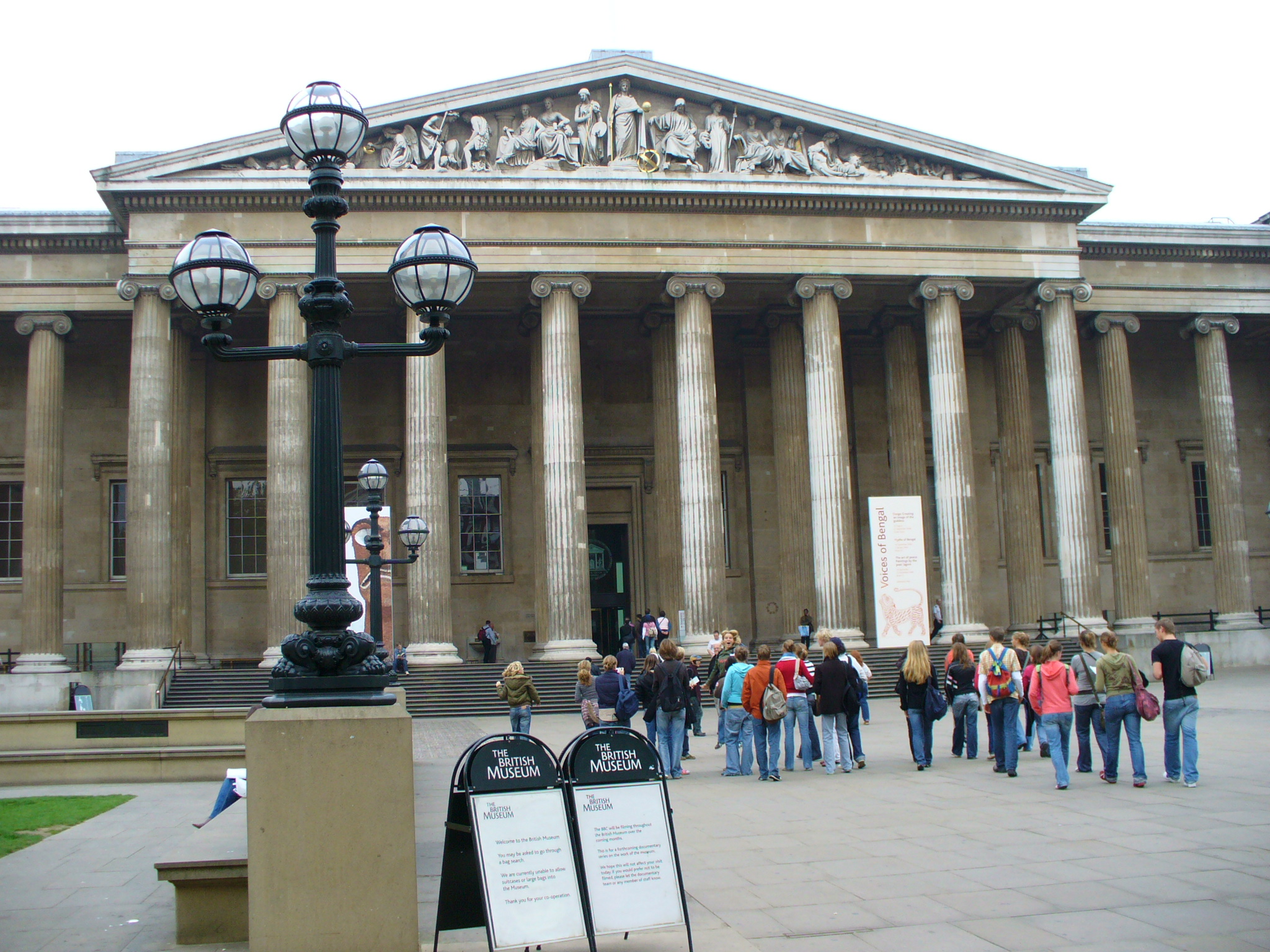
Sadly, on that trip to the UK I had no time for the first three-fourths of the list, but I made it to the British Museum. The edifice is impressive – a wide yard with steps that lead up to a long portico of sturdy, grey columns.

Fetch your hiking boots…

When I think museum, I think a small, well organized place with five or six rooms you can see in a fairly short time. This is not the right impression for the British M. The £2 map you can buy to keep you on track is a maze of room upon room of antiquities.

With only a few hours to see a tiny sampling of what it has to offer, I strolled through the main exhibit hall of Egyptian artifacts (the Rosetta Stone among them) into the Parthenon sculptures and back down the Assyrian hall. I looked in vain for a Scythian exhibit, only to find out it was closed for repair, so I took a short turn in the temporary display of 18th century exploration. I entirely missed the ancient British artifacts, Asian, and African exhibits, among all the rest.

It’s hard to take in the scale of so many ‘things’ housed in the museum complex, but it helps to imagine a very classy warehouse where you can see into most of the boxes. To learn more about the museum, the web address is http://www.britishmuseum.org.

I recommend going because it’s the abode of bits and fascinating pieces of ancient civilizations, but also because the building itself is an historic landmark. Frankly, most of London is an historic landmark.

Museums draw you to the past. Coming face to face with an ancient Egyptian carving brings reality to your sense of history – something that looking at a picture in a book cannot do. You may be surprised at how your assumptions are burst by seeing how much smaller or larger a famous artifact is from the way you imagined it would be.

Who owns what?

On a related note, there is a continuous debate about the ethics of major European museums keeping ownership of items discovered in other countries (mostly former colonies or protectorates). British, German, and French museums, among others, house some of the seminal pieces representing Africa, Asia, and the Middle East.

Many nations want their items returned, and fairly enough, as they exemplify the cultural history of those places. On the other hand, with the instability, politically and religiously of many nations of origin, some argue that human history is best protected by keeping the items where they have been for the past century or more.

Arguing in favor of this sentiment was the 2001 destruction in Afghanistan of two giant statues of Buddha by Islamic extremists. Likewise the ensuing chaos and devastation of Iraq at war has resulted in the pilfering and destruction of many Assyrian and Babylonian artifacts from Iraqi museums.

Consensus eludes the world on this issue at present, but compromises have been suggested. Returning the originals to their homes, but not before precise copies can be made to remain in place at western museums. Not unlike the copy of the Lascaux caves in France that was made to protect the original from too many respirating tourists.

Skimming is not just for milk…

So far I’ve learned that Athens had a Navy, a rather glorious one, and that in order to work this miracle the Athenians had to turn themselves into a democratic state. This all took place from about 483 to 322 B.C. on the Peloponnesus (information courtesy of the back cover blurb and index of Lords of the Sea: The Epic Story of the Athenian Navy and the Birth of Democracy by John R. Hale).

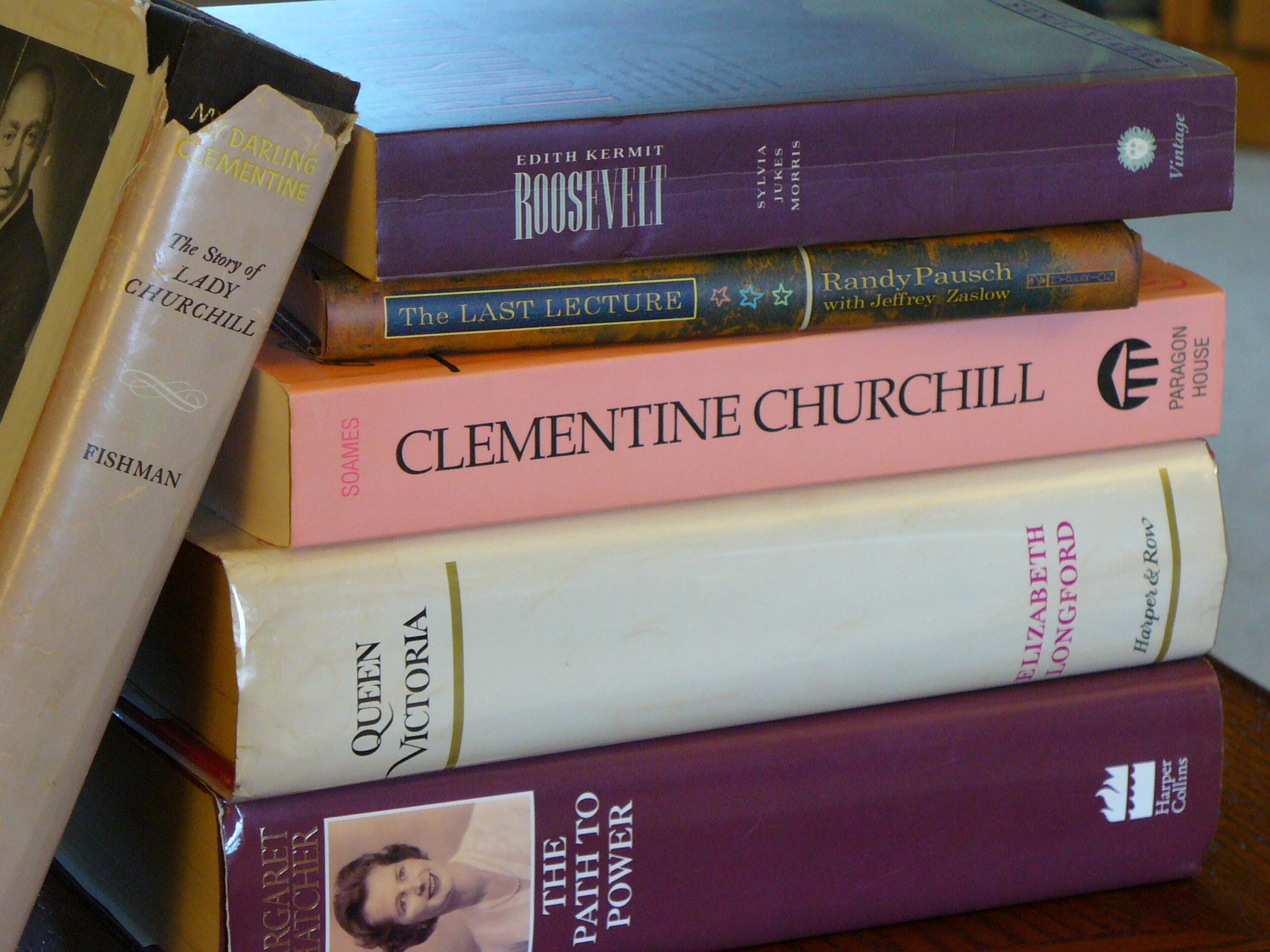
On a trip to Costco today I spotted this volume by Hale and it now has the honor of residing on my reading pile. It was a tough decision, but the Athenian Navy won out over other front-runners like Teddy Roosevelt as Conservationist, the Mayflower, and a history of the Battle of Trafalgar. I am already endowed with or have access to books covering the Napoleonic naval wars, the landing of the Mayflower, and several biographies of Theodore R.

I would like to give a full-scale critique of my purchase, but I haven’t read it. However, I have employed my trusty skimming skills, my old allies since discovering a book on speed-reading in high school. I figured that was the only way I could make it through my U.S. Advanced Placement History textbook and ace the test (I did and I did).

Read a little, learn a lot

I love the subtlety of skimming (it’s  sort of like literary espionage). With  one glance at the cover I know title  and author. The back cover or inside  jacket flaps give me a summary of  what the book is about as well as  reviews. A word on reviews, they are  either insightful or worthless –  depends on the author, so don’t  always take their word for it.

Next I march on to the index, which tells me how the author organized his research and thoughts on the subject. I flip through the book and see what visuals it has to offer. Visuals aren’t important for everyone, but if I am going to take the time to read the whole text on Greek history and Athenian democracy I would like to hope that a handy reference map has been provided.

Finally, I get to the words, the prose. I read a few paragraphs of the introduction in search of a thesis or specific purpose statement as well as perceived bias. Then I trudge through, sampling a paragraph here and there for style and content. If the writing is really tedious, and I don’t have to know the subject matter – I don’t want to read it. Lastly, I read the final few paragraphs in order to know if I want to spend those precious hours working word by word through the entire book.

All this takes about 3-5 minutes and by then I have made my decision to purchase. Not only that, I have now a framework for all the material I will glean from reading the book. This is a valuable memory and comprehension tool.

Try this technique on your next read and see how it works for you!

The Internet: Research Tool

In my college days the Internet as a research tool had the reputation of a con artist heading up a charity. Academia didn’t like the idea of all that unsubstantiated “chatter” out there.

Well, times are changing and a little over a decade has given the Internet a sheen of respectability. It’s still a jungle of information but not a dead loss.

The Internet is a useful tour guide. With regard to history, Wikipedia and the like are a good starting point if you want basic information and are prepared to swim through a river of bias to get it. Encyclopedic sites that are reader-written have obvious problems – anybody can say anything!

Start there and move on to verifiable sources: books, official journals, news items (although, depending on source and with the political bias of many news sources, take them with a grain of salt), and official websites. Some of these are available on the Internet. And then there are story verifying watchdog sites (like Snopes) that come in handy.

Find the Facts

“Verify, verify, verify” is the catch phrase of Internet research. So much information, often self-published, is circulating that you have to consider it questionable until you have two or three sources to back it up.

If I’m trying to recall an historical event and it’s just barely escaping me, search engines can take the details I do remember and lead me back to the source. That is the beauty of the being online.

I’d like to say a word for online bookstores, like Amazon, and their review pages. Thrown in with the occasional crank are useful bits of information that may lead to another book or source of study.

Research on the Internet is still much like putting together a jigsaw puzzle with part of the information here, another fact there, mixed in with a lot of repetition, or on the downside, a bunch of lies.

Tread the river of information carefully, and be grateful we have the freedom to produce it!