How Does Your Garden Grow?

Having recently spent time getting my own small vegetable garden prepared for planting I was reminded of the work that went on across the nation as Americans got back to the land and grew Victory Gardens during World War II.

Victory Gardens were a pivotal way to make a personal sacrifice of time and effort on the WWII home front. Not that growing your own food was much of a novelty at that time. Many people still filled their produce needs by growing their own as agrarian America had done for centuries.

Veggie tales

According to the Victory Garden Manual published in 1943 and written by James H. Burdett, “War, food rationing, and the Victory Garden campaign have given millions of Americans a new appreciation of vegetables.

“… when our appetites were stimulated and our cooks trained, we were summoned as a patriotic duty to grow our own Victory Gardens so as to release commercial crops and canned goods for war demands [to feed the troops].”

The book goes on to say that, “War gave dramatic emphasis to vegetable gardening, but it is an art which is as important in peace as in war. The need for abundant supplies of garden-fresh vegetables in every home is far from ended by a peace treaty.”

“Those who enjoy the making of Victory Gardens should resolve never to abandon a practice which gives so much of exercise, recreation, and good health to all who follow it.”

Productive produce

About 20 million Victory Gardens were planted in the United States during the war. Folks in the country and those in the city turned their yards into large vegetable patches capable of feeding a whole family for most of the year if stored properly. Victory Gardeners effectively produced 9 million tons of vegetables.

For many young adults during the war the habit of growing a large, “Victory-style” garden never left them. My grandparents, for the rest of their lives, continued to grow a massive vegetable and berry garden that took up nearly half of their large yard. I have great memories of visiting the red raspberry vines and eating my fill. My first experience of harvesting potatoes was with my grandma in the garden as I helped her fish them up from the depths of the soil, like buried treasure.

Historical trends swirl around and pop up in the present every now and then and growing one’s own produce is about as good a trend as I’ve seen in a long time. Many people are growing their own because it cuts down costs and enables a more bountiful table during a crummy economy, others are influenced by the philosophies of environmental causes, and some believe that homegrown is healthier because it is generally treated with fewer chemicals.

Me, I just like reliving history and knowing that if I had to grow my own produce, I could. That said; I still have a long way to go to achieve a true Victory Garden!
My Kingdom for a Ship

A Short History of Athenian Naval Wars

From about 506 B.C. onward until 322 B.C. the Greek city-state of Athens was in a nearly continuous state of making war or preparing for it. And lest I single them out, so were the rest of the Greeks as well as the Persians and generally most of the occupants of the Mediterranean shores.

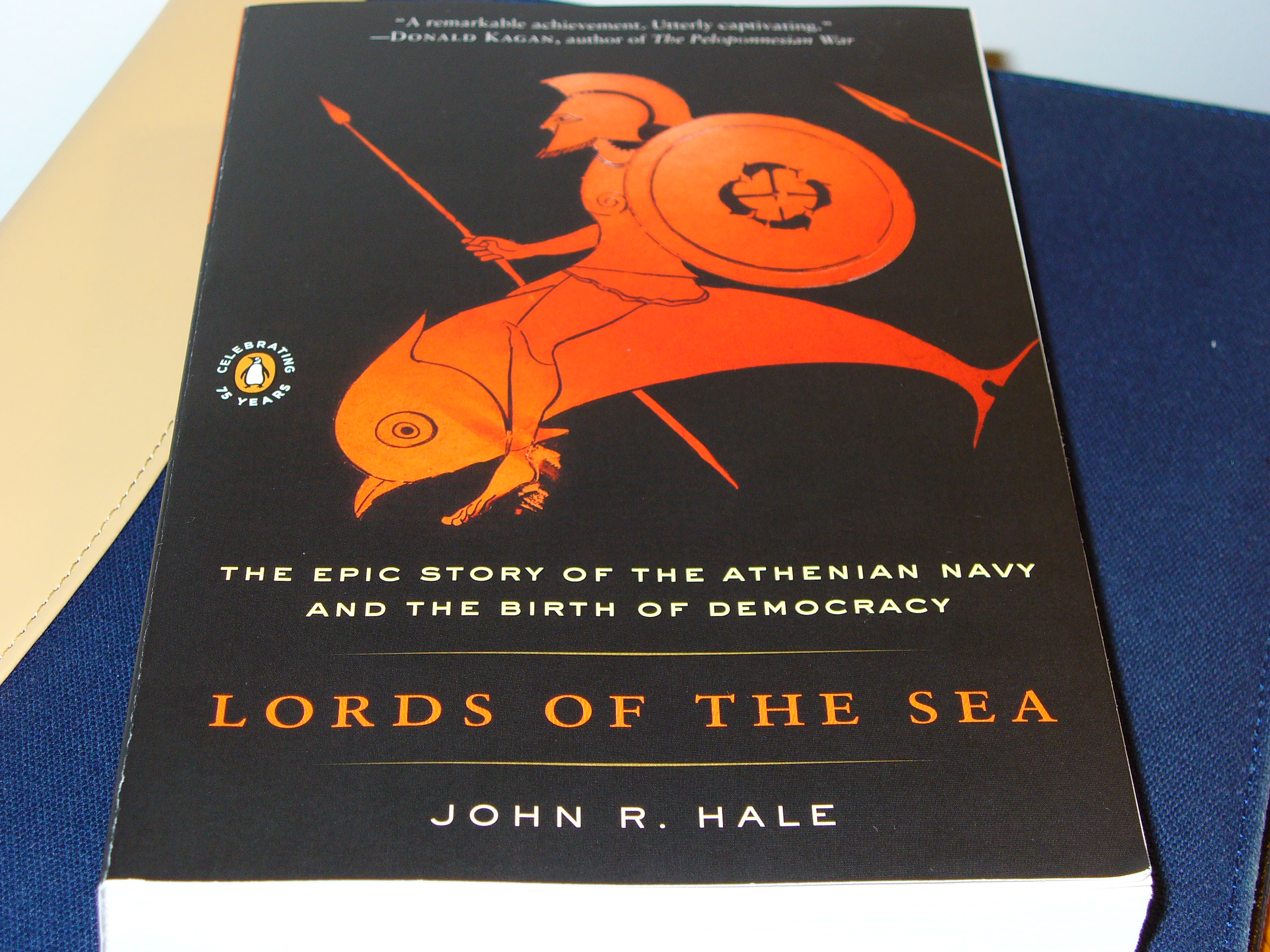
To help you locate it, here is an image of the cover.

According to John R. Hale’s Lords of the Sea: The Epic Story of the Athenian Navy and the Birth of Democracy the Peloponnesus, that peninsula that juts into the Mediterranean and which is connected to the Greek mainland by a narrow slip of land called the Isthmus of Corinth, was embattled with internecine wars, primarily between the Athenians and the Spartans (of 300 fame).

Oddly, these two archenemies could also be allies if the need arose. When the Persians to the East decided to wage a campaign to increase their imperial holdings in Mediterranean Greece, the two allied against Kind Xerxes. This led to the famous Spartan loss at the Battle of Thermopylae in 480 B.C. followed in concert by the victorious Athenian naval battle of Salamis in the same year. At Salamis the Greeks wailed on the Persians and rendered their fleet useless.

Athens rules the waves

Hale explains that Athens was a significant naval power from this point onward until the rise of Alexander the Great, and the ensuing Macedonian empire (322 B.C.). They policed the Mediterranean and brokered deals with various city-states, receiving tributes of silver or gold for protecting harbors and ships on the sea. Athens invested in its navy by building a fleet of the state-of-the-art ship of the day – the trireme.

This vessel, originally a product of Phoenicia, was 120 feet long, powered by rowers on three tiers (hence trireme) in the hold. The Greeks added a top deck that could double as a troop carrier for marines. It was guided by a steersman and commanded by a trierarch. It was the kind of ship that worked well on calm seas but was useless in inclement weather when swelling seas could pour water into the oar ports and swamp the ship.

I’ll have my say…

The author of Lords of the Sea contends that because the ships relied on significant manpower the less wealthy individuals who risked their lives to row their superiors in the Athenian class system (the steersman and trierarchs) to and from battle wanted and had the leverage to demand a voice in the Athenian assembly. This resulted in eventual suffrage and leadership roles for all citizens of Athenian society, regardless of wealth.

The investment of funds and lives in the Athenian navy meant that those who served, every male citizen, had a say in the governing of the city. This was the motivating force for democracy in this place, at this time in history. It did not, however, mean that Athens was the ideal democracy.

Missteps

The Athenians grew, through alliances with other city-states and the tribute paid to them, into an imperial power. If your city-state angered or defected from the league you were subject to the wrath of Athens, generally wholesale massacre of all citizens in your city. If Athens didn’t get enough tribute from its allies it would also resort to pillaging and piracy to gather the extra funds from enemies and allies alike.

Occasionally the democracy would even turn self-destructive. After one famous victory against the Spartan navy at the Battle of the Arginusae Islands in 406 B.C. six of its victorious generals were executed for failing to pick up the bodies of the dead from the sea because of bad weather despite their overall success in the battle. One of these generals was Pericles, the son of Pericles, the great man of Athens.

Athens had a democracy, but it also had great men of vision who guided the democracy: Themistocles, Pericles, Socrates, and others. However, without these men who could think into the future, Athens struggled.

Hale’s writing is easy to read, but the book is a little battle heavy as one reviewer put it. It gives a clear analysis of Athens and its naval ambitions, and really, much of the rest of Greece during their heyday just prior to the ascension of Alexander the Great and the Macedonians.

Gateways to History: Getting Started

What makes a person like history?

Is it just a quirk of personality that leads them to be insatiably curious about the past?

Is it a family member who shared his or her own love of history?

Is it just a coincidence of factors: good books, great teachers, a need to know?

All of these things can contribute to the creation of an avid historian, but what if you didn’t have the benefit of such circumstances – are you doomed to dislike history?

Not at all! There are other gateways to history and finding yours is the challenge!

Image: Amanda Stiver

Image: Amanda Stiver

More than one way to… study history

History is stereotypically fed to students via the textbook and a class lecture. A good textbook can spur an interest in students, but more importantly a good teacher can spur a lifelong love of the subject.

I had two particularly memorable high school history teachers. They each had a different approach to teaching, but were equally successful.

One teacher taught by lecture. The good thing was that he was one of the best lecturers I have ever heard. He gave us clear instructions from the start, if you want to get a good score on the Advanced Placement U.S. history test at the end of the year, then read the textbook twice. His expectation that we would do our reading and come to class with a clue about the day’s subject freed him up to add extra material from his vast store of historic knowledge during the lecture. He could tell a great story.

The other teacher had a different approach, but was also a gifted storyteller. She was a multi-media historian. We watched videos, read textbooks, read primary source excerpts, viewed art history slides and maps, did re-enactments, had class discussions, and completed writing assignments. She illustrated to me the importance of a variety of sources and approaches that make the subject vibrant and alive!

I had other great teachers, but I think this makes clear that the best gateway to a love of history is a fantastic teacher.

Find your gate, take the path

If you don’t like history because you had bad teachers, all is not lost. Try this: go watch a movie that has an historic setting or read an historical novel. How many people who went to see 300 or Braveheart consciously thought they were going to study history – surely not many.

Movies and historical fiction aren’t perfect, but they are a kind of gateway. Ideally they should spur a curiosity into an area of history that draws you to your local library and a good book on the subject. They are highly interpretive, so by all means, if something sounds far-fetched in a book or movie – go prove the author or directors wrong by researching the subject yourself.

Let a productive curiosity be your gateway into history. Maybe you want to know more about family genealogy – research the era in which your relatives immigrated! Maybe the history of a national or religious holiday has always made you wonder about its origins – go find out! Perhaps you read a short article that was so well written it made you want to know more.

Best of all, if you are planning a trip, don’t leave until you have at least one book under your belt about the area you are going to visit. When you get there, go see some of the places you read about, make the story come alive.

Once you cross the threshold, keep your curiosity alive. Make it a challenge to find the thread that connects each historical era or subject you study or come across. Or my personal favorite, when you’re at the store and you get the total cost of your purchases, take four of the digits and try to remember what happened in that year in history. If you can’t think of anything, go home and use a search engine to find out!

Take the plunge, it’s more exciting that you ever imagined!

Read Me A Little History…

Read aloud. Or better yet, listen to someone else read aloud. Really, try it!

Sound a little too dramatic? Seems kind of weird, maybe, because we don’t do that kind of think anymore. Or do we?

Have you ever watched a news anchor talk at you? They aren’t gabbing from memory – they’re reading aloud! Yep, from that teleprompter screen right next to the camera!

Guess who else reads aloud? Right – politicians. Teleprompters being the modern default, but some still use good old note cards.

Whatever the case, they are all reading aloud. We do a lot of reading these days, the Internet has made that a necessity, and so we don’t often take the time to read out loud from a book. However, back before moving pictures, radio, television, and Internet folks regularly read to each other.

Tell me a story, read me a book

On a cold winter evening around the fireplace of a rough log cabin, by the light of homemade candles, settlers would read out loud from the Bible, maybe Plutarch’s Lives (thank you Seven Brides for Seven Brothers), or perhaps a collection of Shakespeare. They didn’t have many books, but what they had, they read.

It was entertainment and education. Poetry was read aloud (sometimes from memory) as were plays, works of fiction, works of history, and religious works. It was a shared experience.

If you read aloud often enough, you begin to understand written works in a different way. Try reading the Bible silently – zoom through a few verses in the historical books of Chronicles or Kings – kind of dull, you say?

Okay, change tack, read aloud as if you are narrating a Cecil B. DeMille production of epic biblical proportions! Make sure that your audience, real or imagined, can understand each word and that the transitions from action to description are clear. Suddenly it isn’t so dull! Try the same thing with Jane Austen – you’ll be amazed at how her works come to life!

Reading aloud is an art form and a connection to the historic past. Back in the days of limited literacy those who could read aloud did so that others would have a chance to hear whatever it was they were reading. It was the default mode of literacy for many centuries until fairly recently.

Try it and you’ll find that a simple activity like this is a fun trip to the historical past.

Skimming is not just for milk…

So far I’ve learned that Athens had a Navy, a rather glorious one, and that in order to work this miracle the Athenians had to turn themselves into a democratic state. This all took place from about 483 to 322 B.C. on the Peloponnesus (information courtesy of the back cover blurb and index of Lords of the Sea: The Epic Story of the Athenian Navy and the Birth of Democracy by John R. Hale).

On a trip to Costco today I spotted this volume by Hale and it now has the honor of residing on my reading pile. It was a tough decision, but the Athenian Navy won out over other front-runners like Teddy Roosevelt as Conservationist, the Mayflower, and a history of the Battle of Trafalgar. I am already endowed with or have access to books covering the Napoleonic naval wars, the landing of the Mayflower, and several biographies of Theodore R.

I would like to give a full-scale critique of my purchase, but I haven’t read it. However, I have employed my trusty skimming skills, my old allies since discovering a book on speed-reading in high school. I figured that was the only way I could make it through my U.S. Advanced Placement History textbook and ace the test (I did and I did).

Read a little, learn a lot

I love the subtlety of skimming (it’s  sort of like literary espionage). With  one glance at the cover I know title  and author. The back cover or inside  jacket flaps give me a summary of  what the book is about as well as  reviews. A word on reviews, they are  either insightful or worthless –  depends on the author, so don’t  always take their word for it.

Next I march on to the index, which tells me how the author organized his research and thoughts on the subject. I flip through the book and see what visuals it has to offer. Visuals aren’t important for everyone, but if I am going to take the time to read the whole text on Greek history and Athenian democracy I would like to hope that a handy reference map has been provided.

Finally, I get to the words, the prose. I read a few paragraphs of the introduction in search of a thesis or specific purpose statement as well as perceived bias. Then I trudge through, sampling a paragraph here and there for style and content. If the writing is really tedious, and I don’t have to know the subject matter – I don’t want to read it. Lastly, I read the final few paragraphs in order to know if I want to spend those precious hours working word by word through the entire book.

All this takes about 3-5 minutes and by then I have made my decision to purchase. Not only that, I have now a framework for all the material I will glean from reading the book. This is a valuable memory and comprehension tool.

Try this technique on your next read and see how it works for you!

The Internet: Research Tool

In my college days the Internet as a research tool had the reputation of a con artist heading up a charity. Academia didn’t like the idea of all that unsubstantiated “chatter” out there.

Well, times are changing and a little over a decade has given the Internet a sheen of respectability. It’s still a jungle of information but not a dead loss.

The Internet is a useful tour guide. With regard to history, Wikipedia and the like are a good starting point if you want basic information and are prepared to swim through a river of bias to get it. Encyclopedic sites that are reader-written have obvious problems – anybody can say anything!

Start there and move on to verifiable sources: books, official journals, news items (although, depending on source and with the political bias of many news sources, take them with a grain of salt), and official websites. Some of these are available on the Internet. And then there are story verifying watchdog sites (like Snopes) that come in handy.

Find the Facts

“Verify, verify, verify” is the catch phrase of Internet research. So much information, often self-published, is circulating that you have to consider it questionable until you have two or three sources to back it up.

If I’m trying to recall an historical event and it’s just barely escaping me, search engines can take the details I do remember and lead me back to the source. That is the beauty of the being online.

I’d like to say a word for online bookstores, like Amazon, and their review pages. Thrown in with the occasional crank are useful bits of information that may lead to another book or source of study.

Research on the Internet is still much like putting together a jigsaw puzzle with part of the information here, another fact there, mixed in with a lot of repetition, or on the downside, a bunch of lies.

Tread the river of information carefully, and be grateful we have the freedom to produce it!

Learning from the Past: School Books

“Here, Kitty; see what I have. Oh yes; she sees me now. I have an apple for you, Kit. One for you, and one for me. Kitty is my horse. She will eat grass and apples.”

So goes a reading lesson from page 15 of Classics for Children: A First Reader by J.H. Stickney published by Ginn & Company, Boston, USA, 1893.

I doubt you would find similar subject matter in an early grade English book today. I also doubt many kids know much about horses anymore. Back then, nearly everybody had a horse for transportation and farm work.

I find it interesting that the assumed common knowledge of 1893 differs so much from what we find common today. Digital technology has replaced mechanical technology in most realms of our life, at least on the surface.

If you scratch down deep enough you’ll find that we still rely on mechanical technology the bulk of the time. Until someone invents the replicator of Star Trek fame, we’re going to be planting seeds in the ground and harvesting them for a long time to come. Mechanical muscle gets the heavy work done.

I before E-mail

Flipping through an antique English primer is a fascinating journey into the past. The rest of Stickney’s reader is filled with references to farm animals, the agricultural world, the natural world, physical chores, and old-fashioned games like rolling a hoop.

I can still remember this world from family stories because my maternal grandparents lived it until they died and my parents grew up in it, but I wonder whether youngsters in their twenties and under will understand these basic things if the digital world continues to grow on its current scope and scale.

An old adage of history, and life, is that you have to walk before you run. You need a solid grounding in the fundamentals before you can move on to the complexities.

Learn a little bit about the agricultural world that preceded and still sustains our digital world.

It’s important.

Time Machines…

At a garage sale I picked up a book entitled, A Lady’s Life in the Rocky Mountains by Isabella Bird, who, according to the cover blurb was “a Victorian Englishwoman” – an intrepid lady traveler of the late nineteenth century.

These journalized or epistolary (letter based) accounts of the past, primary sources, are a fun way to study history. Their first-person perspective is always a refreshing change from most analytical histories on the bookstore shelf. Such perspectives, untainted by revision or assumptions are the actual thoughts of those who lived the past, warts and all.

Good intentions

I like this genre so much that I have two other books of this type in my reading pile. Mollie: The Journal of Mollie Dorsey Sanford by the aforementioned Mollie Dorsey Sanford and Daughter of the Regiment: Memoirs of a Childhood in the Frontier Army, 1878-1898 by Mary Leefe Laurence. Neither of which I have finished. For, unlike fiction, journals have their boring days, even historical journals, which tempts me to put them down and reach for something more exciting.

This is a conundrum of historiography (the study of the study of history) – the boring stuff. What do we do with it? Read, skip it, or write about it in painful detail? There are authors who do that!

Acknowledge it. If our lives were daily filled with fast-paced action, danger, and intrigue, we’d be neurotic! The boring stuff lets us live a saner life.

Life is in the details

Maybe boring is too much of a condemnation; call it instead daily life, the details of living. Stopping for a pretty sunset, relaxing in an empty hour with a good book, washing the clothes, fixing a meal, etc. These things go on, even when the danger of wars, upheaval and panic have passed.

I suspect my curiosity will get the best of me and I’ll drift back to Mollie, Mary or Isabella and finish their works. The rich detail of the eras in which they lived adding to a greater knowledge of life in the past.

If you’re stuck for an interesting history read, try an historical journal – your very own guided trip back in time.

What’s in a name?

Here’s an experiment in the obvious: take a map of the world and read the names of countries in any one of the continents… Britain, Germany, France, Spain… China, Japan, Korea… Zimbabwe, Sudan, Nigeria… America, Canada, Mexico…

See how easy it is to roll right over them?

This is what I mean; we are attuned to ignore the obvious (Sherlock Holmes would be proud of this deduction). But every once in a while we turn our head, squint our eyes and suddenly a word we have read or typed hundreds of times looks like a foreign language to us.

Why is that?

I’m an English speaker, and I can cope with French, but I can’t easily read Middle English. Yet many of the words I use on a daily basis are mutants of the English linguistic past – let alone the influence of German, Spanish, Latin, Greek, Gaelic and Hebrew among the many other languages that contribute to modern English.

America, Amerigo, and Ap Meric

Yesterday I picked up a book that I had read a few years ago, The True Story of How America Got Its Name by Rodney Broome. It’s an interesting volume and as I skimmed it, I got to thinking about the many variations of the origin of “America,” as an appellation for the continent.

Nearly everyone has heard of Amerigo Vespucci, and how a friendly mapmaker gifted his first name to the continent. Well, maybe – but why use a first name, usually reserved for royals, when surnames were the norm for everyone else?

So Broome supposes that maybe it wasn’t Vespucci’s first name, but someone else’s last name on the map. Interestingly, Vespucci was on board a Spanish ship with an aggressive captain who readily attacked English vessels. At the same time an English vessel disappeared, carrying the famous explorer John Cabot in whose possession was a map illustrating the American continent and inscribed with the name of Richard Amerike (or Ap Meric, as it is in Welsh).

Call in NCIS, this has the makings of a mystery! Did the map change hands? Was Amerike’s surname on the map first? Could be.

America, by any other name…

If you search far enough there are a number of other origins for the name “America” that pop up.

Some claim that the Scandinavian Norsemen who came exploring the American continent in pre-Colombian times brought with them a phrase for this new western land, “Ommerike” that sounds roughly like America.

Other possibilities suggest the Mayans had a similar sounding phrase for their lands.

So what’s the truth?

Names that sound similar and move from one language to another can become mixed and “owned” by both cultures. Imagine the interesting spelling variations you can get from an answering machine if the caller’s voice isn’t clear!

In my opinion there is validity to the connection to Richard Ap Meric. As Broome contends, maps were precious at that time in history, particularly in areas previously unexplored by Europeans. If Mr. Vespucci got a hold of it, why wouldn’t he want to cash in on a similar sounding name? After all, exploring the new world was all about finding gold, glory and gathering fame back home!

The possibilities have merit… or is that Meric?