Living like it’s 1873

Not long ago I finished A Lady’s Life in the Rocky Mountains by Isabella Bird. The book covers her remarkable travels as an Englishwoman in the nineteenth century American West.

Bird was subject to ill health and traveled, as many did at that time, to different climates to restore her strength. Among other places she also visited Hawaii as well as Canada, Japan and China. In this case Bird was on a trip to reach Estes Park, Colorado.

Her journey begins at Lake Tahoe and she travels east from there into Colorado. Given the strictures of the time she was unusual as an independent woman who traveled alone and un-chaperoned through vast prairies and mountainous regions. With the exception of a few close calls she remained quite safe. After her return she compiled letters written to family into a journal of her travels and published it for sale.

The narrative is full of action and moves quickly, so it is a worthy read if you are interested in doing a little time travel and getting some firsthand experience in the “old west.”

Word pictures

Two things stand out from the book. First, is Bird’s ability to use language to describe her surroundings. The book is un-illustrated, but I was surprised at how little I missed photographs or maps. Her descriptions are precise and show a facility of language usage that is completely lacking these days.

Here are a few samples:

“The stars were intensely bright, and a well-defined auroral arch, throwing off fantastic coruscations, lighted the whole northern sky. Yet I was only in the Foot Hills, and Long’s glorious Peak was not to be seen (p. 229, Comstock Editions, INC., 1987).”

Who uses the word “coruscations” these days? (It means “sparklings and glitterings,” by the way.)

“Long’s Peak, 14,700 feet high, blocks up one end of Estes Park, and dwarfs all the surrounding mountains. … By sunlight or moonlight its splintered grey crest is the one object which, in spite of wapiti and bighorn, skunk and grizzly, unfailingly arrests the eyes. From it come all storms of snow and wind, and the forked lightnings play round its head like a glory. It is one of the noblest of mountains, but in one’s imagination it grows to be much more than a mountain. It becomes invested with a personality (pp.78-79).”

I know that a picture can speak a thousand words, but words like these can speak a thousand pictures!

At your leisure…

Secondly, the descriptions of life at this time in American (and British) history fill a need-to-know of mine. When I sit down in the evening to watch a television show or movie I sometimes ponder at the passivity of my modern habits. It doesn’t take much intellectual stimulation to watch a video (which is sometimes the point after a busy day), but on the other hand, how much of the human brain do we leave inactive for the sake of “entertainment.”

The following quote from the book gives a hint at the kind of end-of-day events common in the early 1870’s:

“After that we all sit in the living room, and I settle down to write to you, or mend my clothes, which are dropping to pieces. Some sit round the table playing at eucre, the strange hunters and prospectors lie on the floor smoking, and rifles are cleaned, bullets cast, fishing flies made, fishing tackle repaired, boots are waterproofed, part-songs are sung, and about half-past eight I cross the crisp grass to my cabin, always expecting to find something in it [based on a previous encounter with a skunk] (pp. 108-109).”

Life was not a piece of cake and leisure time was at a minimum. If you wanted to hear music, you sang it. If you wanted amusement, you played cards. Otherwise you were busy repairing your equipment.

Travel by book – I highly recommend this volume as your personal tour guide into the past!

The Great Depression and “Stuff”

A few months back I was blessed to be able to compile an article about survivors of the Great Depression. The article was an assignment for Vertical Thought magazine, which reaches out to a young adult and teen audience. My goal was to connect young people to the now elderly folks who lived through the Great Depression.

What was great about doing the article was that the subject fascinated me. Likewise, my interview material was everywhere! My relatives, older folks from the church congregation I attend, and from the community.

I think what has always amazed me about that era was that although so many people were barely scraping along; you will often hear them say that they didn’t know they were poor.

There was still an unspoken rule that if you had food to eat, a roof over your head, and a family with love – you were all right. Notice I didn’t say indoor plumbing, electricity, air conditioning, a new car, digital communication devices, digital music devices, etc. There are some basic things that all humans truly need. Then there are “necessities” that we are conditioned to “need.”

Binary Burden

To be fair, I, like the next person, use my fair share of these devices and benefit as a result, but I also find myself over-processed from them. In the same way that junk food is over-processed to the point that it doesn’t resemble its original components; I think over-digitalization is similar.

We lose ourselves in the crush of information, our ability to concentrate is tampered with, and we begin to feel like we can’t live without all the social networking, constant texting, and electronic gadgets. We’re addicted to a pile of things or worse, to the miles of information encoded in the vapor that is the web!

Tough as it is to imagine, we could all probably get along without the proliferation of leisure and time saving devices that drive store and Internet sales these days.

Maybe I’m a young curmudgeon in the making, but there is something to be said for daily physical activity that leaves you fatigued, but invigorated by the activity and accomplishment.

Walk the talk

My challenge to you – go find one of these elders and ask them about (if possible) their life before electricity. Ask them to tell you what it was like when each new device came into popular use. Ask them how they got along without all those things.

You will be intrigued by the answers, and more than that, you will have made a connection to their past, which is now part of yours. You will be an historian!

Founding Parents: Advice for a Nation

Reading about colonial life in America got me thinking about the founding fathers (and mothers) of the revolutionary period. I thought it would be interesting to examine a piece of parenting advice from one of the many individuals who, essentially, parented this country.

John Adams served as both President and Vice President of America in the last decades of the 18th century and early 19th. He had been a member of the Continental Congress and helped to write the Declaration of Independence. He and his wife, Abigail, both of Massachusetts, spent time on diplomatic missions to France. One of their sons, John Quincy Adams, also served as President.

I turned to my copy of Our Sacred Honor: Words of Advice from the Founders in Stories, Letters, Poems, and Speeches compiled by William J. Bennett (Simon & Schuster, 1997). The following quote, in a letter from John to Abigail, explains the expectations they had for their children:

“Human nature with all its infirmities and depravation is still capable of great       things. It is capable of attaining to degrees of wisdom and of goodness, which, we have reason to believe, appear respectable in the estimation of superior intelligences. Education makes a greater difference between man and man, than nature has made between man and brute. The virtues and powers to which men may be trained, by early education and constant discipline, are truly sublime and astonishing.”

“It should be your care, therefore, and mine, to elevate the minds of our children and exalt their courage; to accelerate and animate their industry and activity; to excite in them an habitual contempt of meanness, abhorrence of injustice and inhumanity, and an ambition to excel in every capacity, faculty, and virtue. If we suffer their minds to grovel and creep in infancy, they will grovel all their lives.”

“But their bodies must be hardened, as well as their souls exalted. Without strength and activity and vigor of body, the brightest mental excellencies will be eclipsed and obscured.”

Discipline your mind, use your intellect, exercise your body, and above all, value virtue.

Good advice for a nation, too.

Daily Life – Living in the Past

I just came across a magazine called Early American Life. It is a niche magazine dealing with Colonial life in America, both east and southwest. It has plenty of historical detail for re-enactors or history buffs like myself.

It is refreshing to see a magazine with quality reporting and well-crafted articles that are directed at a specific field of interest. General interest magazines are sadly, a dime a dozen, particularly as they move to the Internet. This needn’t be so, but it is the nature of a void like the Internet that demands to be filled with endless amounts of copy.

Most importantly I was excited to find a magazine that exemplifies an area of history study that has always fascinated me. The word quotidian expresses it best, those little things that add up to make what we know as everyday life. To simplify, I call it the history of daily life.

Time Travel

This was my favorite boredom fix as a kid. I would take whatever circumstance I was in and try to imagine it in a different era of history, a little time travel.

Say I was on a long drive home with my parents, no scenery to speak of, 12 years old, getting carsick, what to do? What if it wasn’t the present, but two hundred years earlier in colonial era America?

What would I wear? Well, not jeans and a t-shirt, but what was the equivalent for a middle class miss? What would I be riding in? A mini-van? No. Well then, maybe a carriage, but what kind? How many horses, or would I be on horseback?

Where would I be traveling? What kind of house would I live in? What would I eat? What amenities would exist? Electricity? Certainly not. Plumbing? Not really – just a chamber pot (imagine that the next time you stumble to the bathroom early in the morning!). What would I do all day? Sewing? School? Music? The list can go on and on.

Try a little time travel yourself – where would you go? How would you have been living?

In Memoriam

Today is Memorial Day in the United States. The origins vary, but days of memorial to fallen soldiers of the American Civil War were observed shortly after the end of that conflict in the late 1860’s.

After World War I Memorial Day acknowledged not just the war dead of the Civil War, but of all conflicts in which America was or became involved. For most Americans this day is just one of a three day weekend, time for a family barbeque or other late spring outdoor activities. We tend to reserve our patriotism (or what there is left of it) for Independence Day on the 4th of July.

Memorial Day used to be a far more formal occasion with parades and solemn observes during which families would decorate the graves of loved ones who had served in the military. This is a day of mourning and I think we’ve lost that distinction.

To that end, let me explain why we mourn by providing you with a list of America’s war dead:

Revolutionary War-             4,435 American dead

War of 1812-                          2,260 American dead

Mexican War-                       13,283 American dead

Civil War-                               364,511 Union dead

289,000 Confederate dead

Spanish-American War-    2,446 American dead

World War I-                          116,516 American dead

World War II-                        405,399 American dead

Korean War-                           36,574 American dead

Vietnam War-                         58,220 American dead

Persian Gulf War-                  383 American dead

Since 1980 until 2008

and including the Persian Gulf War-

45,706 American dead

Total–                                         1,338,350 American dead

These Americans died in dispute or defense of our right to exist as a nation and uphold the daily freedoms upon which we rely.

(Sources: “American War and Military Operations Casualties: Lists and Statistics,” http://www.fas.org/sgp/crs/natsec/RL32492.pdf, and “Civil War Statistics,” http://www.phil.muni.cz/~vndrzl/amstudies/civilwar_stats.htm, any mistakes in sums or typography are my own.)

Whether or not we have family who served or whether we believe in bearing arms or not, our gratitude is still required to acknowledge the debt we owe those who willingly gave their lives for a purpose greater than themselves.

Human history is a series of conflicts punctuated by occasional bursts of peace and cooperation, or at least grudging armistice. We are not, by nature, a peaceful species. Peace requires reaching outside ourselves for the good of others. Ironically, war produces in those who serve the altruism to sacrifice for others around them in battle or for the ideal of a peaceful and prosperous homeland.

There are other reasons people go to war, but when you try to understand history the exceptions generally prove the rule. Look at the broad view, history is holistic and requires stepping back from the minutiae in order to understand historical trends and see the larger picture in full.

Please think on these things as you mourn today.

Back to the Victory Garden!

Recommended: WWII era Victory Garden film

Working in my own garden has narrowed my focus for the time being to Victory Gardens. In the course of an Internet search on the subject I came across a short film from the 1940’s covering the virtues of a Victory Garden and the need for it on the home front.

Click here to view video.

It’s only about 20 minutes long, but it gives you a clear picture of what the ideal Victory Garden looked like. It puts to shame my pitiful little kitchen garden, but then again, the garden patch in the film could contain nearly my entire yard!

Make no mistake, growing a substantial garden like this was no walk in the park. It took a lot of hard work, a hugh time commitment, and it didn’t end with the harvest. Keeping vegetables for the winter wasn’t a matter of washing, chopping, filling a plastic bag and throwing them in the freezer. Canning or “putting food by” was a big job in the kitchen. Besides that, non-processed food that could be stored through the winter was packed in sand, sawdust, wood chips or newspaper to keep it dry and placed in a root cellar (the same place everybody went during a tornado).

Living off the land was a full-time job!

When you watch the video, take note of the “engines” used for plowing the soil! Not your average garden tractor – no, this was the original horsepower! It really wasn’t that long ago that human kind switched from animal power to internal combustion power. Imagine feeding your John Deere and scratching it on the nose as it whinnies softly when you put it in the barn for the night!

How Does Your Garden Grow?

Having recently spent time getting my own small vegetable garden prepared for planting I was reminded of the work that went on across the nation as Americans got back to the land and grew Victory Gardens during World War II.

Victory Gardens were a pivotal way to make a personal sacrifice of time and effort on the WWII home front. Not that growing your own food was much of a novelty at that time. Many people still filled their produce needs by growing their own as agrarian America had done for centuries.

Veggie tales

According to the Victory Garden Manual published in 1943 and written by James H. Burdett, “War, food rationing, and the Victory Garden campaign have given millions of Americans a new appreciation of vegetables.

“… when our appetites were stimulated and our cooks trained, we were summoned as a patriotic duty to grow our own Victory Gardens so as to release commercial crops and canned goods for war demands [to feed the troops].”

The book goes on to say that, “War gave dramatic emphasis to vegetable gardening, but it is an art which is as important in peace as in war. The need for abundant supplies of garden-fresh vegetables in every home is far from ended by a peace treaty.”

“Those who enjoy the making of Victory Gardens should resolve never to abandon a practice which gives so much of exercise, recreation, and good health to all who follow it.”

Productive produce

About 20 million Victory Gardens were planted in the United States during the war. Folks in the country and those in the city turned their yards into large vegetable patches capable of feeding a whole family for most of the year if stored properly. Victory Gardeners effectively produced 9 million tons of vegetables.

For many young adults during the war the habit of growing a large, “Victory-style” garden never left them. My grandparents, for the rest of their lives, continued to grow a massive vegetable and berry garden that took up nearly half of their large yard. I have great memories of visiting the red raspberry vines and eating my fill. My first experience of harvesting potatoes was with my grandma in the garden as I helped her fish them up from the depths of the soil, like buried treasure.

Historical trends swirl around and pop up in the present every now and then and growing one’s own produce is about as good a trend as I’ve seen in a long time. Many people are growing their own because it cuts down costs and enables a more bountiful table during a crummy economy, others are influenced by the philosophies of environmental causes, and some believe that homegrown is healthier because it is generally treated with fewer chemicals.

Me, I just like reliving history and knowing that if I had to grow my own produce, I could. That said; I still have a long way to go to achieve a true Victory Garden!

My Kingdom for a Ship

A Short History of Athenian Naval Wars

From about 506 B.C. onward until 322 B.C. the Greek city-state of Athens was in a nearly continuous state of making war or preparing for it. And lest I single them out, so were the rest of the Greeks as well as the Persians and generally most of the occupants of the Mediterranean shores.

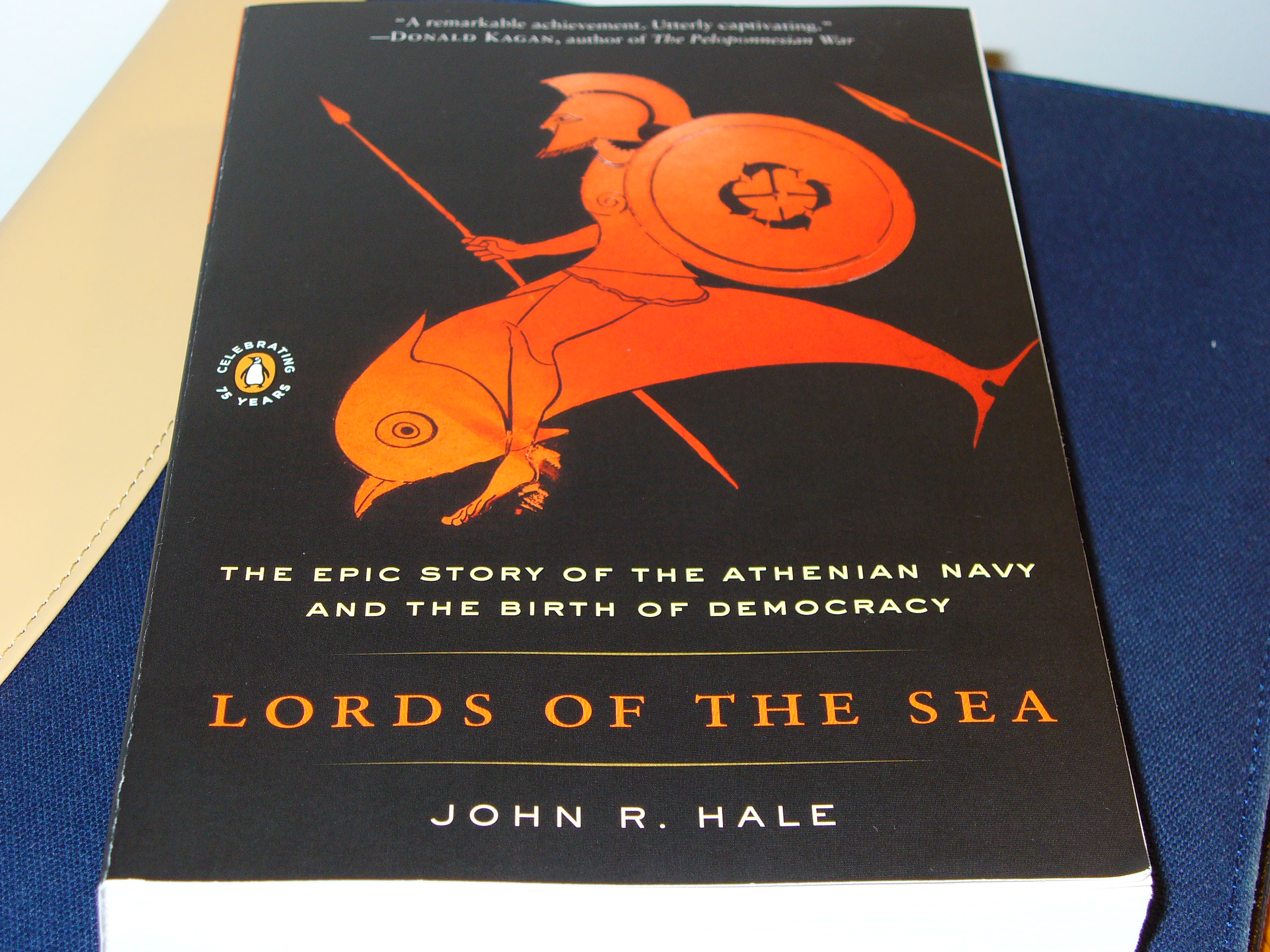
To help you locate it, here is an image of the cover.

According to John R. Hale’s Lords of the Sea: The Epic Story of the Athenian Navy and the Birth of Democracy the Peloponnesus, that peninsula that juts into the Mediterranean and which is connected to the Greek mainland by a narrow slip of land called the Isthmus of Corinth, was embattled with internecine wars, primarily between the Athenians and the Spartans (of 300 fame).

Oddly, these two archenemies could also be allies if the need arose. When the Persians to the East decided to wage a campaign to increase their imperial holdings in Mediterranean Greece, the two allied against Kind Xerxes. This led to the famous Spartan loss at the Battle of Thermopylae in 480 B.C. followed in concert by the victorious Athenian naval battle of Salamis in the same year. At Salamis the Greeks wailed on the Persians and rendered their fleet useless.

Athens rules the waves

Hale explains that Athens was a significant naval power from this point onward until the rise of Alexander the Great, and the ensuing Macedonian empire (322 B.C.). They policed the Mediterranean and brokered deals with various city-states, receiving tributes of silver or gold for protecting harbors and ships on the sea. Athens invested in its navy by building a fleet of the state-of-the-art ship of the day – the trireme.

This vessel, originally a product of Phoenicia, was 120 feet long, powered by rowers on three tiers (hence trireme) in the hold. The Greeks added a top deck that could double as a troop carrier for marines. It was guided by a steersman and commanded by a trierarch. It was the kind of ship that worked well on calm seas but was useless in inclement weather when swelling seas could pour water into the oar ports and swamp the ship.

I’ll have my say…

The author of Lords of the Sea contends that because the ships relied on significant manpower the less wealthy individuals who risked their lives to row their superiors in the Athenian class system (the steersman and trierarchs) to and from battle wanted and had the leverage to demand a voice in the Athenian assembly. This resulted in eventual suffrage and leadership roles for all citizens of Athenian society, regardless of wealth.

The investment of funds and lives in the Athenian navy meant that those who served, every male citizen, had a say in the governing of the city. This was the motivating force for democracy in this place, at this time in history. It did not, however, mean that Athens was the ideal democracy.

Missteps

The Athenians grew, through alliances with other city-states and the tribute paid to them, into an imperial power. If your city-state angered or defected from the league you were subject to the wrath of Athens, generally wholesale massacre of all citizens in your city. If Athens didn’t get enough tribute from its allies it would also resort to pillaging and piracy to gather the extra funds from enemies and allies alike.

Occasionally the democracy would even turn self-destructive. After one famous victory against the Spartan navy at the Battle of the Arginusae Islands in 406 B.C. six of its victorious generals were executed for failing to pick up the bodies of the dead from the sea because of bad weather despite their overall success in the battle. One of these generals was Pericles, the son of Pericles, the great man of Athens.

Athens had a democracy, but it also had great men of vision who guided the democracy: Themistocles, Pericles, Socrates, and others. However, without these men who could think into the future, Athens struggled.

Hale’s writing is easy to read, but the book is a little battle heavy as one reviewer put it. It gives a clear analysis of Athens and its naval ambitions, and really, much of the rest of Greece during their heyday just prior to the ascension of Alexander the Great and the Macedonians.

Gateways to History: Getting Started

What makes a person like history?

Is it just a quirk of personality that leads them to be insatiably curious about the past?

Is it a family member who shared his or her own love of history?

Is it just a coincidence of factors: good books, great teachers, a need to know?

All of these things can contribute to the creation of an avid historian, but what if you didn’t have the benefit of such circumstances – are you doomed to dislike history?

Not at all! There are other gateways to history and finding yours is the challenge!

Image: Amanda Stiver

Image: Amanda Stiver

More than one way to… study history

History is stereotypically fed to students via the textbook and a class lecture. A good textbook can spur an interest in students, but more importantly a good teacher can spur a lifelong love of the subject.

I had two particularly memorable high school history teachers. They each had a different approach to teaching, but were equally successful.

One teacher taught by lecture. The good thing was that he was one of the best lecturers I have ever heard. He gave us clear instructions from the start, if you want to get a good score on the Advanced Placement U.S. history test at the end of the year, then read the textbook twice. His expectation that we would do our reading and come to class with a clue about the day’s subject freed him up to add extra material from his vast store of historic knowledge during the lecture. He could tell a great story.

The other teacher had a different approach, but was also a gifted storyteller. She was a multi-media historian. We watched videos, read textbooks, read primary source excerpts, viewed art history slides and maps, did re-enactments, had class discussions, and completed writing assignments. She illustrated to me the importance of a variety of sources and approaches that make the subject vibrant and alive!

I had other great teachers, but I think this makes clear that the best gateway to a love of history is a fantastic teacher.

Find your gate, take the path

If you don’t like history because you had bad teachers, all is not lost. Try this: go watch a movie that has an historic setting or read an historical novel. How many people who went to see 300 or Braveheart consciously thought they were going to study history – surely not many.

Movies and historical fiction aren’t perfect, but they are a kind of gateway. Ideally they should spur a curiosity into an area of history that draws you to your local library and a good book on the subject. They are highly interpretive, so by all means, if something sounds far-fetched in a book or movie – go prove the author or directors wrong by researching the subject yourself.

Let a productive curiosity be your gateway into history. Maybe you want to know more about family genealogy – research the era in which your relatives immigrated! Maybe the history of a national or religious holiday has always made you wonder about its origins – go find out! Perhaps you read a short article that was so well written it made you want to know more.

Best of all, if you are planning a trip, don’t leave until you have at least one book under your belt about the area you are going to visit. When you get there, go see some of the places you read about, make the story come alive.

Once you cross the threshold, keep your curiosity alive. Make it a challenge to find the thread that connects each historical era or subject you study or come across. Or my personal favorite, when you’re at the store and you get the total cost of your purchases, take four of the digits and try to remember what happened in that year in history. If you can’t think of anything, go home and use a search engine to find out!

Take the plunge, it’s more exciting that you ever imagined!

Play Me A Dirge, Matey…

A few years ago my folks were out on a garage sale tour and they came across an estate sale with a significant collection of books. Garage sales are fun on their own, but with the added incentive of books they are irresistible, to me at least. So I went along.

The collection was breaking up at a rapid pace, but before they disappeared I located part of a series of Time-Life books called The Seafarers. I ended up with eight volumes out of a set of 22.

Ever since high school when I read C.S. Forrester’s Captain Hornblower I have been curious about naval history. I’ve not sailed, but have had the chance to tour a replica of Captain Cook’s HM Bark Endeavour and my haul at the estate sale came as a boost to my curiosity.

Would you be interested in buying…

I remember commercials for Time-Life books when I was a kid, but I didn’t realize, until I got my hands on the nautical volumes, how detailed and fascinating they were. The illustrations are spectacular and the writing very approachable.

Collections of books like the ones sold by Time-Life take me back to the days of encyclopedia sets as well. My mom tells me childhood stories of curling up with a crunchy apple or wedge of cabbage and reading through a volume of the encyclopedia. I remember going through our own set and being fascinating by the pictures and the concise descriptions or explanations of various entries – mostly scientific.

The history of science

It wasn’t until my parents did some research that we learned the rocky relationship encyclopedias have had with history. Early on in the 18th century these compendiums of knowledge contained history as well as the burgeoning study of science and the natural world. This trend continued until the early 20th century, around WWI. At this point the history got dropped in favor of the multitude of scientific discoveries that were coming along at a rapid pace.

Our modern default setting is for science and scientific proof to back up even historical discoveries. Sometimes this “proof” is debatable, science itself not being a science, but an art and subject to interpretation. Human witness can get relegated to second place behind scientific substantiation in anthropological and archeological pursuits. Perhaps not always without cause, humans can be liars.

Meanwhile, I will continue to enjoy the pages of well-reasoned, carefully researched history and see if someday I can track down a few more volumes of The Seafarers.