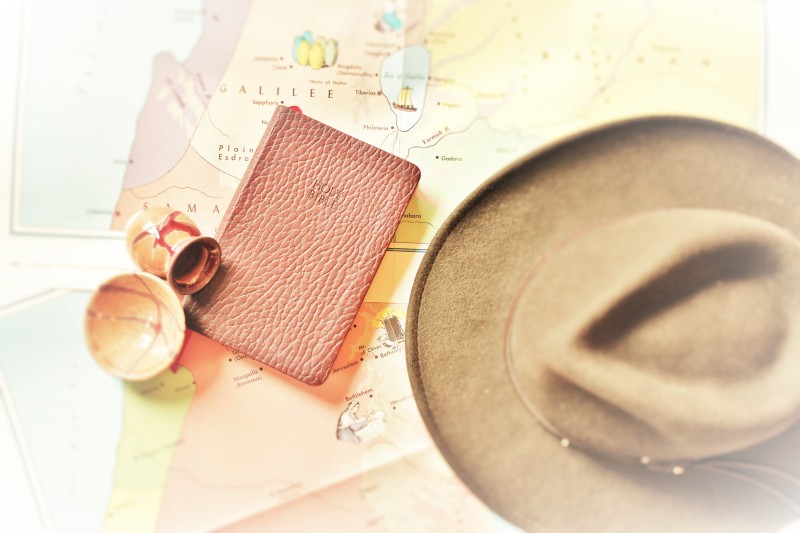
What’s in a name?

Here’s an experiment in the obvious: take a map of the world and read the names of countries in any one of the continents… Britain, Germany, France, Spain… China, Japan, Korea… Zimbabwe, Sudan, Nigeria… America, Canada, Mexico…

See how easy it is to roll right over them?

This is what I mean; we are attuned to ignore the obvious (Sherlock Holmes would be proud of this deduction). But every once in a while we turn our head, squint our eyes and suddenly a word we have read or typed hundreds of times looks like a foreign language to us.

Why is that?

I’m an English speaker, and I can cope with French, but I can’t easily read Middle English. Yet many of the words I use on a daily basis are mutants of the English linguistic past – let alone the influence of German, Spanish, Latin, Greek, Gaelic and Hebrew among the many other languages that contribute to modern English.

America, Amerigo, and Ap Meric

Yesterday I picked up a book that I had read a few years ago, The True Story of How America Got Its Name by Rodney Broome. It’s an interesting volume and as I skimmed it, I got to thinking about the many variations of the origin of “America,” as an appellation for the continent.

Nearly everyone has heard of Amerigo Vespucci, and how a friendly mapmaker gifted his first name to the continent. Well, maybe – but why use a first name, usually reserved for royals, when surnames were the norm for everyone else?

So Broome supposes that maybe it wasn’t Vespucci’s first name, but someone else’s last name on the map. Interestingly, Vespucci was on board a Spanish ship with an aggressive captain who readily attacked English vessels. At the same time an English vessel disappeared, carrying the famous explorer John Cabot in whose possession was a map illustrating the American continent and inscribed with the name of Richard Amerike (or Ap Meric, as it is in Welsh).

Call in NCIS, this has the makings of a mystery! Did the map change hands? Was Amerike’s surname on the map first? Could be.

America, by any other name…

If you search far enough there are a number of other origins for the name “America” that pop up.

Some claim that the Scandinavian Norsemen who came exploring the American continent in pre-Colombian times brought with them a phrase for this new western land, “Ommerike” that sounds roughly like America.

Other possibilities suggest the Mayans had a similar sounding phrase for their lands.

So what’s the truth?

Names that sound similar and move from one language to another can become mixed and “owned” by both cultures. Imagine the interesting spelling variations you can get from an answering machine if the caller’s voice isn’t clear!

In my opinion there is validity to the connection to Richard Ap Meric. As Broome contends, maps were precious at that time in history, particularly in areas previously unexplored by Europeans. If Mr. Vespucci got a hold of it, why wouldn’t he want to cash in on a similar sounding name? After all, exploring the new world was all about finding gold, glory and gathering fame back home!

The possibilities have merit… or is that Meric?

Every little piece of history…

I think there is a misconception about history. That you have to slog through a massive tome on the more esoteric details of Early Modern Germany, or whatever, in order to really grasp history.

If you get a kick out of Early Modern Germany, then great, enjoy, and there are some of us who do. However, in order to develop a working knowledge of history you really just need a good, solid curiosity and a few resources.

I personally will slog through the heavy volumes from time to time, but I also like a good documentary. Usually the fare of PBS, the BBC, and the History Channel, documentaries are a great framework from which to build a knowledge of history.

Why documentaries?

I like them especially for a couple of reasons. First, they are visual and visual people need to see something. Drawing word pictures in your mind from a book is fine, but to understand an historical event it helps if you can take a gander at the actual surroundings where it took place.

Secondly, a good documentary can help you overview a topic because no matter how detailed or specific the subject is, producers assume the audience will initially know nothing about whatever it is they are covering. Say you are doing a show on Hitler’s advance into Russia – most people know something about WWII, but generally the writers and producers will give a short overview of the war at the start.

This is like Cliffs Notes for history novices – a quick review or introduction that helps you wrap your mind around the topic and secure the details in the chronology of history.

Thirdly, a great presenter can make history come alive.

Docu-nots

Okay, now for the downside – documentaries will have a bias. You may agree with it, you may not. If you don’t, don’t watch it or watch it with reservations – there may be some interesting facts still to be gleaned.

Finally, just like a great presenter can make a great documentary, a really crummy presenter can bore you to tears – find the good ones, usually by trial and error.

Netflix.com, Hulu.com, and the like make history videos readily available, as do libraries. Search them out and add one to your regular rotation of entertainment.

Every little piece of history is one more part of the puzzle. One more fact, event or personality that helps us understand what mankind has done and will do. Put on your Indiana Jones fedora, sling your bull-whip over your shoulder and get exploring!

That takes me back…

History.

We all have a history and so does the world.

History happens every day. Think of it as one long, ongoing museum display – each day new images are created, new events occur, new biographies are lived – and with technology we see more of it, or ignore more of it than ever before.

Strange though it may seem, history is actually cyclical. What happens in the past will affect the future, and what happens in the future will affect how we view the past. Crazy, but true.

Join me on this web log for a journey into the past, the present, and the future. One historical event at a time!