Wall Drug: An American Experience

I’m back in one of those tourist haunts that helps define the geography of my life. That sounds a lot more romantic than it is. I’m in Wall, South Dakota, at Wall Drug, a strip of western themed tourist trap that is a true tribute to the effectiveness of billboard advertising.

(Image: Amanda Stiver)

When Ted Hustead and his wife moved to the town of Wall to operate their drugstore back in the 1930’s, they latched onto the idea of using billboards to advertise their wares to weary and thirsty passing tourists. If you have ever taken Interstate 90 across the state of South Dakota, you know what I’m talking about. You can establish your relative location in the state by the sheer number of “Wall Drug” billboards that stack up in herds along the freeway.

Selling the goods

The funny thing about it is that it actually works. After 1,200 miles of seeing Wall Drug signs, people become, quite naturally, curious. Even people like me who have driven these roads to see family so many times I can watch the scenery (or sometimes lack thereof) pass through my visual memory with my eyes closed. Familiarly provides no immunity to the lure of Wall.
(Image: Amanda Stiver)

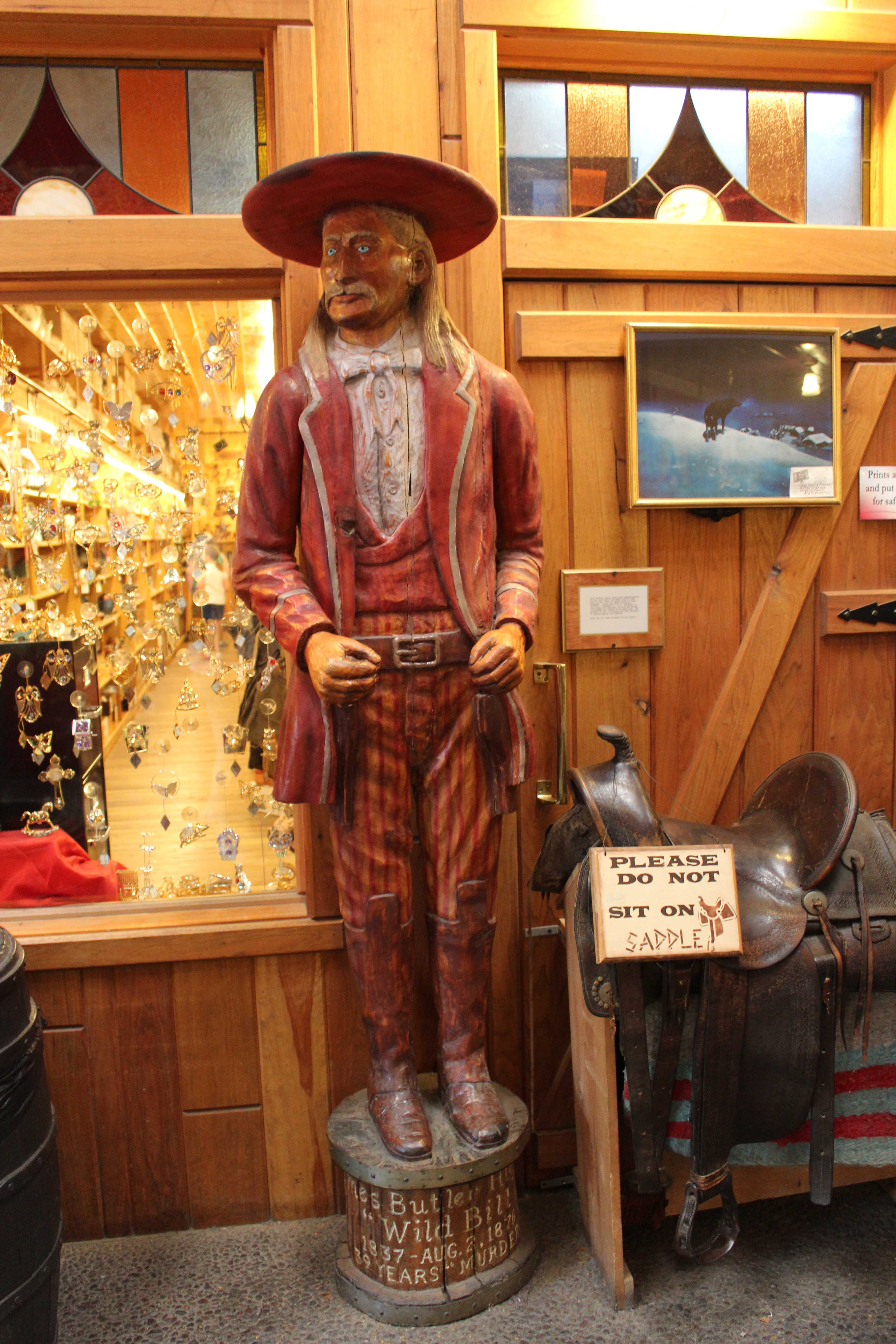
I think this is because Wall Drug, despite all the tourist adverts and schtick, provides things that tourists naturally crave – restrooms and cold liquids and ice cream. That and a nice bookstore and some quality western art. It also provides the myth of the west, with wooden cowboys and gamblers lurking in the halls of the indoor street. The complex has grown over the years, but the core is comfortingly familiar.

My last visit was 15 years ago, and by and large it remains the same. Families roaming the halls, ice cream in one hand, camera in the other. People taking a pit stop before continuing on to Mt. Rushmore or the Badlands. Just as I did on my visit years ago I bought a book, a definite step up from my initial visit when I was small and craved such sundries as cute little dolls dressed as western characters.

Questions raised

There is something plaintive, too, about a place like Wall. It raises questions: How long will tourism last in a tough economy? How long will we even recognize the quaintness of such a place? What does the future hold for a country whose younger generations know only a caricature of the history of the American West?
(Image: Amanda Stiver)

Maybe part of the answer is in that history of the peoples whose collective experiences made the West great. Where ideals of hard work, faith and justice, side by side with hardship and struggle fill in the spaces of the Western Myth of gamblers, claim jumpers, and outlaws.

If you’re in South Dakota and need a cool drink on your parched journey, stop at Wall and contemplate these questions and maybe you’ll be the one to find the answer.

– Amanda Stiver

I Beg of You… Don’t Hate History

Let the following numbers sink in and then I’ll explain why they’re horrifying…

(Image: Morguefile.com)

— A mere 20% of American fourth-graders (~10-11 years old) passed a National Assessment of Educational Progress U.S. history test with a “proficient” knowledge of their country’s history.

— Only 17% of eighth-graders (~14-15 years old) tested proficient.

— Worst of all, twelfth-graders, seniors in high school ready to go to college and become registered voters at 18 years old, scored a horrendous 12% proficiency (Stephanie Banchero, “Students Stumble Again on the Basics of History,” Online.WSJ.com, June 15, 2011).

I cannot number the times I’ve heard the now familiar statement, “Well, I hated history when I was a kid, but now I’m that I’m older, I’d really like to learn about it.” Followed by, “It’s probably because I didn’t have very good history teachers in school.”

I can’t fix the latter, which is the quagmire of our educational system dictated by politics. I can address the former; indeed I feel I must, so dangerous is this crisis.

I have but one life to give…

(Image: Morguefile.com)

Theoretically, 88% of American seniors know next to nothing about the country that gave birth to them, prospered their parents, allows their freedoms of dissent, and finally freedom to vote (or not to vote, as they wish).

88 per cent devoid of basic U.S. history knowledge! This is abysmal!

To me, as a historian, it is tragic because I love history, and my knowledge of the past lets me see into the future. Yet more fundamentally, I am appalled that our nation knows so little of its glorious, storied, sometimes dark, but often bright history.

It is tragic, too, because history is the fulcrum upon which our freedoms balance. Educationally speaking, math, science, and written word studies give us the means to improve our lot and style of life, but history hovers above, around, and beyond all that. History was passed on by word of mouth long before it was written down; it pre-existed and sustained those other disciplines. You can’t learn math if it is illegal for you to do so. History teaches us what is legal and what is not.

Most importantly, however, history preserves our knowledge of what freedom is. Without that, any dictator can come in and trounce us into submission. Without understanding the history of their struggle for freedom, any people can and will become the servant rather than the master. They no longer value what generations before fought and died to give them. They no longer value the representative government, the checks and balances, the useful traditions that give us identity, freedom of expression, freedom to meet together in peace, and freedom to transact government of the people, by the people, and for the people.

(Image: Amanda Stiver)

The Scottish Declaration of Arbroath says it this way:

“It is in truth not for glory, nor riches, nor honours that we are fighting, but for freedom—for that alone, which no honest man gives up but with life itself.”

Give me your tired, your poor…

To know history is also to learn compassion for those who suffer because so much of human history is suffering. It is to hear the cries of hungry children during the Great Depression, waiting for food that would not come because no food could be bought because no one had money and no jobs were to be found.

It is to hear the weeping of mothers whose sons died at Lexington and Concord, and at Gettysburg and Antietam. It is to see the fire fall from the sky as American soldiers invaded the coast of Normandy and made bombing runs deep into enemy territory over Germany to defeat the Nazis during World War II.

It is the struggle of pioneer families who made the hard, unrelenting trek across the American West to find a better life, full of greater promise and a more abundant future for their children and generations to come.

Learn to love history…

These low scores are simply one of the signs of a greater malaise in America right now. It will take us some doing to get out from under its apathetic and dreary spell.

(Image: Morguefile.com)

I’m prescriptive by nature, and every problem has a solution. I can’t think of a better way to illustrate how history should be taught, and how to find the stories hidden amongst the dates, battles, and personalities than to recommend the following clip of Andy Griffith teaching a history lesson. It is classic and unparalleled. It is how I see history when I read it – full of life, full of great causes, full of heritage.

http://www.youtube.com/watch?v=aGXCH7zBdc4

In my next post…

I will concentrate on ways to re-invigorate a personal and family love of history with book and magazine recommendations and other ways to make history approachable. Man or woman, parent or child, young or old it is essential to find a way to learn U.S. and World History, and to learn to love it… stay tuned.

– Amanda Stiver