My Kingdom for a Ship

A Short History of Athenian Naval Wars

From about 506 B.C. onward until 322 B.C. the Greek city-state of Athens was in a nearly continuous state of making war or preparing for it. And lest I single them out, so were the rest of the Greeks as well as the Persians and generally most of the occupants of the Mediterranean shores.
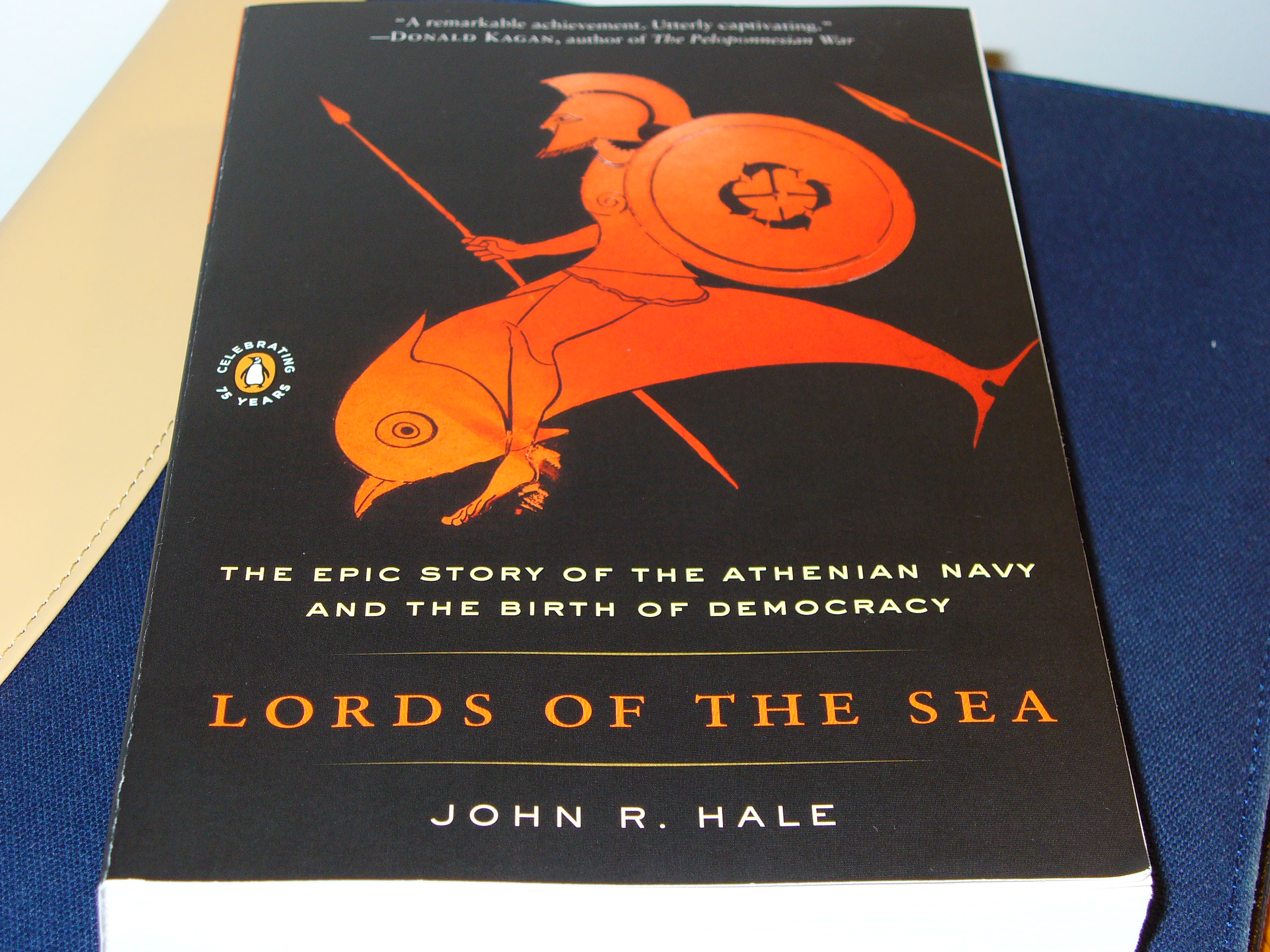
To help you locate it, here is an image of the cover.

According to John R. Hale’s Lords of the Sea: The Epic Story of the Athenian Navy and the Birth of Democracy the Peloponnesus, that peninsula that juts into the Mediterranean and which is connected to the Greek mainland by a narrow slip of land called the Isthmus of Corinth, was embattled with internecine wars, primarily between the Athenians and the Spartans (of 300 fame).

Oddly, these two archenemies could also be allies if the need arose. When the Persians to the East decided to wage a campaign to increase their imperial holdings in Mediterranean Greece, the two allied against Kind Xerxes. This led to the famous Spartan loss at the Battle of Thermopylae in 480 B.C. followed in concert by the victorious Athenian naval battle of Salamis in the same year. At Salamis the Greeks wailed on the Persians and rendered their fleet useless.

Athens rules the waves

Hale explains that Athens was a significant naval power from this point onward until the rise of Alexander the Great, and the ensuing Macedonian empire (322 B.C.). They policed the Mediterranean and brokered deals with various city-states, receiving tributes of silver or gold for protecting harbors and ships on the sea. Athens invested in its navy by building a fleet of the state-of-the-art ship of the day – the trireme.

This vessel, originally a product of Phoenicia, was 120 feet long, powered by rowers on three tiers (hence trireme) in the hold. The Greeks added a top deck that could double as a troop carrier for marines. It was guided by a steersman and commanded by a trierarch. It was the kind of ship that worked well on calm seas but was useless in inclement weather when swelling seas could pour water into the oar ports and swamp the ship.

I’ll have my say…

The author of Lords of the Sea contends that because the ships relied on significant manpower the less wealthy individuals who risked their lives to row their superiors in the Athenian class system (the steersman and trierarchs) to and from battle wanted and had the leverage to demand a voice in the Athenian assembly. This resulted in eventual suffrage and leadership roles for all citizens of Athenian society, regardless of wealth.

The investment of funds and lives in the Athenian navy meant that those who served, every male citizen, had a say in the governing of the city. This was the motivating force for democracy in this place, at this time in history. It did not, however, mean that Athens was the ideal democracy.

Missteps

The Athenians grew, through alliances with other city-states and the tribute paid to them, into an imperial power. If your city-state angered or defected from the league you were subject to the wrath of Athens, generally wholesale massacre of all citizens in your city. If Athens didn’t get enough tribute from its allies it would also resort to pillaging and piracy to gather the extra funds from enemies and allies alike.

Occasionally the democracy would even turn self-destructive. After one famous victory against the Spartan navy at the Battle of the Arginusae Islands in 406 B.C. six of its victorious generals were executed for failing to pick up the bodies of the dead from the sea because of bad weather despite their overall success in the battle. One of these generals was Pericles, the son of Pericles, the great man of Athens.

Athens had a democracy, but it also had great men of vision who guided the democracy: Themistocles, Pericles, Socrates, and others. However, without these men who could think into the future, Athens struggled.

Hale’s writing is easy to read, but the book is a little battle heavy as one reviewer put it. It gives a clear analysis of Athens and its naval ambitions, and really, much of the rest of Greece during their heyday just prior to the ascension of Alexander the Great and the Macedonians.

Gateways to History: Getting Started

What makes a person like history?

Is it just a quirk of personality that leads them to be insatiably curious about the past?

Is it a family member who shared his or her own love of history?

Is it just a coincidence of factors: good books, great teachers, a need to know?

All of these things can contribute to the creation of an avid historian, but what if you didn’t have the benefit of such circumstances – are you doomed to dislike history?

Not at all! There are other gateways to history and finding yours is the challenge!

Image: Amanda Stiver

Image: Amanda Stiver

More than one way to… study history

History is stereotypically fed to students via the textbook and a class lecture. A good textbook can spur an interest in students, but more importantly a good teacher can spur a lifelong love of the subject.

I had two particularly memorable high school history teachers. They each had a different approach to teaching, but were equally successful.

One teacher taught by lecture. The good thing was that he was one of the best lecturers I have ever heard. He gave us clear instructions from the start, if you want to get a good score on the Advanced Placement U.S. history test at the end of the year, then read the textbook twice. His expectation that we would do our reading and come to class with a clue about the day’s subject freed him up to add extra material from his vast store of historic knowledge during the lecture. He could tell a great story.

The other teacher had a different approach, but was also a gifted storyteller. She was a multi-media historian. We watched videos, read textbooks, read primary source excerpts, viewed art history slides and maps, did re-enactments, had class discussions, and completed writing assignments. She illustrated to me the importance of a variety of sources and approaches that make the subject vibrant and alive!

I had other great teachers, but I think this makes clear that the best gateway to a love of history is a fantastic teacher.

Find your gate, take the path

If you don’t like history because you had bad teachers, all is not lost. Try this: go watch a movie that has an historic setting or read an historical novel. How many people who went to see 300 or Braveheart consciously thought they were going to study history – surely not many.

Movies and historical fiction aren’t perfect, but they are a kind of gateway. Ideally they should spur a curiosity into an area of history that draws you to your local library and a good book on the subject. They are highly interpretive, so by all means, if something sounds far-fetched in a book or movie – go prove the author or directors wrong by researching the subject yourself.

Let a productive curiosity be your gateway into history. Maybe you want to know more about family genealogy – research the era in which your relatives immigrated! Maybe the history of a national or religious holiday has always made you wonder about its origins – go find out! Perhaps you read a short article that was so well written it made you want to know more.

Best of all, if you are planning a trip, don’t leave until you have at least one book under your belt about the area you are going to visit. When you get there, go see some of the places you read about, make the story come alive.

Once you cross the threshold, keep your curiosity alive. Make it a challenge to find the thread that connects each historical era or subject you study or come across. Or my personal favorite, when you’re at the store and you get the total cost of your purchases, take four of the digits and try to remember what happened in that year in history. If you can’t think of anything, go home and use a search engine to find out!

Take the plunge, it’s more exciting that you ever imagined!

Play Me A Dirge, Matey…

A few years ago my folks were out on a garage sale tour and they came across an estate sale with a significant collection of books. Garage sales are fun on their own, but with the added incentive of books they are irresistible, to me at least. So I went along.

The collection was breaking up at a rapid pace, but before they disappeared I located part of a series of Time-Life books called The Seafarers. I ended up with eight volumes out of a set of 22.

Ever since high school when I read C.S. Forrester’s Captain Hornblower I have been curious about naval history. I’ve not sailed, but have had the chance to tour a replica of Captain Cook’s HM Bark Endeavour and my haul at the estate sale came as a boost to my curiosity.

Would you be interested in buying…

I remember commercials for Time-Life books when I was a kid, but I didn’t realize, until I got my hands on the nautical volumes, how detailed and fascinating they were. The illustrations are spectacular and the writing very approachable.

Collections of books like the ones sold by Time-Life take me back to the days of encyclopedia sets as well. My mom tells me childhood stories of curling up with a crunchy apple or wedge of cabbage and reading through a volume of the encyclopedia. I remember going through our own set and being fascinating by the pictures and the concise descriptions or explanations of various entries – mostly scientific.

The history of science

It wasn’t until my parents did some research that we learned the rocky relationship encyclopedias have had with history. Early on in the 18th century these compendiums of knowledge contained history as well as the burgeoning study of science and the natural world. This trend continued until the early 20th century, around WWI. At this point the history got dropped in favor of the multitude of scientific discoveries that were coming along at a rapid pace.

Our modern default setting is for science and scientific proof to back up even historical discoveries. Sometimes this “proof” is debatable, science itself not being a science, but an art and subject to interpretation. Human witness can get relegated to second place behind scientific substantiation in anthropological and archeological pursuits. Perhaps not always without cause, humans can be liars.

Meanwhile, I will continue to enjoy the pages of well-reasoned, carefully researched history and see if someday I can track down a few more volumes of The Seafarers.

Reminiscing

I’ve written about using documentaries, historical journals, museums, and re-enactments to explore history, but I can’t go on without praising one of my favorite publications. It is a magazine that brings primary source history to my fingertips and reminds me of the struggles and challenges my parents and grandparents faced.

Don’t jump to conclusions! I’m not talking about WWII history magazines, archeological reviews, etc. I like those too, but they’re for another day.

I’m talking about entry-level history where even the most disinterested beginner can take a bit out of time and enjoy it.  A visual layout with great, short, first person reports on the historical past of the 20th century is the fundamental strength of Reminisce magazine published by Reiman Media Group which is a subsidiary of The Reader’s Digest Association, INC.

Tales of the past

This is the kind of history that you might hear your grandparents or great-grandparents tell if you are lucky enough to have these resources still alive. It isn’t ground breaking, never-before-seen historical research, but it is just as important. Knowing the daily details of the past and the experiences of our elders help us to live a fuller life, to respect them more, emulate the great things they did, and, one hopes, not make the same mistakes.

Magazines like this are a great teaching tool for kids and teens and a way to get them interested in history. Reminisce in particular has a surfeit of photographs, illustrations, and reprints of old cartoons and advertisements. Every issue is colorful, like having your own personal museum to page through whenever you need to fill a few minutes.

Did people really act like that?

After flipping through the past, it might surprise you to realize how degraded our current society has become. Wholesomeness is not something marketers feature much anymore. We are so used to the world in which we live that sometimes it takes a virtual journey back in time to realize how sordid it has become.

Scanning the advertisements of years past is an education in what people valued. The advertising professionals of the era designed their material to appeal to those values: wholesomeness, dignity, respect, faith, hard work, thrift, good clean fun, cleanliness, good cheer, family, marriage, the innocence of romance. From our 21st century cynical viewpoint we often see this material and think it looks hokey or syrupy. Kind of sad that good clean fun isn’t considered fun anymore.

There is one requirement when delving into this kind of historical record (or any part of the past, actually): check your modern sensibilities and put them aside, don’t reason from our contemporary perspective. Trade cynicism for a lighter approach to life in order to appreciate an era, only a few decades old, which had a greater sweetness and innocence than what we suffer through today.

Read Me A Little History…

Read aloud. Or better yet, listen to someone else read aloud. Really, try it!

Sound a little too dramatic? Seems kind of weird, maybe, because we don’t do that kind of think anymore. Or do we?

Have you ever watched a news anchor talk at you? They aren’t gabbing from memory – they’re reading aloud! Yep, from that teleprompter screen right next to the camera!

Guess who else reads aloud? Right – politicians. Teleprompters being the modern default, but some still use good old note cards.

Whatever the case, they are all reading aloud. We do a lot of reading these days, the Internet has made that a necessity, and so we don’t often take the time to read out loud from a book. However, back before moving pictures, radio, television, and Internet folks regularly read to each other.

Tell me a story, read me a book

On a cold winter evening around the fireplace of a rough log cabin, by the light of homemade candles, settlers would read out loud from the Bible, maybe Plutarch’s Lives (thank you Seven Brides for Seven Brothers), or perhaps a collection of Shakespeare. They didn’t have many books, but what they had, they read.

It was entertainment and education. Poetry was read aloud (sometimes from memory) as were plays, works of fiction, works of history, and religious works. It was a shared experience.

If you read aloud often enough, you begin to understand written works in a different way. Try reading the Bible silently – zoom through a few verses in the historical books of Chronicles or Kings – kind of dull, you say?

Okay, change tack, read aloud as if you are narrating a Cecil B. DeMille production of epic biblical proportions! Make sure that your audience, real or imagined, can understand each word and that the transitions from action to description are clear. Suddenly it isn’t so dull! Try the same thing with Jane Austen – you’ll be amazed at how her works come to life!

Reading aloud is an art form and a connection to the historic past. Back in the days of limited literacy those who could read aloud did so that others would have a chance to hear whatever it was they were reading. It was the default mode of literacy for many centuries until fairly recently.

Try it and you’ll find that a simple activity like this is a fun trip to the historical past.

When is history fact – wait, let me revise that…

Human interest in its own history has been around for, well, since humanity began. Through different means – oral, written, re-enacted – has history been passed down between generations. It was important to live up to the expectations and deeds of the elders.

Herodotus is given credit for being the father of history, but if we look further back we will find that various cultures had already been recording their history in writing. The Israelites spring to mind with the earliest historical works in the Bible: the five books of Moses.

Were all of these accounts (Greek, Roman, Babylonian, Israelite, etc.) factual? Some yes, some no. Do humans revise their history? Certainly. So are there really facts in history? Yes – the key is how to find and organize them to accurately understand an historic event.

You printed what?

Think of a reporter in an old black and white film, being chewed out by the editor of the paper for not getting the facts. The editor goes on to remind the wayward employee that he needs to get back to the basics – who, when, where, what and then, maybe, how and why!

Reporting or researching history works along the same lines. Who was involved in the event in question? When did it occur? Where? What kind of event was it? These can usually be verified by physical evidence – inscriptions, written records, archeological ruins, etc.

When the concrete details are corralled, then the suppositions may begin. How was it done? And, most iffy of all – why it happened?

It’s like working through one of those logic puzzles, with a series of clues and a criss-cross chart. Verify the easy items first. Then come the mental gymnastics.

See, what I really meant was…

Revise means to correct or improve – not a bad idea if past research was flawed or a supposition was off base because of societal taboos or bias. It has another meaning, slightly less virtuous sounding – to amend (not so bad) or alter (hmm, bad).

Alteration to rectify a mistaken fact is what history is about, but altering an historic record to change the interpretation based on current societal bias, personal opinion or grudge isn’t history – it’s misleading and dishonest. Ironically, the record of human history is full of this kind of revision.

To see through revision, learn about the authors; find out their philosophy of history. Then if you subtract the bias of their philosophy, does their interpretation still hold up? Be your own historian, be it academic history or any story or human event because, tomorrow, it will all be history!

Skimming is not just for milk…

So far I’ve learned that Athens had a Navy, a rather glorious one, and that in order to work this miracle the Athenians had to turn themselves into a democratic state. This all took place from about 483 to 322 B.C. on the Peloponnesus (information courtesy of the back cover blurb and index of Lords of the Sea: The Epic Story of the Athenian Navy and the Birth of Democracy by John R. Hale).

On a trip to Costco today I spotted this volume by Hale and it now has the honor of residing on my reading pile. It was a tough decision, but the Athenian Navy won out over other front-runners like Teddy Roosevelt as Conservationist, the Mayflower, and a history of the Battle of Trafalgar. I am already endowed with or have access to books covering the Napoleonic naval wars, the landing of the Mayflower, and several biographies of Theodore R.

I would like to give a full-scale critique of my purchase, but I haven’t read it. However, I have employed my trusty skimming skills, my old allies since discovering a book on speed-reading in high school. I figured that was the only way I could make it through my U.S. Advanced Placement History textbook and ace the test (I did and I did).

Read a little, learn a lot

I love the subtlety of skimming (it’s  sort of like literary espionage). With  one glance at the cover I know title  and author. The back cover or inside  jacket flaps give me a summary of  what the book is about as well as  reviews. A word on reviews, they are  either insightful or worthless –  depends on the author, so don’t  always take their word for it.

Next I march on to the index, which tells me how the author organized his research and thoughts on the subject. I flip through the book and see what visuals it has to offer. Visuals aren’t important for everyone, but if I am going to take the time to read the whole text on Greek history and Athenian democracy I would like to hope that a handy reference map has been provided.

Finally, I get to the words, the prose. I read a few paragraphs of the introduction in search of a thesis or specific purpose statement as well as perceived bias. Then I trudge through, sampling a paragraph here and there for style and content. If the writing is really tedious, and I don’t have to know the subject matter – I don’t want to read it. Lastly, I read the final few paragraphs in order to know if I want to spend those precious hours working word by word through the entire book.

All this takes about 3-5 minutes and by then I have made my decision to purchase. Not only that, I have now a framework for all the material I will glean from reading the book. This is a valuable memory and comprehension tool.

Try this technique on your next read and see how it works for you!

The Internet: Research Tool

In my college days the Internet as a research tool had the reputation of a con artist heading up a charity. Academia didn’t like the idea of all that unsubstantiated “chatter” out there.

Well, times are changing and a little over a decade has given the Internet a sheen of respectability. It’s still a jungle of information but not a dead loss.

The Internet is a useful tour guide. With regard to history, Wikipedia and the like are a good starting point if you want basic information and are prepared to swim through a river of bias to get it. Encyclopedic sites that are reader-written have obvious problems – anybody can say anything!

Start there and move on to verifiable sources: books, official journals, news items (although, depending on source and with the political bias of many news sources, take them with a grain of salt), and official websites. Some of these are available on the Internet. And then there are story verifying watchdog sites (like Snopes) that come in handy.

Find the Facts

“Verify, verify, verify” is the catch phrase of Internet research. So much information, often self-published, is circulating that you have to consider it questionable until you have two or three sources to back it up.

If I’m trying to recall an historical event and it’s just barely escaping me, search engines can take the details I do remember and lead me back to the source. That is the beauty of the being online.

I’d like to say a word for online bookstores, like Amazon, and their review pages. Thrown in with the occasional crank are useful bits of information that may lead to another book or source of study.

Research on the Internet is still much like putting together a jigsaw puzzle with part of the information here, another fact there, mixed in with a lot of repetition, or on the downside, a bunch of lies.

Tread the river of information carefully, and be grateful we have the freedom to produce it!

UK Election, Hung Parliaments, and History

Watching the electoral machinations of another country carries the detached, but comforting sentiment that, “ah well, they do have their problems, don’t they!”

It makes us feel better about things back home – almost. Knowing that leadership around the world seems to be faltering on a variety of levels isn’t really comforting, but it is a distraction.

This most recent election in Great Britain has been interesting to me, for its import on a national level in the UK, but also because of the situation it created, a hung parliament.

Three-for-all

Being an American, I’m still trying to wrap my head around the British Parliament and it’s associated traditions and functions. A multi-party system has its share of challenges and this most recent election proves the point.

Three parties took the lion’s share of the general election: the Labour party (of seated Prime Minster Gordon Brown), the Conservative party, and the Liberal- Democrat party. By vote the Conservatives won the most, but in order to create a cabinet and functioning government, a more significant surplus of votes was required for an outright Conservative win. Labour came in second, and the Liberal-Democrats third, with a much smaller percentage.

This is where it gets tricky because, suddenly, the power play is in the hands of the third party – though small, it is the deal breaker. A coalition must be formed by the first two in line or no one has the momentum to rule. Thus, the third party becomes the bride and the first two her ardent suitors.

In this case the leader of the Liberal-Democrats, Nick Clegg, decided on a coalition government under the Conservatives (ironic, as these two parties tend not to be ideologically closely related) and their leader, David Cameron. Using the analogy of American politics, this is like a Republican president peopling his cabinet, attorneys general, and other administration posts with Democrats as well as members of his own party and adding into the goals of his administration, those of his opponents. Thus, you see the complications.

Once the hashing out has been done, Queen Elizabeth invites the prime ministerial candidate with the best odds of creating a coalition government to her presence and asks him to form a government (or as we would style it, an administration). This makes it official. It is the pomp part of the equation that is at once quaint and foreign to those of us from the States.

As a result the new Prime Minister is David Cameron.

Where’s the history?

That’s just it; this is history. The last hung parliament was in the middle 1970’s, it doesn’t happen often, but when it does, it makes for a lot of drama.

“Present-vision,” which is the inability to recognize an historical moment while one is in it, affects us all. We don’t realize until someone tells us later that, yes, your freedoms were being rapidly erased by a government with starkly different views on social structures. Or that, yep, that war in the 1940’s was a big deal!

Worse than present-vision is historical illiteracy. When people can’t look at the past, get the facts, and believe what happened happened, then they, by default, ask for a repeat performance. A few charmers from my college days, “That Soviet Union thing, well, it didn’t work out so well, especially if you disagreed with anybody in power,” and “No, the United States did not know they were going to win the Second World War when they entered the fray, that’s why they had to fight a war!”

Live in the present, but learn from the past, and look to the future!

Do you remember when…?

The details of the past are accessible by a single question. Being an historian only takes that one question and someone with a story to tell.

There are so many assumptions about history – primarily that it is inaccessible and boring. It really isn’t. It just takes someone young asking an elder what they know about the past.

History passed down in this way is referred to as an oral record. Often, people who yearn to research their personal genealogy become the default guardians of this historical record in their family. They were the ones who cared enough to find out about the family history before the bearers of that record were no more.

Sometimes we assume that once we’re tagged as the “family historian” we’re expected to write a book, which is a great achievement, but simply being able and willing to one day share those same stories with a younger generation is a great achievement, too.

Be the link – learn the history – pass it on.