Tomorrow’s History: Weekly Roundup (Trump – Holocaust – Year Without Summer)

“Today’s news is tomorrow’s history,” is a quote attributed to Judy Croome, a South African writer. However, the jist has long been known to historians, is ignored by politicians and celebrities, and has become the fight song of History teachers throughout the world…if only students would listen!

So follow along as we look at some current events, possible implications, and a few random pieces of history that should interest and amuse:

THE GOP PICKS A FINALIST:

DONALD TRUMP APPEARS TO BE THE GOP NOMINEE FOR THE 2016 U.S. PRESIDENTIAL ELECTION

It seems the era of American oligarchies may have begun (though it has surfaced now and again for decades). Mr. Trump has the luck of FDR with him at the moment…a promise of better things, regardless of the existence of a down payment. Mrs. Clinton is a known quantity with a great deal of baggage and bad health. Mr. Sanders plays well before but one audience, the young, starry-eyed Millennial population that has been taught to idolize the socialist ideal, but has never lived in its dangerous and constrictive borders.

Above all, Mr. Trump is shiner, wealthier, and exudes more power, and those three things play well in American elections, especially in an era of underlying financial recession (where the economy looks good-ish on the outside, but beneath it is in peril). The outcome remains to be seen.

Whatever the choice, it is clear the U.S. is barrelling rapidly away from the foundations of the Union, the Constitution. We are drifting perilously close to the shores of a confederacy, rather than a union of states. Love them or hate them, the Judeo-Christian principles upon which the nation was founded gave us greater purpose, cause, and humanity. Without that we tread toward a dark age (incidentally, those are never pleasant to live through, and most die in them).

TO REMEMBER THE HOLOCAUST

An interesting news story re-surfaced this week thanks to the algorithmic aggregators of news that feed us our daily thoughts on Facebook as it followed on the May 4th and 5th occasion of Yom Hashoah (Holocaust Remembrance Day), commemorating the Jewish lives lost in the slaughter by the Nazis. Featured on the “House Beautiful” magazine website, it related the discovery last year by renovators in Holland of an inscription on a door. Written in 1942, it appears to be the last written testament of a Jewish couple in hiding during WW2 (Nikki Erlick, “A House Reno Reveals A Heartbreaking Message Etched Into A Door,” House Beautiful at HouseBeautiful.com, July 17, 2015).

A short, simple inscription in Dutch which said, “Look on the roof and find my last personal things and try after the war to find family of ours. Give them my things and you will become something. Oh God of Israel, have mercy on your humiliated brothers. Signed, Levie Sajet born at 1-8-1881 born in Nijmegen and his housewife Ester Zilberstein born at Stettin on the 28-7-1899.”

Tragic events in history can become so big and anonymous that we sometimes fail to relate on an individual level to those who have suffered. But such a short, sad witness to two lives must affect us. It must bring us back to the understanding that people just like us died then, and die now, and that murder is evil.

This tragic replay of history was cited in a quote by Mordechai Palzur, a Holocaust survivor and former diplomat, “I’m not sure that there is any improvement because we see that hundreds of thousands of people are being murdered and they are showing how they cut off the heads and so on and nothing happens [referring to the current conflict across the Middle East]. I would not generalize and say that there has been a change, but altogether from what we see today the people who were cruel then they are cruel today,” (Sam Sokol, “Against Orders, Some Diplomats Saved Jews During Holocaust,” The Media Line for The Jerusalem Post at JPost.com, May 5, 2016).

1816, THE YEAR WITHOUT SUMMER

Let’s take a step back, say, two-hundred years to 1816. It was, in many ways, a frightening year. The sun stopped shining brightly, crops failed (accounts speak of frosts in mid-June), and the warm, sunny productive season of Summer was nowhere to be found. Don’t worry, in case you are, it wasn’t man-made global warming, but rather…just plain old global cooling courtesy of the planet itself.

The reason, fully understood much later, was a volcanic eruption in the Indian Ocean. Mt. Tambora, erupting in April 1815, had sent ash high into the atmosphere, which manually blocked the sunlight from filtering down to the surface of the earth, where it was needed. Overall the year wasn’t an overly cold one, it just happened to get very cold right during growing season leading to crop failure and food shortages. Even Thomas Jefferson noted the phenomenon in his copious records keeping at Monticello. (Robert McNamara, “The Year Without A Summer Was A Bizarre Weather Disaster in 1816,” About: Education at History1800s.About.Com, November 27, 2014.)

Some historians even suggest that this dismal year for crops pushed restless souls west to seek better land, becoming therefore an impetus for the vast westward migration and settlement in American history. My own family, one of them at least, had just survived a stint in Napoleon Bonaparte’s army in the disastrous invasion of Russia of 1812. He picked up his family a few years later in the 1820’s and departed the Swiss-German borderlands for Pennsylvania, a generation later his children would push west with the rest of the migration and settle in Nebraska.

The lesson, watch out for earthquakes and volcanic explosions that have far reaching consequences (I say this as we experience an increased amount of seismic activity in the Ring of Fire). Also, remember, an event here, a consequence there, and we, too, can feel the very pulse of history, if we are not careful. Events trigger other events, so keep your eyes open and stay the course!

I’ll be back next week to bring you another weekly roundup of tomorrow’s history!

Keeping thinking history in the meantime!

– Amanda Stiver

Getting the Story…the Whole Story

get-the-story-the-whole-story

Source: morguefile.com/eskodesign

HISTORY.   Or just, the news. When does the one become the other?

A hundred years ago the news was on the page of a newspaper, heard through the local telegrapher’s office, or announced at public meetings or church assemblies…or through gossip. Radio hadn’t quite arrived in 1916, and TV was a long way off, to say nothing of the Internet. So the news usually came at you…relatively slowly.

Is it slow anymore?   Hardly.

What do we owe our intelligence as consumers of this deluge of digital, video, audio or printed matter? We owe ourselves and we owe others the truth.

How do you get the truth from three minute video news stories. Twitter and Facebook posts of a handful of words? Instagram images that tell but one single thread of what ought to be a fully woven story?

TAKE YOUR TIME, QUERY YOUR SOURCES

FIND your way, slow the news down. Digest the story. Then consume another. Look at a story or news item as if with facets. Each side should be explored and there are usually even more than two posited sides of the story. Find those facets and analyze them by a standard of truth.

Find out the bias of the report you’ve just read or watched. Learn about the writer, the  news agency, what is their political interest, what is their national interest? Analyze the thread of logic. Seek wisdom, and if there is none, find out why.

Go to news sources outside your country, not because they are always right, but because as was wisely written…

“…in the multitude of counselors there is safety.” (Proverbs 11:14).

TRUTH

THERE is truth. You have to assume that somewhere, buried beneath the landslide of blather it exists. But to find it, you often have to put your own self interest aside. The greater good…what is it? The rule of law…what supports it? What precedents lead to good government? Good leadership?

And remember…after you find the truth, don’t let go of it.

History is made in the stacking up of events. News stories are made, in many cases, in the moment and for a moment’s notice.

Seek the long term. Find the history.

– Amanda Stiver

Quotes and Thoughts: The Revolutionary War and the Price of Rebellion

“Like most ‘wars of liberation’ the American War of Independence was a bitter civil war too. One contemporary guess divided the people into three: the patriots, one-third, the Tory loyalists, one-third, and the remainder prepared to go along with either party. It is likely, however, that those who declined to take an active part were fully half the nation, the militants being almost equally divided, though the Tories, by their very nature, lacked leaders and the extremism which drove the liberators. They looked to leadership from England and were poorly served.” — Paul Johnson, A History of the American People, 1997, page 171.

WHAT can a random quote from a history book on any subject teach us? Isn’t this an exercise in futility? Don’t we need more information?

WE do need more information, but let’s use this exercise as a memory building tool. When developing your historical memory, and yes, memory function comes pre-installed in our brains when we leave the production center (other wise known as ‘birth’), you need to retrieve the current stock of what’s stored up there. Find out what you know, and then fit in the new information presented in a quote like the one above.

So what do we know?

Let’s start with the quote itself…what era, or period of events connected in historical continuity, is the quote referencing?

Okay, let’s assume first that we are Americans reading this quote. If we have spent any time in a US school we’ll have some idea that the “American War of Independence” is also known as the Revolutionary War (note, the author is British, so he is using the academic title from across the Atlantic for that colonial disturbance centering around 1775). We know that the events surrounding that era had to do with a break with the British government, which had in various ways originally and until that time considered the 13 colonies of the eastern shore of the now United States to be British territory. There were strong, vocal colonial opponents of British oppression, excess taxation and lack of Parliamentary representation, and these we, as Americans, know as “Founding Fathers.” George Washington, John and Abigail Adams, Sam Adams, James Madison, Thomas Jefferson, Patrick Henry, John Hancock, Benjamin Rush, Benjamin Franklin, Richard Henry Lee, among many others. They were extremely influential in the early years of the United States and all the constitutional and legal documents written then.

As the quote shows us, there were also opponents of the rebellion who were called “Tories”. They desired to remain loyal to Britain, wherein many of their business interests were entwined. They were fighting for a “status quo”, which is a difficult position to fight from, and particularly, as the quote implies, without solid recognition and support from their motherland, England. Indeed, may of the Tory families were treated with nearly as much contempt as rebel families by the British Army when it arrived in the colonies and was installed in the homes of the colonists. It was difficult to remain loyal to a country that didn’t seem to want them.

An additional fact that we can add to our historical memory is that, as the quote explains, there was another group of people who simply wanted to live their lives, without interference from either side of the battle. Perhaps they were unsure of the outcome, or unsure where their true loyalties rested, or maybe it took a bit of convincing through the brutal realities of British occupation that they eventually had to stand for something. Who knows, but it does tell us one thing, that despite the noises of the “militants” and “activists” in any nation, and any cause, there will always be those who simply want to grow their crops in peace, make a life for themselves and their children. These are the people who eventually struggle on when the voices of the extremes have faded and, sadly, these are usually the people who get trampled by both sides in their quest for supremacy.

Am I saying the Revolutionary War was an aimless quest? Not at all, Britain and America were on a course for separation, and the tendrils of financial investment and history between the two made it almost impossible for a separation to come without bloodshed. Is this the best way for people to reconfigure their alliances? No. Is it the way of humanity? Yes. Is there another way? Yes, but not without help from a power greater than the finest of our human minds. A subject for another time.

SO, AS OUR EXERCISE comes to a close take a moment to realize all that you already had in your historical memory about the Revolutionary War. Are other details coming to you that you may have picked up from articles, books, or even movies? The way people ate, fought, dressed, scenes reenacted of the battles and atrocities wrought on some colonists (I’m thinking of The Patriot here)?

We’ll do this again sometime, using a quote as a gateway into history. You’ll be amazed at what you know already and can learn!

Keep thinking history!

– Amanda Stiver

What Other Flags Fly in Support of Slavery?

IT’S A WEEK for heavy subjects, so let’s look at the recent flag removals from Southern state capitals…

Though the removal of the flag of the Confederate States of America (a long-dead representative republic based, economically and culturally, on the repugnant sin of human slavery) ought to have come many years ago, not just in reaction to a tragic massacre, but as a matter of course of the acknowledgement of the Union of the United States after the American Civil War; one cannot help but notice a certain hypocrisy among American politicians.

Readily and eagerly they hop on the bandwagon of publicity by taking down flags of a defunct republic (a noble thought, but not one that faces significant opposition), while at this very time, a mere 12 hour flight away, another self-proclaimed nation/terror state – the Islamic State, which is a theocracy, and does violence and murder to any under the rule of its flag, is also presently, culturally based on the human slave trade.

Why are these same voices in America so utterly silent? Why, if they truly wish to abolish the sin of human slavery, do they not declaim those who continue to indulge in its depravity around the world, in the Middle East, in Asia, and other places?

Keep thinking history.

– Amanda Stiver

Tragedy in Charleston…Division is Destructive

YOU KNOW, what strikes me with this latest tragic shooting in Charleston, is that while the US media has been preoccupied with the high profile psychological problems of two individuals (Bruce Jenner and Rachel Dolezal), we have been neglecting the core principles of what makes America great. It is our heritage of honor, dignity, respect, morality (hard fought for during a bloody Civil War), and, most importantly, fear of God and His Law, regardless of ethnicity, that has made and can make America great. Bluntly, our professional media is divisive and destructive. Respectful coverage of the lives of the individuals lost in this recent shooting will be neglected for political aims (as we lead up to a campaign year), and skewed for various agendas. Tragedy of loss of life, compounded by the tragedy of division.

As a student of history it is not impossible to understand that what happens when a society is riveted by its rifts and hatreds, its criminals, and its moral inadequacies. We can look to the debauchery of Rome as it slid into oblivion to see a case study for lost focus. America is great because it is full of regular folks, being regularly law abiding, and caring about their neighbors, regardless of ethnicity. Millions of immigrants from various backgrounds have come here to become “Americans.” Some came by force, some came by choice, but without that coalescing of identity into “American” – we will become stressed and fractured by division, hatred and violence. America is framed by a set of laws, a Constitution. Back in the day, a constitution was what we called our human frame, our bodies. If you don’t have a body of laws that frame our society, that protect the individual and define respect for same, we have nothing, we simply have to wait for the “strong men” who want a piece of the action to hack away through violence and intimidation so we can pay for the pleasure of not being killed. Am I being extreme? I think not…please refer to recent coverage of the Middle East and the rise of ISIS.

ABRAHAM Lincoln once quoted this simple statement, “And if a house be divided against itself, that house cannot stand.” If you want to quote Lincoln’s source, see the book of Mark, chapter 3, verse 25.

If we continue to feed on divisions, to disdain the beauty and mechanics of law abiding, and to neglect the value of life, our house, our nation will fail. If by chance, we can summon the courage, by the grace of God, to reject division and those that feed on it, to treasure the Divine intelligence of Law, and to respect life…we might, might have a chance. The choice is ours.

Value, and keep thinking history! For we are living tomorrow’s history today.

– Amanda Stiver

Potholes and Pitfalls: The Bumpy Roads of History

“That’s how history works. The mundane things often times become the measure of a civilization.”

AFTER A month of tooth-jarring journeys over the pothole infested roads of north eastern Ohio, I’ve decided that there must be a lesson of history here. Surprisingly, there is one and not very far off.

Roads are, for the U.S. and much of the developed world, a thing to be taken for granted as they are so ubiquitous, but not always was it so. Smooth, or relatively smooth, asphalt and concrete rivers of traffic flowing across the face of the land are a product of the past century. Before that waterways, railways, and dirt tracks were the cross-continental lanes of locomotion.

What does it mean to us when road begin to degrade? Is it just an annoyance – or are there deeper implications?

Unrepaired and unmaintained roads, like wounds, begin to fester. Traffic slows, the spread of goods slows, more repairs on trucks – the price of milk at your grocery store goes up. But ultimately, it is indicative of the state of finance and stable government of any given nation. Maintenance is a strong indicator that a nation is functioning well, while disrepair suggests that dissipation, internal problems, and debt are pulling the focus away from these boring, but vital details. When Rome was falling, its roads descended into disrepair and then disuse.

THAT’S HOW history works. The mundane things often times become the measure of a civilization. Will it continue in good health or collapse in the shadow of a coming power with more nefarious and darker motivations? How many times has history repeated this scenario?

Never forget that though we may study the past – we live in history right now!

Keeping thinking history!

– Amanda Stiver

The Best Book of Biographies: Great Lives, Great Deeds

“We were knowledgeable enough to verify our information, reverent enough to respect the deeds of a hero without trying to deconstruct his every molecule, and still innocent enough to believe in heroic, altruistic, moral duty. We don’t live there anymore as a society and it would benefit us to look back at some of what was good about that era.” — Amanda Stiver

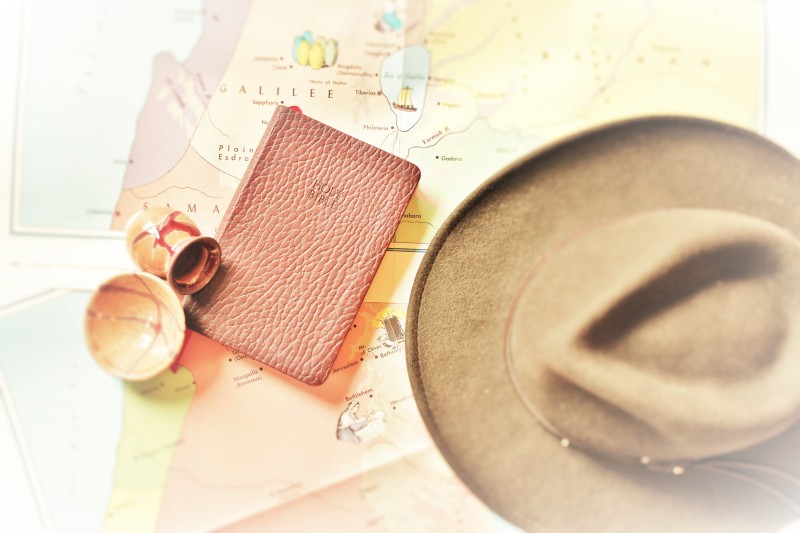
hat and artifacts on map

Image: Amanda Stiver

HAVING taken a break from talking history for a while, I come back in the midst of missing Malaysian airliners, war in the Crimea, tensions in the Israeli corridor, tragic shootings on a U.S. military base, ongoing economic sticky-messes, inept political leadership, earthquakes in California and Chile, and buffalo running a-muck in Yellowstone National Park… so more of the same, only different.

As always, or this site wouldn’t be called “HistoryGal,” I tend to look back to get a little perspective on the future. One of my favorite sources (parents and home-based teachers, this one’s a great resource) is a chubby collection of biographies by that superb purveyor of condensed books of old, Reader’s Digest. Titled Great Lives, Great Deeds it contains over 80 short biographies of famous individuals.

True enough, modern scholarship may make some of the information outdated, but generally the basics are accurate. Remember that all history rises and falls on the bias of those writing it, even current authors.

WHAT I love most of all about this book is the stirring way in which history was written. I consider it the golden age of American historiography (mid-20th century). We were knowledgeable enough to verify our information, reverent enough to respect the deeds of a hero without trying to deconstruct his every molecule, and still innocent enough to believe in heroic, altruistic, moral duty. We don’t live there anymore as a society and it would benefit us to look back at some of what was good about that era.

Of particular note in Great Lives, Great Deeds are the biographies of American revolutionary heroes. The account of Paul Revere, “The Midnight Rider,” by Esther Forbes is stunning. An excerpt, like much of Reader’s Digest material, it is from a larger work I have not yet read, but plan to. A very short sample:

“They who had so recently seen the stocky, benevolent old gentleman walking the streets of Boston could hardly have guessed that he was destined forever to ride a foaming charger, his face enveloped in the blackness of a famous night, to become in time hardly a man at all–only a hurry of hoofs in a village street, a voice in the dark, a knock on a door, a disembodied spirit crying the alarm–an American patriot who, on a moonlit night in 1775, started out on a ride which, in a way, has never ended,” (Great Lives, Great Deeds, Reader’s Digest Association, 1964, pg. 272).

THIS kind of history moves, the writing has electricity and it stirs us to greater devotions of our own, whatever the cause is to which we are devoted (we all need one by the way, preferably a good one). This kind of stirring writing is not unlike the Bible accounts of the great heroes, and sometimes anti-heroes, of the Israelite world and environs. When most people think of the Bible, they think of stories (hopefully not films like the recent non-version of Noah) and characters. This one did this deed, that one fought that war, this one stood up to this dictator, etc…

I like to talk about gateways to history. Interesting ways in which we can pique our curiosity and gain an appreciation for and desire to learn from history. Biographies are a fantastic gateway. They give you enough of a story flow to sink your teeth into, while still filling in historical details of one era or another that by the end of a biography you will find that you are somewhat of a burgeoning expert on a small section of the historical timeline!

SO if you can find a used copy of Great Lives, Great Deeds to add to  your shelf (it is out of print) then do so (it also makes a great bathroom reader). There are many other historical characters of note to get acquainted with like Winston Churchill, Simon Bolivar, Edith Cavell, Booker T. Washington, Theodore Roosevelt, Patrick Henry, George Washington… and many more.

Find a copy and make an exploration of history, person by person.

And as always–keep thinking history!

– Amanda Stiver

A Wish for the 4th

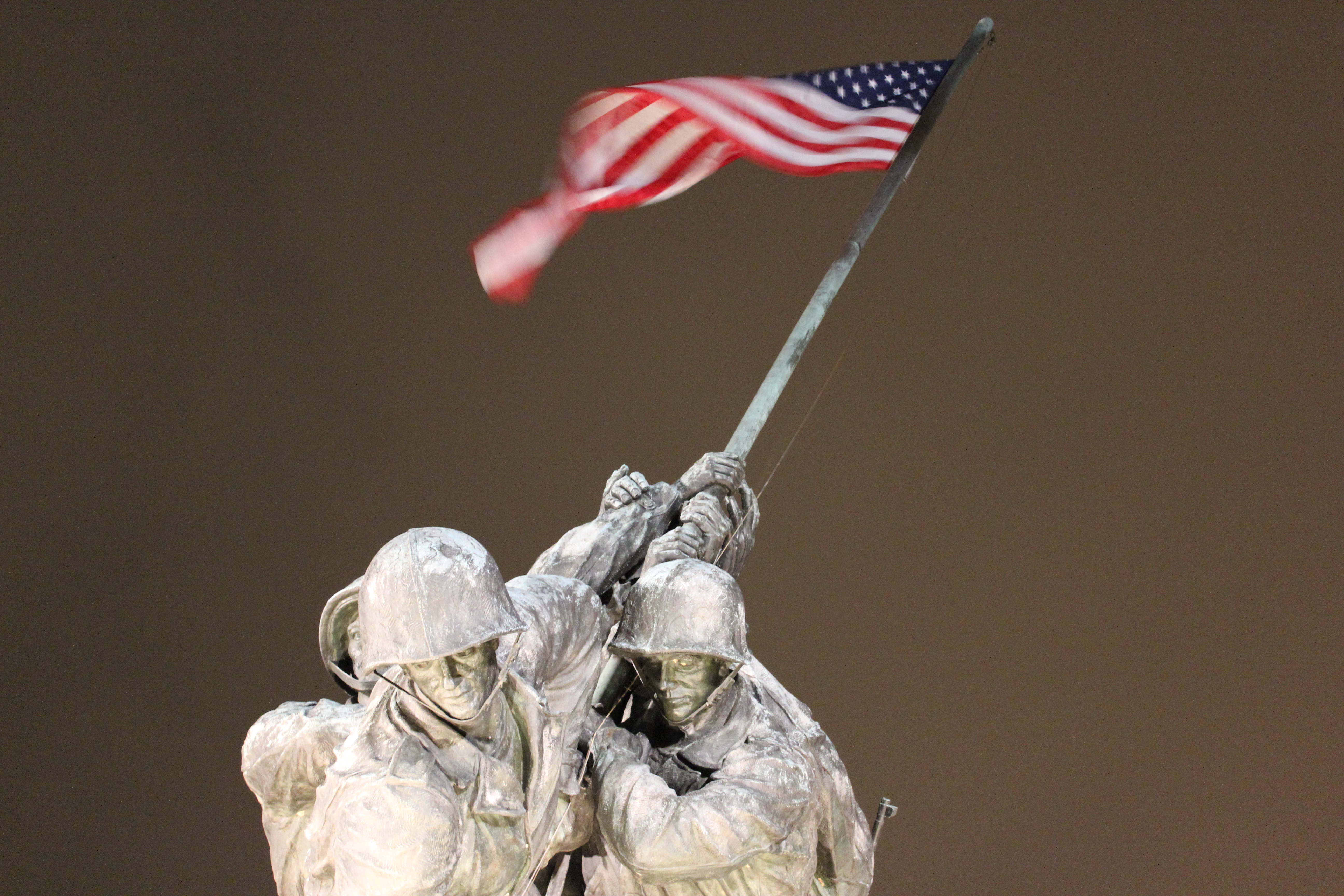
american flag on iwo jima statue

Image: Amanda Stiver

Here’s to the 4th!

Living in the United States is a unique experience at this time in history. Daily I enjoy the bounty procured by generations, but as my nation moves away from the basic tenets of law, justice, and the duties and piety of citizenship, the future may hold unpleasant surprises. I say, savor freedom while it is ours.

As a child, the 4th of July was on my radar because of the cookouts, the fireworks, the firecrackers, and the patriotic music, but as I grow older, the meaning of the day supersedes the accoutrements.

The price

Our Declaration of Independence includes these words, “…Prudence, indeed, will dictate that governments long established should not be changed for light and transient causes…” Yet we live in an era, a half-century or so, of changing governments around the world. Some changes justified, others simply to satisfy the whims of a slim minority.

When the men who signed their defiance to the crown with the words, “And for the support of this Declaration, with a firm reliance on the protection of Divine Providence [God, in our modern parlance], we mutually pledge to each other our Lives, our Fortunes, and our sacred Honor,” they put their lives on the line. How many of us use such words anymore? Is it perhaps because our causes are not sacred, nor honorable?

John Adams, firebrand political figure, described his feelings about the Battle of Bunker Hill (a loss, but a gain in courage for the American forces) in a letter to his wife, Abigail, “The race is not to the swift, nor the battle to the strong, but the God of Israel is he that giveth strength and power unto his people. Trust in him at all times, ye people pour out your hearts before him. God is a refuge for us. –Charlstown is laid in ashes.” Whatever your creed, these are the words of a man who didn’t put all his faith in his own powers of brilliance or strength of arm. Self-reliance is noble, but all human selves eventually fail.

The Light and Glory

Adams projected a future beyond himself when he described what he foresaw as the festivities of the future Independence Day in America, “I am apt to believe that it will be celebrated, by succeeding Generations, as the great anniversary Festival… You will think me transported with Enthusiasm but I am not. –I am well aware of the Toil and Blood and Treasure, that it will cost Us to maintain this Declaration, and support and defend these States. –Yet through all the Gloom I can see the Rays of ravishing Light and Glory. I can see that the End is more than worth all the Means.”

May this Independence Day remind us that freedom is a gift of God and that liberty is bought at a price.

And may you, in whatever nation you live, know and accept the responsibility that what you do now, what ideas you support, and causes you uphold, will be paid for by the generations that come after us. For better or worse.

Keep thinking history! Keep thinking ahead!

– Amanda Stiver

The Window of History

window

Image: morguefile.com/hamper

Sitting in my office I have a great view of the woods. I can see birds, cats, deer, my neighbors, lush deciduous trees, the change of seasons and the occasional fox or raccoon. My view out the window is never the same twice. It can be similar, but never an exact copy. A leaf moves, the clouds are different, the dappling of sunshine through leaves changes, and different creatures troll the yard.

I never get tired of peering out that window to see what’s below. Such variety is refreshing and I often turn to look out when I get filled to saturation with staring at the computer.

Window of history

In the same way I never get tired of peering through the window of history. Okay, sometimes I do get tired of the same historical subject. So I solve the problem, I rotate subjects. On the whole, though, I don’t get tired of history. I find that a trip back in time via a well written history book helps me to see the present more clearly.

According to the StrengthsFinder program this is a particular trait called “Context.” StrengthsFinder is a workplace personality testing program that helps users find out how to use their strengths in connection with others.

Context is the use of a knowledge of history to see how that past shapes people and events. The ultimate goal being to anticipate what may happen in the future. According to StrengthsFinder it is also a way of relating to other people by empathizing with how they came to be the way they are.

Thus history becomes a window into not only the past, but also the future.

Back to the future!

I have been on a recent stroll through the boulevard of history, peering into various centuries and cultures as I go. It’s really a form of historical tourism, only you learn stuff and don’t pay as much as you would for a third-rate hotel room assigned to you because of over-booking.

Since the beginning of the year I’ve been to ancient Greece, the American Civil War era, the Revolutionary War era, and I’m just beginning a look into the history of the City of Jerusalem. Each book is a window, allowing me to see into the past with an eye open to the potential of what may come in the future.

What have I learned?

People haven’t really changed much despite centuries and millennia of existence. The window dressing may be different, but human motivation, greed, lust, anger, jealousy… are still the same and they still are at the crux of what turns the tide of world events.

So what window of history will you peer through today? What will you see and how will it affect your understanding of the present and the future?

Keep thinking history!

– Amanda Stiver

rusty lawn chair

History Is in the Details

rusty lawn chair

sxc.hu/liaj

History comes at us in different ways. Daily, as we live it. Sometimes as we watch it on TV or in the cinema, or someone’s version of it. Rarely, unless you really love it, in the form of books.

Watching an Agatha Christie series, having just listened to a lecture on archaeology, and reading a book on The Peloponnesian War all have in common the details of history. An Agatha Christie episode of Miss Marple, made in the middle 1980’s and starring Joan Hickson (the preeminent Miss Marple, in my opinion) reminded me that to make an historically accurate production of an earlier era requires attention to detail. Not just major details, but especially the small details.

The small details are the most telling. In one scene, a character from the 1950’s seats himself on a canopied gliding lounge sofa. It was the kind I remember seeing from my childhood in the 1980’s, but I had to search my memory because it didn’t quite fit in the 1950’s surroundings. Then I dimly remembered seeing something like it in an old magazine picture from the 50’s, possibly online. Regardless, it did make me realize that what we see around us, the things that are seemingly unimportant, are the stuff of history, which leads me to the lecture on archaeology.

Digging into history

The lecturer pointed out that it was the small things that an excavation discovers that tell the story of history. The little things tell the story, bits and pieces like ostraca, pieces of broken pottery with writing on them, sometimes even shopping lists of 6th century B.C. ladies of the manor. These details, the same kind of shopping lists that we would toss as we return home from the market, help give a clear picture of what everyday life was like many centuries in the past. Thrilling stuff, huh?

Which brings me to the Peloponnesian War. Reading The Peloponnesian War by Donald Kagan has been informative, but also a challenge. The book is well written, but the event is long and arduous. Thirty years of the Greeks at war and frankly it feels like it has taken me almost as long to read about it as it took to fight it. A detailed war, in a region of numerous city-states and decades of leaders with names that are remarkably similar if you aren’t a fluent speaker of Greek. It is history, it is compelling, but it isn’t light reading.

The big and small of history

The connection? There isn’t one, not a similarity at least, but a disparity. The accounts of this Greek war come from the detailed histories written by various ancient scholars and historians. They are based on military accounts, biographies of great men, and political rhetoric. Somewhat removed from the odd shopping list and glider-lounge. But both are history. They are the big and small of history.

The big history is charging Greek soldiers leaping off of triremes and sloshing onto the beaches of recalcitrant city-states. The little history is what they ate on board the morning before and how they polished their spears. The big history is 1950’s cold-war counter-movements done by spies. The small history is what they bought at the grocery when they had a toothache while spying (and if they bought a gliding lounger when they retired).

We live daily with big history and little history. Big history is government legislation. Small history is whether we bought Nutella for a our chocolate craving or simply a Hershey bar. Both become a part of the whole picture of history of the past and our place in it. The big history is affected by the small history, cravings for Nutella affect trade partnerships between Europe and the US. And, of course, the big history affects the small. Government legislation affects what and how and how much we eat.

Food for thought. Keep thinking history!

– Amanda Stiver