
rusty lawn chair

History Is in the Details

rusty lawn chair

sxc.hu/liaj

History comes at us in different ways. Daily, as we live it. Sometimes as we watch it on TV or in the cinema, or someone’s version of it. Rarely, unless you really love it, in the form of books.

Watching an Agatha Christie series, having just listened to a lecture on archaeology, and reading a book on The Peloponnesian War all have in common the details of history. An Agatha Christie episode of Miss Marple, made in the middle 1980’s and starring Joan Hickson (the preeminent Miss Marple, in my opinion) reminded me that to make an historically accurate production of an earlier era requires attention to detail. Not just major details, but especially the small details.

The small details are the most telling. In one scene, a character from the 1950’s seats himself on a canopied gliding lounge sofa. It was the kind I remember seeing from my childhood in the 1980’s, but I had to search my memory because it didn’t quite fit in the 1950’s surroundings. Then I dimly remembered seeing something like it in an old magazine picture from the 50’s, possibly online. Regardless, it did make me realize that what we see around us, the things that are seemingly unimportant, are the stuff of history, which leads me to the lecture on archaeology.

Digging into history

The lecturer pointed out that it was the small things that an excavation discovers that tell the story of history. The little things tell the story, bits and pieces like ostraca, pieces of broken pottery with writing on them, sometimes even shopping lists of 6th century B.C. ladies of the manor. These details, the same kind of shopping lists that we would toss as we return home from the market, help give a clear picture of what everyday life was like many centuries in the past. Thrilling stuff, huh?

Which brings me to the Peloponnesian War. Reading The Peloponnesian War by Donald Kagan has been informative, but also a challenge. The book is well written, but the event is long and arduous. Thirty years of the Greeks at war and frankly it feels like it has taken me almost as long to read about it as it took to fight it. A detailed war, in a region of numerous city-states and decades of leaders with names that are remarkably similar if you aren’t a fluent speaker of Greek. It is history, it is compelling, but it isn’t light reading.

The big and small of history

The connection? There isn’t one, not a similarity at least, but a disparity. The accounts of this Greek war come from the detailed histories written by various ancient scholars and historians. They are based on military accounts, biographies of great men, and political rhetoric. Somewhat removed from the odd shopping list and glider-lounge. But both are history. They are the big and small of history.

The big history is charging Greek soldiers leaping off of triremes and sloshing onto the beaches of recalcitrant city-states. The little history is what they ate on board the morning before and how they polished their spears. The big history is 1950’s cold-war counter-movements done by spies. The small history is what they bought at the grocery when they had a toothache while spying (and if they bought a gliding lounger when they retired).

We live daily with big history and little history. Big history is government legislation. Small history is whether we bought Nutella for a our chocolate craving or simply a Hershey bar. Both become a part of the whole picture of history of the past and our place in it. The big history is affected by the small history, cravings for Nutella affect trade partnerships between Europe and the US. And, of course, the big history affects the small. Government legislation affects what and how and how much we eat.

Food for thought. Keep thinking history!

– Amanda Stiver

Olympic Shooting Sports: Finally, A Positive Example

I like the Olympics. They are full of history. Mostly ancient Greek history, but also Celtic history. Many of our modern day track and field sports were well known at Celtic feis (arts and sports festivals). The shot-put, the hammer throw, and foot races, among others.

The Celtic hammer throw (Dublin Irish Festival 2012). (Image: Amanda Stiver)

But what I really like about this year’s games, especially in light of the tragic shootings in the past several years, is the positive image of the firearms and archery sports.

I’m pleased to see firearms used rightly, for constructive competition that celebrates eye-hand coordination and intense focus. Weapons are useless and inert without someone who decides to use them. I like that there are high-profile, skilled, focused, and honorable men and women who compete and show that using a gun or a bow is not inherently evil.

How a gun is used is the key. What you choose to do with it once you pick it up.

Positive reasons

Which leads me to the Cheyenne River in South Dakota. It’s our family locus. We go back there to visit and we compete in familial target competitions. We use our firearms carefully, specifically, and with great regard for safety. Many of my family also hunt for meat during the deer season. We are at home with rifle and shotgun. We take great joy in using them rightly.

(Image: Amanda Stiver)

We have a family tradition that goes back generations using not just guns, but also bow and arrow. It’s part of my family history.

The issue

Which is why it makes me sad and angry that people wantonly destroy human lives in tragedies like we have seen in Norway, Arizona, Colorado, and now Wisconsin. But frankly, it makes me mad that people murder at all, with or without weapons!

And that brings me back to the summer games. I’m proud to see athletes choose to use firearms and bows rightly, and in a safe, positive way.

Just as in every aspect of history, the choice is always down to us. We can choose to perpetuate bad historical precedents of violence and hate or we can choose to stand up for a moral code that values human life and positive traditions.

– Amanda Stiver

The Boundaries of History: Mountains

(Image: Amanda Stiver)

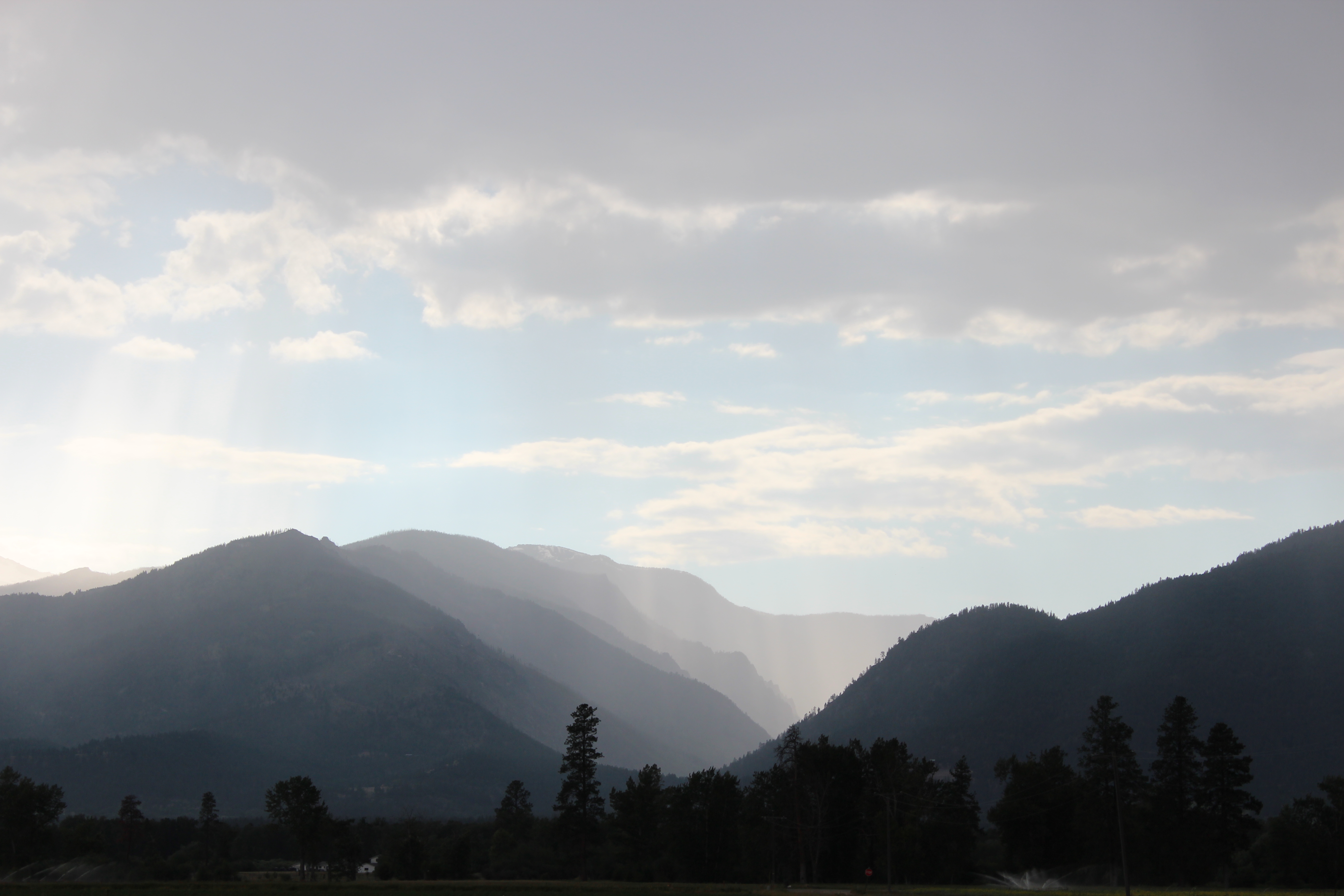
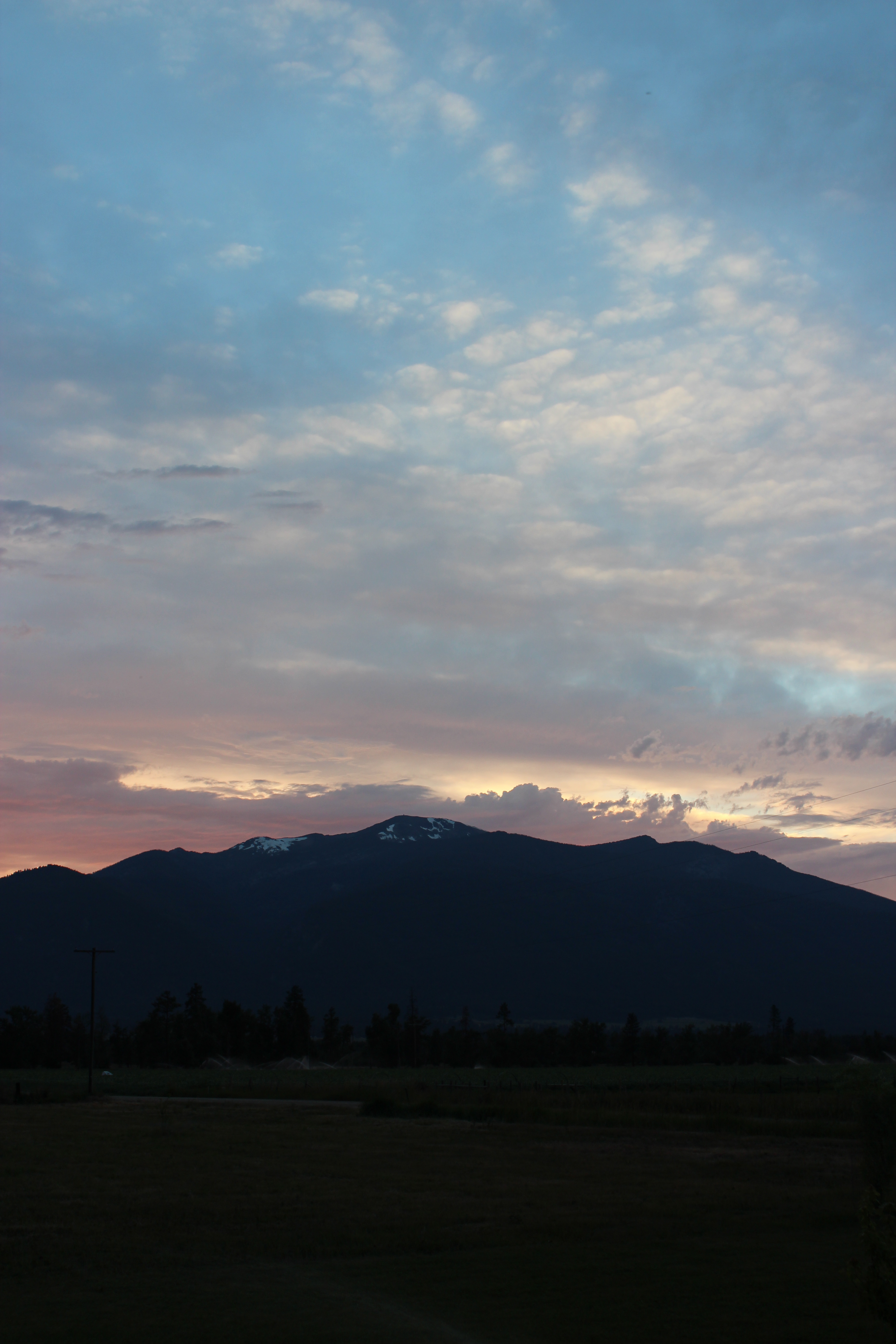
I’m watching a storm break over the Bitterroot Mountains. It’s a spectacular show of grays, blues, greens, and a touch of white off and on. Almost as spectacular as the sunset I watched over the same mountains a few days later. I live in the Midwest in a house among grove of trees and I rarely get to see a solid sunset, just a tint now and then, so watching the mountain version on my visit to Montana was worth the wait.

Mountains. What can I say about them? They are solid, craggy, and looming. They get in the way, they make people go around them and occasionally, they spew lava and pyroclastic muck.

They also make history. For without mountains, the conflicts, borders, traditions, and cultures of our human history would be something completely different. If it were plains all the way around, history would probably look like a glorified game on a chessboard.

(Image: Amanda Stiver)

Kings and their armies would charge across and gain a few miles, and then the opponent would charge over and take them back. Like an endless replay of the trenches of World War One. It takes a lot of manpower and materiel to gain and hold an indefensible flat space. It’s harder to take a mountain fortress, but easier to hold it.

Mountains have shaped us. Mountains and rivers and plains and valleys and oceans. They still shape us.

“And He has made from one blood every nation of men to dwell on all the face of the earth, and has determined their preappointed times and the boundaries of their dwellings,…”

Food for thought.

Keep thinking history.

– Amanda Stiver

Wall Drug: An American Experience

I’m back in one of those tourist haunts that helps define the geography of my life. That sounds a lot more romantic than it is. I’m in Wall, South Dakota, at Wall Drug, a strip of western themed tourist trap that is a true tribute to the effectiveness of billboard advertising.

(Image: Amanda Stiver)

When Ted Hustead and his wife moved to the town of Wall to operate their drugstore back in the 1930’s, they latched onto the idea of using billboards to advertise their wares to weary and thirsty passing tourists. If you have ever taken Interstate 90 across the state of South Dakota, you know what I’m talking about. You can establish your relative location in the state by the sheer number of “Wall Drug” billboards that stack up in herds along the freeway.

Selling the goods

The funny thing about it is that it actually works. After 1,200 miles of seeing Wall Drug signs, people become, quite naturally, curious. Even people like me who have driven these roads to see family so many times I can watch the scenery (or sometimes lack thereof) pass through my visual memory with my eyes closed. Familiarly provides no immunity to the lure of Wall.

(Image: Amanda Stiver)

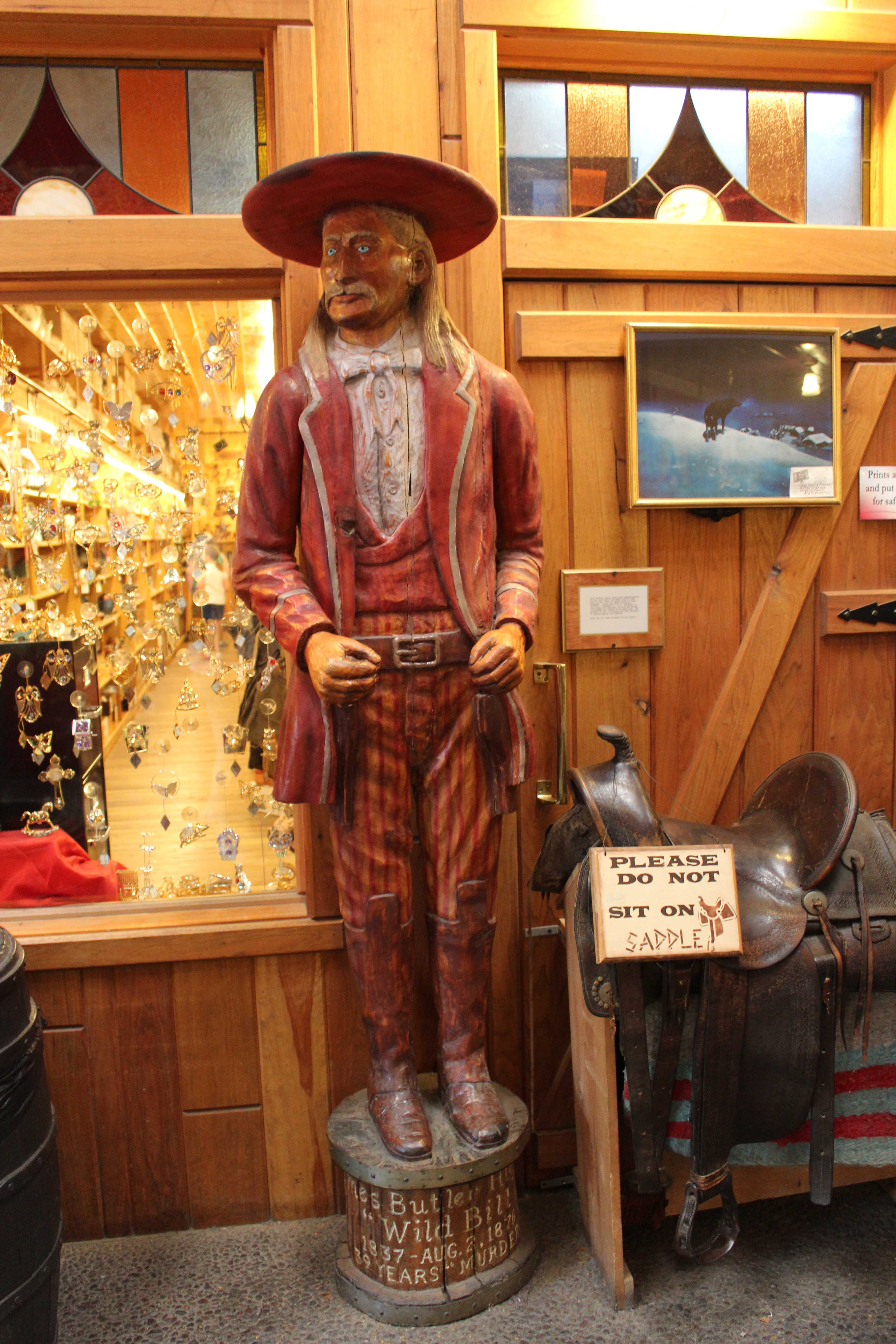
I think this is because Wall Drug, despite all the tourist adverts and schtick, provides things that tourists naturally crave – restrooms and cold liquids and ice cream. That and a nice bookstore and some quality western art. It also provides the myth of the west, with wooden cowboys and gamblers lurking in the halls of the indoor street. The complex has grown over the years, but the core is comfortingly familiar.

My last visit was 15 years ago, and by and large it remains the same. Families roaming the halls, ice cream in one hand, camera in the other. People taking a pit stop before continuing on to Mt. Rushmore or the Badlands. Just as I did on my visit years ago I bought a book, a definite step up from my initial visit when I was small and craved such sundries as cute little dolls dressed as western characters.

Questions raised

There is something plaintive, too, about a place like Wall. It raises questions: How long will tourism last in a tough economy? How long will we even recognize the quaintness of such a place? What does the future hold for a country whose younger generations know only a caricature of the history of the American West?

(Image: Amanda Stiver)

Maybe part of the answer is in that history of the peoples whose collective experiences made the West great. Where ideals of hard work, faith and justice, side by side with hardship and struggle fill in the spaces of the Western Myth of gamblers, claim jumpers, and outlaws.

If you’re in South Dakota and need a cool drink on your parched journey, stop at Wall and contemplate these questions and maybe you’ll be the one to find the answer.

– Amanda Stiver

Book Review: “The Silver Branch”

Sometimes historical curiosity comes from reading historical fiction. Specifically, in this case a Rosemary Sutcliff book.

“The Silver Branch,” a book by Rosemary Sutcliff (Image: Amanda Stiver)

I recently read The Silver Branch by Sutcliff (a great read, originally aimed at a teen/young adult audience, but good for all ages). The Eagle of the Ninth, its better known companion, precedes The Silver Branch, but the former was checked out of my local library so I had to jump into the middle of the series. Thankfully each part of the trilogy can stand on its own.

I was thrown back to the Roman Empire, in the 3rd century AD in the province of Britannia. As the characters, Roman, British, Irish, Dalriad, and Saxon, among others, coursed through the story from skirmishes, to escapes, from espionage, to battle the story of a rift in the Roman Empire unfolds. Three Emperors claimed three parts of the empire and the book concerns the subordinates who either undermine or support the man, Carausius, who ruled Britannia. The emperors are historical figures, but the main characters of the story, Justin and Flavius, though woven into the historical events, are fiction.

Improbable?

As fiction goes, this is reasonably legitimate. There are some flaws, as many others have noted before, particularly the eagle standard (which appears again in this book after its introduction in The Eagle of the Ninth) not being a legionary standard in actuality. An eagle was found in the ancient city of Calleva (Silchester), but it wasn’t the eagle of the ninth. Still, it’s probable.  Some historical fiction is so outlandish that the story becomes completely ridiculous. Sutcliff’s writing is believable, albeit, a number of crucial events and actions are undertaken by one fictional family, but a clear thread is necessary to make a story readable.

The Silver Branch piqued my curiosity about Roman Britain, a part of history, which was, unfortunately, the Swiss Cheese of my historical knowledge – full of holes. In high school and college the Ancient Egyptians, Greeks, and Israelites as well as the Scythians, Chinese, and then English, European and American history from the time of Elizabeth I up to World War II was my focus, partly because those were the classes on offer, but also because the late Roman Empire seemed to be rather gasp-y and sad, so I tended to skip it, but now I find myself filling in my knowledge of this era. Rome had such an impact on so many cultures as friend or as foe that it really is essential knowledge of the world.

Finding your gateway to history

A nice piece of historical fiction like The Silver Branch is a good stepping-stone to delving into a new section of history. I’m interested enough now to crack my textbooks and get the slightly dryer, though still important details about Roman history clear in my mind.

Sutcliff is a fine writer and this book makes for a great literary-historical adventure!

– Amanda Stiver

Invigorate Your History (And Your Family’s) Life!

Following on the heels of my historical consideration of Thanksgiving I’m back tracking to the topic of how to make history a part of daily family life (“I Beg of You… Don’t Hate History”– continued).

(Image: Amanda Stiver)

For those with a pre-existing love of history, this isn’t a problem, people like us discuss history all the time; family history, world history, military history, ancient history, etc.,… we have endless arguments about fairly trivial points of history. We (animatedly) discuss the number of soldiers under the command of a centurion in Ancient Rome – 100 or 60? (60 to 80 actually, opposed to the commonly assumed 100.) We argue about the way people dressed or the historically inaccurate firearms used in movies… and on… and on.

But what about the way people lived a mere two or three generations ago, how do you make that live?

(Image: Amanda Stiver)

I’ll cut to the chase… If you want to learn domestic history for the past 70 to 80 years you can read a few good books on various subjects, or a few dry textbooks that cover all of it… or… you can get a subscription to Reminisce magazine, Looking Back, Good Old Days or one of the other nostalgia periodicals and read compelling, quaint, realistic, snippets of life from the turn of the century to the present day.

I’m not shilling any of these publications I simply like them. They remind me of the stories my parents and grandparents told me about life in past decades. Reading about these people is far from the skewed social messages of neo-socialist-Marxist education materials, you get a sense of how real, ordinary people lived… and they have pictures!

The fundamental commonality of the stories in these publications is usually expressed in this way, “We were so poor, but we really didn’t know it, we had food from the farm, a home, and a loving family.” People worked hard and enjoyed the little they had. They had a sense of hard work, and hope for the future. They were individuals, but they had compassion for their fellow man and a duty to their community that can’t be legislated by a government.

(Image: Amanda Stiver)

I can’t recommend these resources enough. Some of the above publishers also produce compilations of articles based on various subjects, for example the Great Depression. They include photographs and short article stories that are a great read to share with young ones (did I mention the pictures?). Getting them interested in these very human stories is an effective gateway to a lifelong love of history. True history.

– Amanda Stiver

Thankful

Turkey Day, Gratitude Day, Thanksgiving Day – whatever the variation this one day is life or death for a nation, for America.

If we are not thankful, we are entitled and entitlement is the death of a nation. Taking Ancient Rome (among others) as an example, when an empire falls, you can bet that a lack of thankfulness for the freedoms (in America’s case) and advantages (in the case of other empires) is the attitude shift that leads to apathy, degradation, dependency, and finally, destruction.

Every year Thanksgiving comes around and we either look forward to it, or it simply gets lost in the marketing juggernaut of popular holidays from Halloween to New Year’s Day. A true sense of Thanksgiving gets swamped in the onslaught, and that’s sad because a holiday focusing on gratitude and not getting is rare these days.

Gratitude enables us to recognize that we are blessed, that we have something to be thankful for, that we have something to work for in order to be thankful for it. It is the antidote to entitlement, apathy, and self-centeredness.

So, with every bite of turkey you eat, don’t go without remembering and thanking the One who made it possible for all that is there to be thankful for; for life, for freedoms, for peaceful gatherings, for food itself… and much, much more.

– Amanda Stiver

I Beg of You… Don’t Hate History

Let the following numbers sink in and then I’ll explain why they’re horrifying…

(Image: Morguefile.com)

— A mere 20% of American fourth-graders (~10-11 years old) passed a National Assessment of Educational Progress U.S. history test with a “proficient” knowledge of their country’s history.

— Only 17% of eighth-graders (~14-15 years old) tested proficient.

— Worst of all, twelfth-graders, seniors in high school ready to go to college and become registered voters at 18 years old, scored a horrendous 12% proficiency (Stephanie Banchero, “Students Stumble Again on the Basics of History,” Online.WSJ.com, June 15, 2011).

I cannot number the times I’ve heard the now familiar statement, “Well, I hated history when I was a kid, but now I’m that I’m older, I’d really like to learn about it.” Followed by, “It’s probably because I didn’t have very good history teachers in school.”

I can’t fix the latter, which is the quagmire of our educational system dictated by politics. I can address the former; indeed I feel I must, so dangerous is this crisis.

I have but one life to give…

(Image: Morguefile.com)

Theoretically, 88% of American seniors know next to nothing about the country that gave birth to them, prospered their parents, allows their freedoms of dissent, and finally freedom to vote (or not to vote, as they wish).

88 per cent devoid of basic U.S. history knowledge! This is abysmal!

To me, as a historian, it is tragic because I love history, and my knowledge of the past lets me see into the future. Yet more fundamentally, I am appalled that our nation knows so little of its glorious, storied, sometimes dark, but often bright history.

It is tragic, too, because history is the fulcrum upon which our freedoms balance. Educationally speaking, math, science, and written word studies give us the means to improve our lot and style of life, but history hovers above, around, and beyond all that. History was passed on by word of mouth long before it was written down; it pre-existed and sustained those other disciplines. You can’t learn math if it is illegal for you to do so. History teaches us what is legal and what is not.

Most importantly, however, history preserves our knowledge of what freedom is. Without that, any dictator can come in and trounce us into submission. Without understanding the history of their struggle for freedom, any people can and will become the servant rather than the master. They no longer value what generations before fought and died to give them. They no longer value the representative government, the checks and balances, the useful traditions that give us identity, freedom of expression, freedom to meet together in peace, and freedom to transact government of the people, by the people, and for the people.

(Image: Amanda Stiver)

The Scottish Declaration of Arbroath says it this way:

“It is in truth not for glory, nor riches, nor honours that we are fighting, but for freedom—for that alone, which no honest man gives up but with life itself.”

Give me your tired, your poor…

To know history is also to learn compassion for those who suffer because so much of human history is suffering. It is to hear the cries of hungry children during the Great Depression, waiting for food that would not come because no food could be bought because no one had money and no jobs were to be found.

It is to hear the weeping of mothers whose sons died at Lexington and Concord, and at Gettysburg and Antietam. It is to see the fire fall from the sky as American soldiers invaded the coast of Normandy and made bombing runs deep into enemy territory over Germany to defeat the Nazis during World War II.

It is the struggle of pioneer families who made the hard, unrelenting trek across the American West to find a better life, full of greater promise and a more abundant future for their children and generations to come.

Learn to love history…

These low scores are simply one of the signs of a greater malaise in America right now. It will take us some doing to get out from under its apathetic and dreary spell.

(Image: Morguefile.com)

I’m prescriptive by nature, and every problem has a solution. I can’t think of a better way to illustrate how history should be taught, and how to find the stories hidden amongst the dates, battles, and personalities than to recommend the following clip of Andy Griffith teaching a history lesson. It is classic and unparalleled. It is how I see history when I read it – full of life, full of great causes, full of heritage.

http://www.youtube.com/watch?v=aGXCH7zBdc4

In my next post…

I will concentrate on ways to re-invigorate a personal and family love of history with book and magazine recommendations and other ways to make history approachable. Man or woman, parent or child, young or old it is essential to find a way to learn U.S. and World History, and to learn to love it… stay tuned.

– Amanda Stiver

Of Royal Weddings and… Campfires?

What do the newly minted Duke and Duchess of Cambridge, i.e. TRH’s Prince William and Princess Catherine (technically Princess William of Wales) have to do with a campfire? (There’s a question for the ages!) And no, it isn’t their burning devotion to each other, pu-leeeese!

(Image: Morguefile.com)

I speak of the interesting way in which something as history laden and seemingly antiquated as a royal wedding had a refreshingly novel feel about it. Perhaps it was the happiness exuded by the couple, truly in love. Or maybe it came from the fact that a future king marrying a commoner brought the average joe into the wedding spirit (although, to be fair, the elegant Duchess doesn’t look very common). Maybe, but I think it was something else – and it has more to do with a campfire.

A moving experience

I’m moving to a new city, and as all people who are about to move know, you run around fixing and putting in all those yard projects you meant to do but never did. So yesterday I found myself reading the instructions on one of those decorative portable fire-pits sold at home improvement centers. It was fairly simple and for Mother’s Day my parents and I lit a fire and watched it burn from roaring inferno to glowing coals.

That is the magic of campfires – you can sit for hours watching those logs burn in seemingly endless ways and patterns. We spent a good two or so hours enjoying this setting – as long as a blockbuster movie, which is what led to this comparison.

To the royal couple

On April 29 my mom and I got up at 4:00 AM Eastern time, threw some scones in the oven, brewed some tea and watched that antiquated, history laden pomp and circumstance for a good 4 solid hours! For us it wasn’t a stretch, we both like English history and royal weddings, and truth be told, we really wanted to see the dress, too!

But we were not alone – millions, make that, billions of people joined us. And here is the campfire connection – old things are interesting.

(Image: Morguefile.com)

For centuries people would gather around a campfire or a fireplace and watch the blazing flares descend to glowing embers – it was universal, until electricity came along and stole the show. It also slowed down the time and made you think. The royal wedding did the same.

A deeper meaning

A royal event with as much symbolism and meaning as a wedding brought back some of the simple joy and awe that pomp gives us. There are reasons for a wedding covenant to be conducted solemnly. It is a major contract – you wouldn’t sign your name at a house closing while telling jokes and generally goofing off! That’s big money, a big investment. Same with a wedding ceremony – it’s a lifetime investment – a woman and a man bound together until death!

Then there was the music – beautiful compositions by British composers. And the fantastic acoustics of Westminster Abbey. It made you think of the many artistic achievements of song, voice and instrument that we seem to lack in the digital age. Old stuff can be good!

So the next time you gaze at those glowing embers or watch an historical, royal wedding – give the old things a thought – the achievements of the past, the seriousness and joy of it all!

History does that to you! – Stay curious.

Amanda Stiver

Life goes on… and so does History!

History is like that. One day you can’t get enough of WWII culinary skills, Ancient Greek composting, or the Thirty Years War and the next day… nothing!

Historical curiosity travels in phases. While a particular subject can really never be worn out as an area of study, it can wear out in our minds. We get sick of hearing, reading, or thinking about it. At that point some even give up on history (even us nerdy historian types!).

Fear not! It isn’t necessary!

I will call this (since I’m writing here) the Law of Historical Opposites. It’s actually more of a technique, but “law” sounds more impressive.

Flip your area of interest. Love Prairie Cooking in the American West, but are sick of recipes for Johnny Cakes? Try reading about Native American tribal history or the manners and customs of the American East or of Colonial California!

Have always liked the interminable accounts of the WWII European Front action, but simply need a change – then search out Pacific Front histories or leave WWII altogether and pick a different war. Humans being what they are, there will never be a shortage. Or, the ultimate flip, search out the history of Amish and Mennonite pacifism!

Keep it fresh, and you will always stay curious!

– Amanda Stiver