Getting the Story…the Whole Story

get-the-story-the-whole-story

Source: morguefile.com/eskodesign

HISTORY.   Or just, the news. When does the one become the other?

A hundred years ago the news was on the page of a newspaper, heard through the local telegrapher’s office, or announced at public meetings or church assemblies…or through gossip. Radio hadn’t quite arrived in 1916, and TV was a long way off, to say nothing of the Internet. So the news usually came at you…relatively slowly.

Is it slow anymore?   Hardly.

What do we owe our intelligence as consumers of this deluge of digital, video, audio or printed matter? We owe ourselves and we owe others the truth.

How do you get the truth from three minute video news stories. Twitter and Facebook posts of a handful of words? Instagram images that tell but one single thread of what ought to be a fully woven story?

TAKE YOUR TIME, QUERY YOUR SOURCES

FIND your way, slow the news down. Digest the story. Then consume another. Look at a story or news item as if with facets. Each side should be explored and there are usually even more than two posited sides of the story. Find those facets and analyze them by a standard of truth.

Find out the bias of the report you’ve just read or watched. Learn about the writer, the  news agency, what is their political interest, what is their national interest? Analyze the thread of logic. Seek wisdom, and if there is none, find out why.

Go to news sources outside your country, not because they are always right, but because as was wisely written…

“…in the multitude of counselors there is safety.” (Proverbs 11:14).

TRUTH

THERE is truth. You have to assume that somewhere, buried beneath the landslide of blather it exists. But to find it, you often have to put your own self interest aside. The greater good…what is it? The rule of law…what supports it? What precedents lead to good government? Good leadership?

And remember…after you find the truth, don’t let go of it.

History is made in the stacking up of events. News stories are made, in many cases, in the moment and for a moment’s notice.

Seek the long term. Find the history.

– Amanda Stiver

Quotes and Thoughts: The Revolutionary War and the Price of Rebellion

“Like most ‘wars of liberation’ the American War of Independence was a bitter civil war too. One contemporary guess divided the people into three: the patriots, one-third, the Tory loyalists, one-third, and the remainder prepared to go along with either party. It is likely, however, that those who declined to take an active part were fully half the nation, the militants being almost equally divided, though the Tories, by their very nature, lacked leaders and the extremism which drove the liberators. They looked to leadership from England and were poorly served.” — Paul Johnson, A History of the American People, 1997, page 171.

WHAT can a random quote from a history book on any subject teach us? Isn’t this an exercise in futility? Don’t we need more information?

WE do need more information, but let’s use this exercise as a memory building tool. When developing your historical memory, and yes, memory function comes pre-installed in our brains when we leave the production center (other wise known as ‘birth’), you need to retrieve the current stock of what’s stored up there. Find out what you know, and then fit in the new information presented in a quote like the one above.

So what do we know?

Let’s start with the quote itself…what era, or period of events connected in historical continuity, is the quote referencing?

Okay, let’s assume first that we are Americans reading this quote. If we have spent any time in a US school we’ll have some idea that the “American War of Independence” is also known as the Revolutionary War (note, the author is British, so he is using the academic title from across the Atlantic for that colonial disturbance centering around 1775). We know that the events surrounding that era had to do with a break with the British government, which had in various ways originally and until that time considered the 13 colonies of the eastern shore of the now United States to be British territory. There were strong, vocal colonial opponents of British oppression, excess taxation and lack of Parliamentary representation, and these we, as Americans, know as “Founding Fathers.” George Washington, John and Abigail Adams, Sam Adams, James Madison, Thomas Jefferson, Patrick Henry, John Hancock, Benjamin Rush, Benjamin Franklin, Richard Henry Lee, among many others. They were extremely influential in the early years of the United States and all the constitutional and legal documents written then.

As the quote shows us, there were also opponents of the rebellion who were called “Tories”. They desired to remain loyal to Britain, wherein many of their business interests were entwined. They were fighting for a “status quo”, which is a difficult position to fight from, and particularly, as the quote implies, without solid recognition and support from their motherland, England. Indeed, may of the Tory families were treated with nearly as much contempt as rebel families by the British Army when it arrived in the colonies and was installed in the homes of the colonists. It was difficult to remain loyal to a country that didn’t seem to want them.

An additional fact that we can add to our historical memory is that, as the quote explains, there was another group of people who simply wanted to live their lives, without interference from either side of the battle. Perhaps they were unsure of the outcome, or unsure where their true loyalties rested, or maybe it took a bit of convincing through the brutal realities of British occupation that they eventually had to stand for something. Who knows, but it does tell us one thing, that despite the noises of the “militants” and “activists” in any nation, and any cause, there will always be those who simply want to grow their crops in peace, make a life for themselves and their children. These are the people who eventually struggle on when the voices of the extremes have faded and, sadly, these are usually the people who get trampled by both sides in their quest for supremacy.

Am I saying the Revolutionary War was an aimless quest? Not at all, Britain and America were on a course for separation, and the tendrils of financial investment and history between the two made it almost impossible for a separation to come without bloodshed. Is this the best way for people to reconfigure their alliances? No. Is it the way of humanity? Yes. Is there another way? Yes, but not without help from a power greater than the finest of our human minds. A subject for another time.

SO, AS OUR EXERCISE comes to a close take a moment to realize all that you already had in your historical memory about the Revolutionary War. Are other details coming to you that you may have picked up from articles, books, or even movies? The way people ate, fought, dressed, scenes reenacted of the battles and atrocities wrought on some colonists (I’m thinking of The Patriot here)?

We’ll do this again sometime, using a quote as a gateway into history. You’ll be amazed at what you know already and can learn!

Keep thinking history!

– Amanda Stiver

Good Taste Doesn’t Have to Remain Dead: Book Review – ‘The Lost Art of Dress’

Image: Amanda Stiver

Image: Amanda Stiver

Title: The Lost Art of Dress: The Women Who Once Made America Stylish

Author:  Linda Przybyszewski

AS I BEGIN, let me say “thank you” to Linda Przybyszewski, the author of The Lost Art of Dress: The Women Who Once Made America Stylish for this splendid, well-written, thoughtful, humorous, opinionated, and important book. Splendid because it covers a topic I have sorely missed reading about outside my own collection of fashion and dress planning books from the first half of the 20th century – that is, common sense, modesty, and good taste in dress.

As an art history student, I was excited to read about how the “Dress Doctors” – professors, designers, lecturers, and authors, mainly female, of the Home Economist movement – applied the principles (harmony, rhythm, balance, proportion, and emphasis) of what makes “art” beautiful to the composition of dress. The beautifully accessorized outfits of the 30’s and 40’s, the hats, the gloves, the varied and unique dress colors. One look around at what the stores offer this Summer and I bury my head right back in The Lost Art of Dress. What’s happened to the expression, creativity, individuality and chic that was possible in the fashions of half a century ago?

According to the author, the 1960’s happened along with the feminist backlash to the Home Economist movement, which they decided stereotyped women. To add to the trouble the space race drew funding away from what was considered “non-essential” – the home, nutrition, parenting, beauty decor and dress, sanitation, food preservation and consumer standards and toward nuclear weapons and war – quite a trade-off.

The 60’s ushered in a rejection of art in dress for a sort of anti-harmonious cacophony of “expression.” Clothing lost the fine dressmaker details of the previous decades and one and all, young or old was expected to aspire to the same “youth obsessed” style.

WHAT I PARTICULARLY like about this book is the author’s willingness to be frank about what she thinks. So many social history topics are ruined by an author’s attempts to please everyone at once – even polar-opposite opinions! Professor Pski…, as she is known on her website….., teaches at the University of Notre Dame and states her case with verve, good taste, and humor. Along the way, as she delineates how the art principles of design apply to dress, she also informs us of an important piece of 20th century social history – the rise and fall of the Home Economist movement and the USDA. If your taste in clothing runs to garish, grunge, or short and tight you will probably disagree with the author, but you may nonetheless enjoy the history she offers.

The Home Economist movement, USDA, and 4-H programs brought “home-making” skills to millions of women, and it also provided the skill of dressmaking to thousands of women. This practical education became a means of making a respectable living, especially during the “make-do” era of the Great Depression. My grandmother was a product of this system and I can only begin to scratch the surface of the skills she had. Women have many education opportunities now, but it’s vital not to demean the education and wisdom of women in this past era – they were able to absorb a vital core of skills that no college or university offers now. We are clueless in their presence in many ways.

Another detail I appreciate about the book is the perhaps blunt, but common sense explanations the author offers for modesty. There is a spiritual element to modesty and most who feel the subject is important approach it from this perspective, but Pski offers an undervalued, but pragmatic explanation of why mini-dresses, sheers, tight clothes and exposed flesh are not particularly tasteful, and are extremely impractical. How does one maintains one’s dignity in a mini-dress, seriously? Thank you for explaining why modesty and good taste and style are not opposites, but all elements of a harmonious whole!!

SO PLEASE READ this book for many reasons, none the least of which, is that it is an extremely well written, fascinating, well documented example of historiography. It is a form to which good historians aspire.

Read it also if you are one of the many in our generations X, Bridge (of which I am one), or Millennial who love the styles, ensembles, and outfits of the 30’s, 40’s, 50’s and wonder what principles of art and science made those styles so lovely. On a pragmatic note, with the concepts outlined in The Lost Art of Dress it is still possible to aspire to the good taste of those eras.

Finally, read it because the skillful and talented women who were products of the Home Economist movement (our grand and great-grand mothers) deserve a tribute to the abilities and skills they acquired and the contribution to society they made. Their resourcefulness and determination raised families, helped win wars, and achieved greatness in various professions.

Keep reading history!

– Amanda Stiver

What Other Flags Fly in Support of Slavery?

IT’S A WEEK for heavy subjects, so let’s look at the recent flag removals from Southern state capitals…

Though the removal of the flag of the Confederate States of America (a long-dead representative republic based, economically and culturally, on the repugnant sin of human slavery) ought to have come many years ago, not just in reaction to a tragic massacre, but as a matter of course of the acknowledgement of the Union of the United States after the American Civil War; one cannot help but notice a certain hypocrisy among American politicians.

Readily and eagerly they hop on the bandwagon of publicity by taking down flags of a defunct republic (a noble thought, but not one that faces significant opposition), while at this very time, a mere 12 hour flight away, another self-proclaimed nation/terror state – the Islamic State, which is a theocracy, and does violence and murder to any under the rule of its flag, is also presently, culturally based on the human slave trade.

Why are these same voices in America so utterly silent? Why, if they truly wish to abolish the sin of human slavery, do they not declaim those who continue to indulge in its depravity around the world, in the Middle East, in Asia, and other places?

Keep thinking history.

– Amanda Stiver

Tragedy in Charleston…Division is Destructive

YOU KNOW, what strikes me with this latest tragic shooting in Charleston, is that while the US media has been preoccupied with the high profile psychological problems of two individuals (Bruce Jenner and Rachel Dolezal), we have been neglecting the core principles of what makes America great. It is our heritage of honor, dignity, respect, morality (hard fought for during a bloody Civil War), and, most importantly, fear of God and His Law, regardless of ethnicity, that has made and can make America great. Bluntly, our professional media is divisive and destructive. Respectful coverage of the lives of the individuals lost in this recent shooting will be neglected for political aims (as we lead up to a campaign year), and skewed for various agendas. Tragedy of loss of life, compounded by the tragedy of division.

As a student of history it is not impossible to understand that what happens when a society is riveted by its rifts and hatreds, its criminals, and its moral inadequacies. We can look to the debauchery of Rome as it slid into oblivion to see a case study for lost focus. America is great because it is full of regular folks, being regularly law abiding, and caring about their neighbors, regardless of ethnicity. Millions of immigrants from various backgrounds have come here to become “Americans.” Some came by force, some came by choice, but without that coalescing of identity into “American” – we will become stressed and fractured by division, hatred and violence. America is framed by a set of laws, a Constitution. Back in the day, a constitution was what we called our human frame, our bodies. If you don’t have a body of laws that frame our society, that protect the individual and define respect for same, we have nothing, we simply have to wait for the “strong men” who want a piece of the action to hack away through violence and intimidation so we can pay for the pleasure of not being killed. Am I being extreme? I think not…please refer to recent coverage of the Middle East and the rise of ISIS.

ABRAHAM Lincoln once quoted this simple statement, “And if a house be divided against itself, that house cannot stand.” If you want to quote Lincoln’s source, see the book of Mark, chapter 3, verse 25.

If we continue to feed on divisions, to disdain the beauty and mechanics of law abiding, and to neglect the value of life, our house, our nation will fail. If by chance, we can summon the courage, by the grace of God, to reject division and those that feed on it, to treasure the Divine intelligence of Law, and to respect life…we might, might have a chance. The choice is ours.

Value, and keep thinking history! For we are living tomorrow’s history today.

– Amanda Stiver

Potholes and Pitfalls: The Bumpy Roads of History

“That’s how history works. The mundane things often times become the measure of a civilization.”

AFTER A month of tooth-jarring journeys over the pothole infested roads of north eastern Ohio, I’ve decided that there must be a lesson of history here. Surprisingly, there is one and not very far off.

Roads are, for the U.S. and much of the developed world, a thing to be taken for granted as they are so ubiquitous, but not always was it so. Smooth, or relatively smooth, asphalt and concrete rivers of traffic flowing across the face of the land are a product of the past century. Before that waterways, railways, and dirt tracks were the cross-continental lanes of locomotion.

What does it mean to us when road begin to degrade? Is it just an annoyance – or are there deeper implications?

Unrepaired and unmaintained roads, like wounds, begin to fester. Traffic slows, the spread of goods slows, more repairs on trucks – the price of milk at your grocery store goes up. But ultimately, it is indicative of the state of finance and stable government of any given nation. Maintenance is a strong indicator that a nation is functioning well, while disrepair suggests that dissipation, internal problems, and debt are pulling the focus away from these boring, but vital details. When Rome was falling, its roads descended into disrepair and then disuse.

THAT’S HOW history works. The mundane things often times become the measure of a civilization. Will it continue in good health or collapse in the shadow of a coming power with more nefarious and darker motivations? How many times has history repeated this scenario?

Never forget that though we may study the past – we live in history right now!

Keeping thinking history!

– Amanda Stiver

At A Glance: The Wonders of the World Almanac

“Why do I love my World Almanac so? Because I can flip pages, take in a quick dose of information and add that to my appreciation of the world around me.”

Image: Amanda Stiver

Image: Amanda Stiver

IT TOOK me five years to buy a new one (a lapse of sanity, surely), but just the other day I purchased a copy of the The World Almanac and Book of Facts 2015. Now, at my fingertips and within a scan of my eyes is a mountain of interesting facts, statistics, and history that would take me hours to compile looking through Wikipedia or any of its iterations on the Internet.

Why do I love my World Almanac so? Because I can flip pages, take in a quick dose of information and add that to my appreciation of the world around me. It is a fast way to build my knowledge base. A base of information that goes into the scaffolding of my mind and allows me to understand and analyze trends, motivations, and history being made as we speak. Scope is the old fashioned word people used to use to describe this, or even “a wide knowledge of the world.” You get that from books like the Almanac.

TRIVIA. A lot of people think that’s what a book like the Almanac is for. But isn’t life really about the “trivia”? The little things that happen each day make up what become the trends of our lives. So, trivia, factoids, added together make history!

Speaking of history, the Almanac has a great review of world history in it’s “World History and Culture” section. If you need to build a timeline of history in your mind, and you find yourself frustrated when you can’t place this event or that one into perspective, then this brief review is very useful. Read it through, commit the different eras to memory and suddenly, seemingly random events that are going on in our violent, tragic, chaotic world right now will begin to make sense. (On a related note, reading the Bible with a similar mindset will also help to put the craziness of the world in perspective as well.)

THE ALMANAC makes great light reading or a handy reference tool. Add it to your arsenal of history, for personal learning or teaching. Not even the Internet can beat it for quick reference and a fast overview of a subject. One of those old school triumphs that never goes out of style! Keep thinking history! – Amanda Stiver

The Best Book of Biographies: Great Lives, Great Deeds

“We were knowledgeable enough to verify our information, reverent enough to respect the deeds of a hero without trying to deconstruct his every molecule, and still innocent enough to believe in heroic, altruistic, moral duty. We don’t live there anymore as a society and it would benefit us to look back at some of what was good about that era.” — Amanda Stiver

hat and artifacts on map

Image: Amanda Stiver

HAVING taken a break from talking history for a while, I come back in the midst of missing Malaysian airliners, war in the Crimea, tensions in the Israeli corridor, tragic shootings on a U.S. military base, ongoing economic sticky-messes, inept political leadership, earthquakes in California and Chile, and buffalo running a-muck in Yellowstone National Park… so more of the same, only different.

As always, or this site wouldn’t be called “HistoryGal,” I tend to look back to get a little perspective on the future. One of my favorite sources (parents and home-based teachers, this one’s a great resource) is a chubby collection of biographies by that superb purveyor of condensed books of old, Reader’s Digest. Titled Great Lives, Great Deeds it contains over 80 short biographies of famous individuals.

True enough, modern scholarship may make some of the information outdated, but generally the basics are accurate. Remember that all history rises and falls on the bias of those writing it, even current authors.

WHAT I love most of all about this book is the stirring way in which history was written. I consider it the golden age of American historiography (mid-20th century). We were knowledgeable enough to verify our information, reverent enough to respect the deeds of a hero without trying to deconstruct his every molecule, and still innocent enough to believe in heroic, altruistic, moral duty. We don’t live there anymore as a society and it would benefit us to look back at some of what was good about that era.

Of particular note in Great Lives, Great Deeds are the biographies of American revolutionary heroes. The account of Paul Revere, “The Midnight Rider,” by Esther Forbes is stunning. An excerpt, like much of Reader’s Digest material, it is from a larger work I have not yet read, but plan to. A very short sample:

“They who had so recently seen the stocky, benevolent old gentleman walking the streets of Boston could hardly have guessed that he was destined forever to ride a foaming charger, his face enveloped in the blackness of a famous night, to become in time hardly a man at all–only a hurry of hoofs in a village street, a voice in the dark, a knock on a door, a disembodied spirit crying the alarm–an American patriot who, on a moonlit night in 1775, started out on a ride which, in a way, has never ended,” (Great Lives, Great Deeds, Reader’s Digest Association, 1964, pg. 272).

THIS kind of history moves, the writing has electricity and it stirs us to greater devotions of our own, whatever the cause is to which we are devoted (we all need one by the way, preferably a good one). This kind of stirring writing is not unlike the Bible accounts of the great heroes, and sometimes anti-heroes, of the Israelite world and environs. When most people think of the Bible, they think of stories (hopefully not films like the recent non-version of Noah) and characters. This one did this deed, that one fought that war, this one stood up to this dictator, etc…

I like to talk about gateways to history. Interesting ways in which we can pique our curiosity and gain an appreciation for and desire to learn from history. Biographies are a fantastic gateway. They give you enough of a story flow to sink your teeth into, while still filling in historical details of one era or another that by the end of a biography you will find that you are somewhat of a burgeoning expert on a small section of the historical timeline!

SO if you can find a used copy of Great Lives, Great Deeds to add to  your shelf (it is out of print) then do so (it also makes a great bathroom reader). There are many other historical characters of note to get acquainted with like Winston Churchill, Simon Bolivar, Edith Cavell, Booker T. Washington, Theodore Roosevelt, Patrick Henry, George Washington… and many more.

Find a copy and make an exploration of history, person by person.

And as always–keep thinking history!

– Amanda Stiver

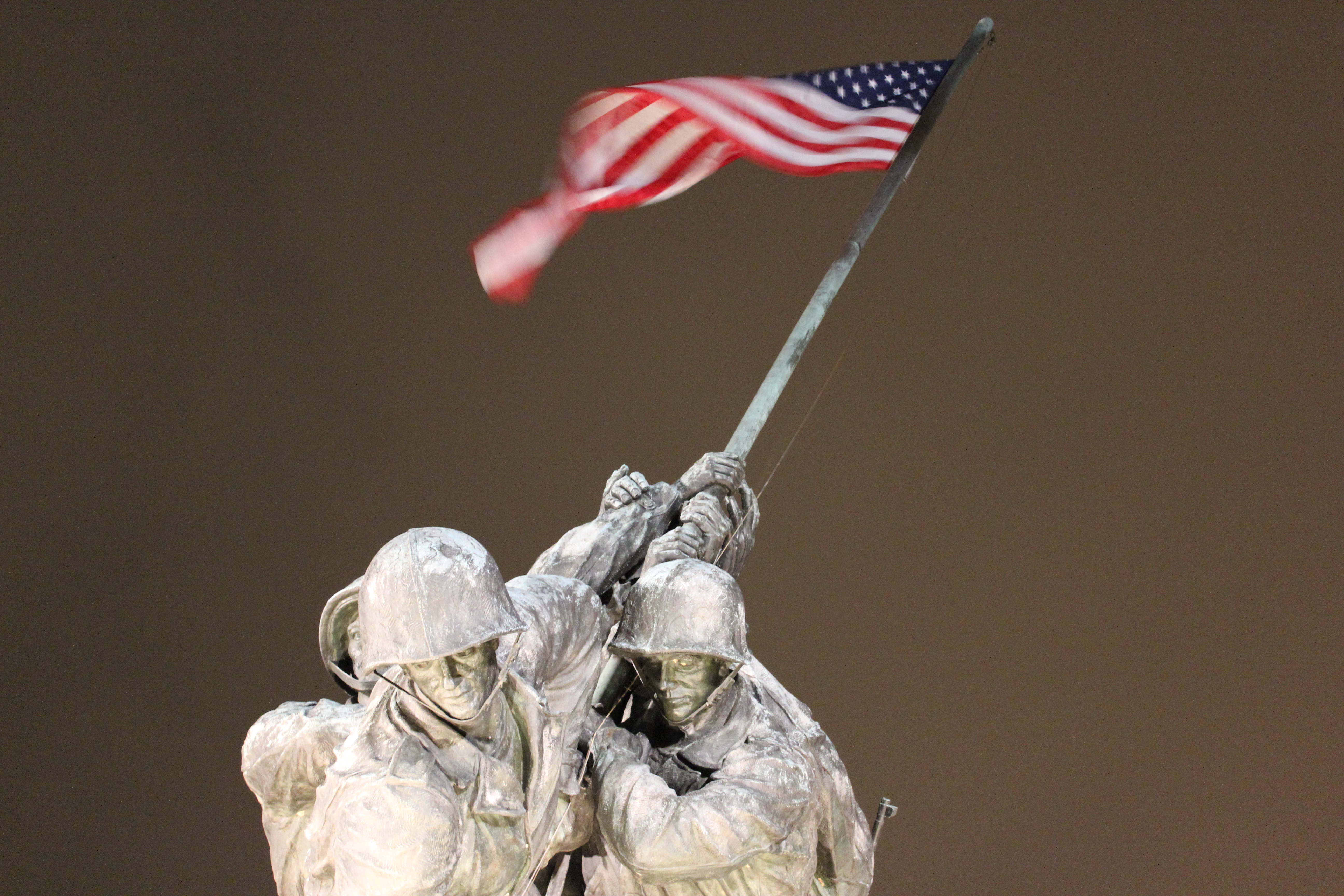
A Wish for the 4th

american flag on iwo jima statue

Image: Amanda Stiver

Here’s to the 4th!

Living in the United States is a unique experience at this time in history. Daily I enjoy the bounty procured by generations, but as my nation moves away from the basic tenets of law, justice, and the duties and piety of citizenship, the future may hold unpleasant surprises. I say, savor freedom while it is ours.

As a child, the 4th of July was on my radar because of the cookouts, the fireworks, the firecrackers, and the patriotic music, but as I grow older, the meaning of the day supersedes the accoutrements.

The price

Our Declaration of Independence includes these words, “…Prudence, indeed, will dictate that governments long established should not be changed for light and transient causes…” Yet we live in an era, a half-century or so, of changing governments around the world. Some changes justified, others simply to satisfy the whims of a slim minority.

When the men who signed their defiance to the crown with the words, “And for the support of this Declaration, with a firm reliance on the protection of Divine Providence [God, in our modern parlance], we mutually pledge to each other our Lives, our Fortunes, and our sacred Honor,” they put their lives on the line. How many of us use such words anymore? Is it perhaps because our causes are not sacred, nor honorable?

John Adams, firebrand political figure, described his feelings about the Battle of Bunker Hill (a loss, but a gain in courage for the American forces) in a letter to his wife, Abigail, “The race is not to the swift, nor the battle to the strong, but the God of Israel is he that giveth strength and power unto his people. Trust in him at all times, ye people pour out your hearts before him. God is a refuge for us. –Charlstown is laid in ashes.” Whatever your creed, these are the words of a man who didn’t put all his faith in his own powers of brilliance or strength of arm. Self-reliance is noble, but all human selves eventually fail.

The Light and Glory

Adams projected a future beyond himself when he described what he foresaw as the festivities of the future Independence Day in America, “I am apt to believe that it will be celebrated, by succeeding Generations, as the great anniversary Festival… You will think me transported with Enthusiasm but I am not. –I am well aware of the Toil and Blood and Treasure, that it will cost Us to maintain this Declaration, and support and defend these States. –Yet through all the Gloom I can see the Rays of ravishing Light and Glory. I can see that the End is more than worth all the Means.”

May this Independence Day remind us that freedom is a gift of God and that liberty is bought at a price.

And may you, in whatever nation you live, know and accept the responsibility that what you do now, what ideas you support, and causes you uphold, will be paid for by the generations that come after us. For better or worse.

Keep thinking history! Keep thinking ahead!

– Amanda Stiver

The Window of History

window

Image: morguefile.com/hamper

Sitting in my office I have a great view of the woods. I can see birds, cats, deer, my neighbors, lush deciduous trees, the change of seasons and the occasional fox or raccoon. My view out the window is never the same twice. It can be similar, but never an exact copy. A leaf moves, the clouds are different, the dappling of sunshine through leaves changes, and different creatures troll the yard.

I never get tired of peering out that window to see what’s below. Such variety is refreshing and I often turn to look out when I get filled to saturation with staring at the computer.

Window of history

In the same way I never get tired of peering through the window of history. Okay, sometimes I do get tired of the same historical subject. So I solve the problem, I rotate subjects. On the whole, though, I don’t get tired of history. I find that a trip back in time via a well written history book helps me to see the present more clearly.

According to the StrengthsFinder program this is a particular trait called “Context.” StrengthsFinder is a workplace personality testing program that helps users find out how to use their strengths in connection with others.

Context is the use of a knowledge of history to see how that past shapes people and events. The ultimate goal being to anticipate what may happen in the future. According to StrengthsFinder it is also a way of relating to other people by empathizing with how they came to be the way they are.

Thus history becomes a window into not only the past, but also the future.

Back to the future!

I have been on a recent stroll through the boulevard of history, peering into various centuries and cultures as I go. It’s really a form of historical tourism, only you learn stuff and don’t pay as much as you would for a third-rate hotel room assigned to you because of over-booking.

Since the beginning of the year I’ve been to ancient Greece, the American Civil War era, the Revolutionary War era, and I’m just beginning a look into the history of the City of Jerusalem. Each book is a window, allowing me to see into the past with an eye open to the potential of what may come in the future.

What have I learned?

People haven’t really changed much despite centuries and millennia of existence. The window dressing may be different, but human motivation, greed, lust, anger, jealousy… are still the same and they still are at the crux of what turns the tide of world events.

So what window of history will you peer through today? What will you see and how will it affect your understanding of the present and the future?

Keep thinking history!

– Amanda Stiver